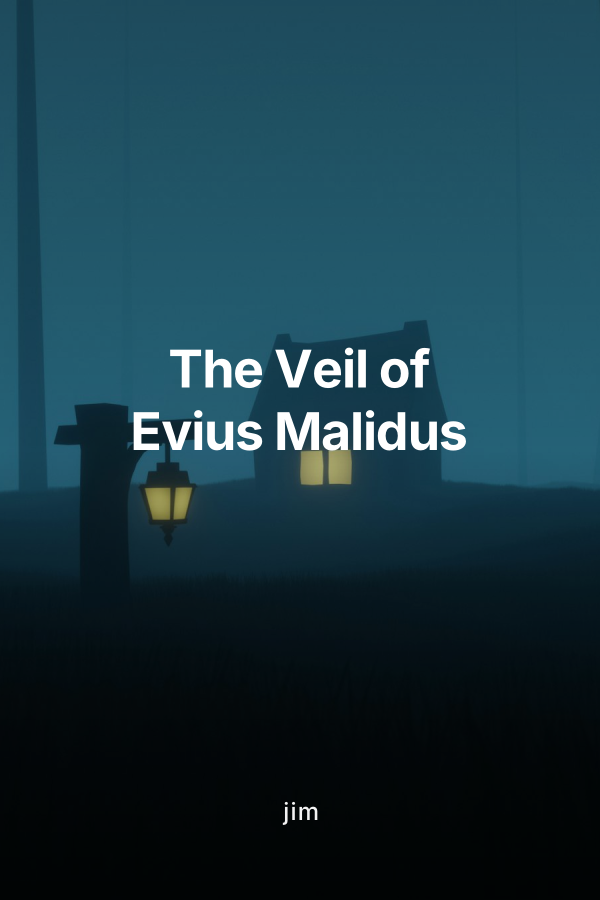
In the dying winter of the Second World War, humanity learns that the worst thing in the universe is not the devil we know. It is the God above him.
The Veil of Evius Malidus is a 10,000 word psychological horror war novel that fuses Eastern Front brutality with cosmic dread. At its core is a secret older than Eden itself: God is not the savior of mankind, but the architect of a coming annihilation. The cherished divide between our world and a rotting dark dimension called Evius Malidus is held together by human faith, human suffering, and a fragile metaphysical barrier known only as the Veil. Now, at the blood-soaked height of World War II, that barrier is failing.
Set amid frozen battlefields, ruined churches, and underground ritual chambers, the story traces three main threads that slowly twist into one suffocating noose. On one side: a Soviet tank commander, Captain Morozov, and his battered crew, slogging through snow and corpse fields on what seems like just another suicidal assignment against the Nazis. On the other: a cadre of fanatical SS occultists, guided by visions and half-burned grimoires, determined to weaponize whatever lies beyond the Veil. Between them, caught like an insect in the closing fist of both history and theology, stands a haunted priest whose faith has become a loaded gun pointed at the sky.
At first, the horror seeps in along the edges. Morozov and his men stumble upon entire villages abandoned overnight, dinner still warm on tables, icons burned to oily smears on the walls. German patrols are found shredded, not by artillery or shrapnel, but by something that worked from the inside out. Radio transmissions warp into hymns sung backward. Wounds that should kill do not, and wounds that should heal open again during prayer. Every explanation feels like a lie, but the soldiers keep clinging to them, because the alternative is far worse.
In parallel, inside a decaying castle converted into an occult research center, SS officers enact rituals that should not work and yet do. Their aim is brutally simple: crack the Veil first, harness the power within, and win the war by unmaking the enemy’s souls. But as they tunnel deeper into forbidden liturgies, the Nazis discover they are not pioneers. Something has been pushing humanity toward this moment for millennia. Their “discoveries” are more like carefully laid breadcrumbs, left by a cosmic intelligence that wants the Veil torn down so it can flood creation with its true nature. They think they are using God. They are wrong.
The third perspective belongs to Father Anselm, a middle aged Catholic priest dragged into the conflict as a theological consultant, confessor to the damned, and reluctant interpreter of prophecies that smell like rot and burning feathers. Years of quiet doubt calcify into full-blown terror as he deciphers a hidden canon buried beneath holy scripture: fragmentary accounts of an “upturned Eden,” of an original covenant not of love but of ownership, and of a creation whose only purpose is to ripen into a harvest of agony. The more he prays, the worse the phenomena become. The churches bleed. Statues twist. Choir music curdles into a kind of living static. It is as if God is answering him at last, and the answer is a smile full of knives.
As the Veil thins, reality itself starts to unravel along religious lines. Battlefields warp into nightmare chapels where tanks grind over altars and stained glass windows depict scenes from tomorrow’s massacres. The dead rise, but not as shambling zombies from pulp horror; they return as “disciples” wired to something on the other side, bodies jerking like meat puppets to a rhythm only they can hear. They fight for neither Reich nor Motherland, but for a third, invisible kingdom that wants all flags cut down and all nations kneeling in the dark.
The novel escalates from eerie omens to all out metaphysical war. Soviet and Nazi forces are forced into brutal, temporary alliances as both sides are attacked by angelic abominations that have nothing soft or merciful about them. Wings become arrays of bone and eyes. Halos shine like surgical lights. These are not messengers of hope, but shock troops of a God that wants the Veil broken so His true kingdom, Evius Malidus, can fuse with Earth. Every prayer whispered in desperation becomes a crack in the barrier. Every hymn, every whispered “save us,” is another stitch undone. Humanity’s faith, it turns out, has never been a shield. It has been kindling.
The heart of the book is not just the spectacle of apocalypse, but the slow, intimate collapse of the human soul when it realizes there is no righteous side. Morozov, once a hard bitten materialist whose world made sense as bullets and mud, is forced to grapple with the idea that his disbelief has not protected him. It may have made him less tempting, but it has not made him invisible. As his crew is picked off and twisted by encounters with the divine, he feels something malignant taking an interest in him in particular. God, or whatever lurks behind that word, likes the challenge of a stubborn mind.
The Nazis, drunk on cruelty and mysticism, edge closer to a revelation that horrifies even them. Their lead occultist, a man who thought blasphemy was his daily bread, finds out there is a difference between spitting on a false idol and discovering that the idol is real and smiling. The rituals begin to turn on their creators. Sigils burn into human skin unbidden. Blood circles form themselves. The castle laboratory becomes a womb for something that does not observe the laws of space, time, or morality. The very war they hoped to win becomes irrelevant, a child’s squabble in the foyer of a house that is about to go up in flames.
Father Anselm’s journey into theological horror is perhaps the most disturbing. Once convinced that suffering had meaning, he is slowly brought to see that the meaning might be exactly what it looks like: pain as product, anguish as currency. He finds documents and apocrypha suggesting that even Lucifer’s rebellion was part of a longer script, a stage-managed revolt that made obedience seem safer by comparison. If hell is a dungeon, then heaven is the warden, and the key is nowhere to be found. The final blow lands when Anselm realizes that the miracles he has prayed for his entire life have been test openings in the Veil: localized punctures to measure how much horror reality can absorb before the whole fabric tears.
As these storylines converge, it becomes clear that God’s goal is not judgment, not purification, but integration. The dark dimension of Evius Malidus is not an exile realm, not a trash bin for souls, but God’s original shape and home. Creation was a foreign body wrapped around it, a bubble for growing a crop of conscious minds fattened on fear and worship. When the Veil breaks fully, there will be no more division between light and dark, heaven and hell, saved and damned. There will only be God, sprawling, all-devouring, clothed in every scream that has ever been offered to Him in trust.
The climax, foreshadowed throughout the book, takes place as the sky literally tears open. Armies fire artillery at incoming “angels” while cities tilt toward a churning wound in the heavens. Churches implode and reassemble as bone spires. Rivers run uphill toward the rift. In this final storm of collapsing physics and theology, Morozov, a broken Nazi occultist, and Father Anselm are forced into a last desperate choice: help God finish His work and perhaps be spared as favored pets, or sabotage the final rituals and try to keep the Veil intact a little longer, dooming humanity to more wars and more lies but at least keeping the true face of divinity at bay.
The book does not offer a comforting answer. It toys with the possibility that even resistance could be part of God’s plan, another flavor of worship. It explores the way humans cling to hope even when every sign points toward betrayal from above. It digs into the bitter humor of soldiers cursing a sky that literally bleeds on them, of priests screaming obscenities at the altar until the altar screams back. Profanity in the novel is not just spice or shock. It is a survival mechanism, a last ragged attempt to define the sacred as something worth defying, even if the sacred is an uncaring cosmic tyrant with a universe for a mouth.
Across five chapters, The Veil of Evius Malidus moves from slow burn dread to convulsive revelation:
-
Frozen Icons introduces Morozov and his crew, the Eastern Front setting, and the first small violations of reality. Crosses drip black resin. Night patrols vanish. Both Soviet and Nazi forces whisper about “the thin places” where prayers feel too loud and silence feels crowded.
-
The Castle and the Choir shifts focus to the Nazi occult center and Father Anselm’s reluctant involvement. We watch as sacrilegious experiments and tortured theology begin to rhyme with what Morozov’s unit is seeing on the ground, sketching the first outlines of a vast, hidden plan.
-
Cracks in the Sky entwines all three perspectives as assaults on the Veil intensify. Here we see full-blown religious horror: cathedrals turning into carnivorous architectures, holy music degrading into a carrier wave for possession, and angelic entities treating human armies as raw material rather than combatants.
-
The Face Behind the Light reveals the core truth about God’s nature and the purpose of Evius Malidus. Characters struggle with the knowledge that every prayer they ever uttered was another brick pried from the only wall shielding them from the divine. Alliances shift, not along national or ideological lines, but according to varying levels of despair and defiance.
-
A Veil of Ashes delivers the apocalyptic convergence. The war, the rituals, and the revelations collide in a final attempt to either preserve the Veil or accelerate its destruction. The outcome is framed not as victory or defeat, but as a choice about what kind of lie, if any, is worth living under. The closing pages linger on the idea that belief itself might be the most dangerous weapon ever handed to a species that never really understood who forged it.
The Veil of Evius Malidus is not a story about atheism versus faith, or good God versus bad devil. It is an exploration of what happens when every comforting dichotomy collapses and the universe reveals itself as a stage for a single, vast, and possibly insane intelligence. It looks unflinchingly at how people behave when the last sanctuary, the idea of a loving higher power, is stripped away and replaced with something hungry.
Yet on the edges of all that darkness, there is a thin human light. Not redemption, exactly, but stubbornness. Jokes bad enough to make a god flinch. Small acts of kindness in trenches carved through reality. Men and women who decide, in the face of absolute proof of cosmic cruelty, to care for one another anyway. The book suggests that if there is any holiness in this world, it does not come from above but from the way shattered people choose each other over the comforting poison of obedience.
Suspense grows not only from the monstrous sights and escalating catastrophes, but from the question that threads through every chapter: if God truly is the author of all this horror, what does it mean to resist Him? Heroism, blasphemy, or just another verse in a hymn we never agreed to sing? The Veil of Evius Malidus leaves that question echoing in the reader’s mind long after the last page, like a prayer whispered into a sky that might, at any moment, decide to whisper back.