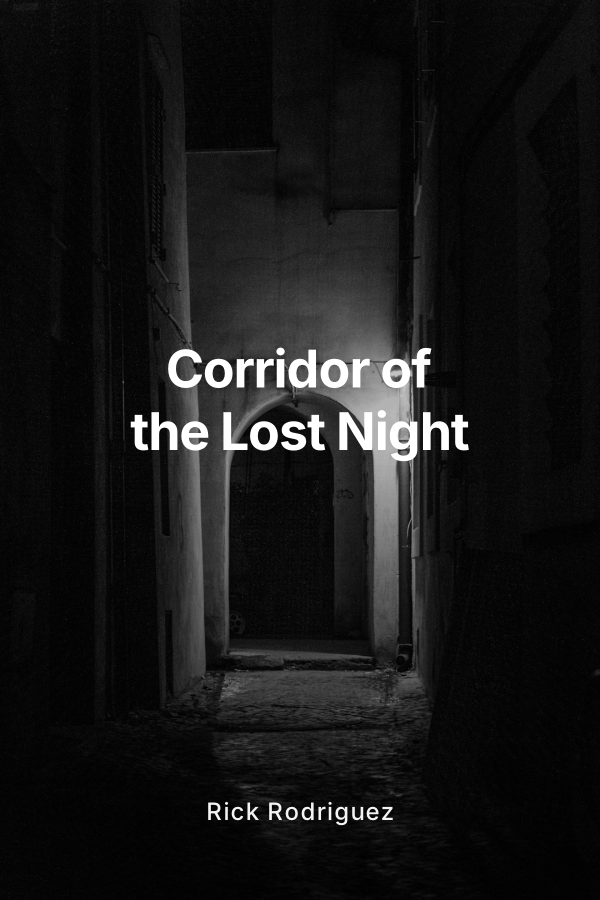
This book is a claustrophobic road‑horror thriller that follows five friends on a party trip from Michigan to Las Vegas that detours into a stretch of back highway locals only whisper about as the Corridor, a place where cults gather, UFOs hunt, and something older slips between dimensions.
They begin with simple road‑trip problems, stocked with two cans of gas, junk‑food snacks, blankets, a baseball bat, a golf club, a BB gun, and their Vegas clothes, only to be forced off the interstate by an aggressive, anonymous vehicle after dark. The detour leads them into a wrong road that does not show up on their maps, where the radio still works but cell phones give only dead air.
The journey unfolds through a rotating point of view between the five, each with a distinct way of seeing the same waking nightmare. Mike, twenty‑five, is the stoic, older driver who shoulders the role of protector and makes the hard calls under pressure. Rick and Ruben, stepbrothers, are bonded by a rough shared family history and instinctively shield each other when things go bad. Willow, a Salvadoran skater and late‑night talk‑radio devotee, connects every strange sign to half‑remembered conspiracies. Tim, a Black anime and UFC fan, brings a sharp, analytical eye and the know‑how to turn their meager supplies into weapons, including the Molotov cocktails that later keep them alive.
From the moment they leave the safety of the interstate, their world shrinks to the interior of the car and the ribbon of road outside the windshield. They spot distant bonfires and robed figures in fields, hear chanting overlaying the static as the radio slips into frequencies it should not reach, and witness uncanny lights performing impossible maneuvers above the treeline. At first, the five try to rationalize what they see, but the pattern that emerges feels disturbingly close to the fringe conspiracies Willow has absorbed over years of late‑night listening: cattle mutilations, Men in Black style clean‑up crews, and cults that treat UFOs not as visitors but as gods.
The Corridor is not simply haunted. It is a thin place, an invisible fracture where dimensions rub together and let things through. The book’s central conspiracy emerges piece by piece, stitched from Willow’s theories, Tim’s observation of patterns and symbols, and the taunting monologues of a radio host who seems to know exactly who they are and where they are. They slowly grasp that cultists and non‑human entities share this ground for a reason. Something about this region’s “sacred power” makes possession, time slips, and dimensional overlap easier, drawing secret societies, government‑style cleaners, and inhuman forces into a lethal alliance.
Yet the heart of the story is not the mythology but the friendship. The five never turn on each other. Terrified and exhausted, they stay united in a way closer to a coming‑of‑age ensemble than a typical horror cast. Their banter, memories, and shared history give the narrative emotional ballast and prevent the nightmare from feeling abstract. Every choice they make is a group decision, from barricading the rear window with blankets to hide from a following vehicle, to quietly deciding who will wield the bat, who will light the Molotovs, and who will stay inside with the BB gun as a last resort.
Midway through the book, the road delivers them to a lone cabin that offers the first shelter they have seen since leaving the main highway. Inside, they meet a woman who claims she was also chased off the road days earlier and has survived on a well‑stocked pantry. She is grateful, kind, and surprisingly composed for someone stranded. The group makes an uneasy pact to stay until morning, rest, and resupply. It seems, for a few hours, like their luck has turned.
Then the boundaries that hold the demonic presence in check start to thin. At first the woman’s oddness could be chalked up to trauma: small slips in her story, a voice that shifts register at the wrong moments, a sudden knowledge of things the friends never said aloud. Gradually, the possession becomes undeniable. Something old and vicious has seeped into her through the Corridor’s fracture point, using her as a vessel and a weapon. The entity toys with them, repeating private phrases it should not know, standing silently in doorways at times it should be asleep, and finally exploding into a violent, predatory attack that forces the friends to flee into the night.
From this point the road trip transforms into a siege. The fog thickens to a choking blanket that forces Mike to crawl forward at a walking pace, headlights reduced to pale halos in front of the car. Chanting grows louder from the treeline. Above, lights begin to appear and vanish, matching symbols the friends have seen etched into roadside poles and the cabin pantry. Snow starts to fall out of season, and the temperature drops inside the car even under their stacked blankets. To cope and to stay oriented, they keep the radio on. That choice saves and damns them at the same time.
The broadcast they tune into is not any normal station. A smooth, amused host welcomes listeners “back to the Corridor” and proceeds to narrate the night almost as it happens, describing five friends in a car, their fear, their improvised weapons, and the cult cells fanning out across backroads to find them. The show spirals between quasi‑religious monologue, late‑night conspiracy patter, and direct taunts. The host hints at shared control by human cult leaders and something non‑human that uses them as pieces, suggesting that the Corridor is not an accident but a cultivated crossing point. The friends, hiding with the engine off on a side track, listen in horror as their choices are predicted minutes before they make them.
The last third of the book tightens the screws. While the UFO presence and demonic influence remain mostly one step removed, exerting pressure through manipulation of weather, electronics, and human vessels, the cult members become a tangible, physical threat. In a set‑piece confrontation under the distorted halos of distant craft and the flicker of ritual fires, robed figures try to force the car off the road and drag the friends out. Here the improvised arsenal finally matters. Tim’s Molotovs transform gasoline and bottles into a blazing barrier. Mike turns from protector to fighter, wielding the bat in brutal, desperate arcs. Rick and Ruben fight back to back, bloody but relentless. Willow uses the BB gun less as a weapon and more as a tool to take out headlights and symbols, buying them precious seconds. Cultists are left burning, broken, or abandoned in the snow while the car limps away on protesting tires.
Despite the violence, the story honors the user’s intent that all five friends survive. Their survival, however, feels earned. They are cut, concussed, frostbitten, and traumatized, yet they refuse to abandon one another. The emotional core of the ending is not triumph but bruised loyalty and an intimate understanding that they have seen behind the curtain of the world.
The climax resolves with a narrow escape from the Corridor. Following a last tenuous thread of normality, they push forward until the fog lifts and neon appears on the horizon. They do not reach Las Vegas, but instead a smaller town with a gas station and emergency services. Help arrives in the form of paramedics and police who seem disarmingly calm about the blood, burns, and half‑coherent story the group offers. For a beat, it looks like the nightmare has broken.
Then the book delivers its final turn of the knife. In quiet details, the friends notice that the world they have reentered is not quite clean. A paramedic’s patch contains a stylized version of a symbol they saw on cult robes and UFO lights. The radio in the ambulance flickers for a second, just long enough to carry a familiar, velvety voice saying a phrase the Corridor host used all night, before cutting back to normal chatter. An officer misstates a small but crucial detail of their trip in a way that implies he knew their route before they told him. Without spelling everything out, the story strongly suggests that the conspiracy extends into the institutions that are supposed to protect them, and that the Corridor is not a single location but part of a wider, hidden network.
The book closes in a muted, eerie key. The five friends, alive and together, must decide what to tell the world and what to keep between them. They carry a shared secret and a permanent crack in their understanding of reality. A final image, chosen to be haunting rather than explicit, implies that while they have escaped the worst of the Corridor, its gaze has not left them. The voice from the radio may return in the most ordinary of places, and the symbols they saw in blood and fire may appear on billboards, corporate logos, and official badges if they look closely enough.
Corridor of the Lost Night is structured into five chapters that mirror the escalation of the night. Chapter One sets up the road trip and the first detour off the interstate. Chapter Two deepens the horror with the first cult and UFO sightings along with their resource inventory. Chapter Three centers on the cabin, the woman, and the possession that forces them back to the car. Chapter Four traps them in the fog, fuses the radio show into the narrative, and reveals the larger conspiracy. Chapter Five delivers the cult confrontation, their razor‑thin escape, and the unsettling aftermath in “normal” civilization. Across these chapters, the book combines the tension of a contained survival thriller with the wide‑angle paranoia of a conspiracy saga, while foregrounding the unbroken bond between five young people who walked into the dark together and refuse to leave anyone behind.