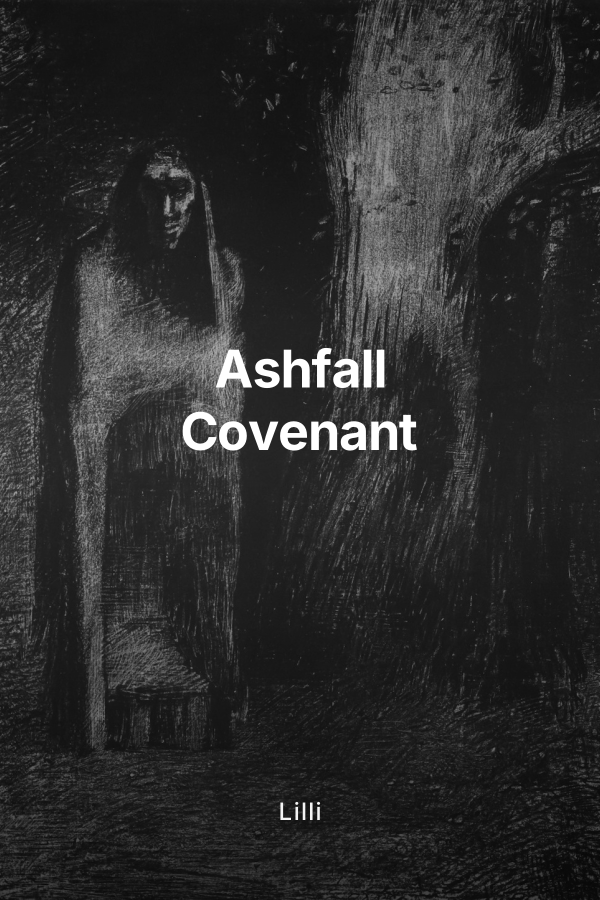
In the fevered hours after the world ends, two men walk out of the smoking wreckage of their former lives bound by a promise they never put into words. One was trained to break bodies in the name of country, the other to mend them in the name of conscience. In the new order written in blood and contagion, both roles turn ugly, and love itself becomes a weapon that cuts in every direction.
Ashfall Covenant is a dark, fast paced horror romance set in the long shadow of an outbreak that tears through cities, institutions, and moral certainties. It follows Achilles, a former special operations soldier, and Patroclus, an emergency physician, as they cross a rotting continent in search of a rumored refuge and a reason to keep believing in each other. Their journey is a jagged line of ruined highways, failed safe zones, small town strongholds, and fleeting oases of peace that never last. At every turn, the infected howl at the edges of their firelight and the living prove more dangerous than the dead. Yet the true terror grows between them, in the choices they make for one another and the things they are willing to do to keep the other breathing.
From their first frantic escape through a collapsing hospital to nights spent listening to the winter wind scream through an abandoned ski lodge, Achilles and Patroclus are pulled between tenderness and brutality, between the urge to protect and the knowledge that protection has a cost. Achilles defaults to the only tools he trusts: violence, precision, and absolute focus on the objective. Patroclus clings to triage protocols and oaths that crumble a little more with each corpse in their wake. The deeper they travel into the wasteland, the more those instincts collide.
Horror seeps in slowly at first. An overrun military safe zone reveals soldiers executing infected civilians who still plead and recognize their loved ones. A fortified small town advertises mercy and community, then barters survival with human lives. A roadside church hides a fervent cult that sees the epidemic as purification and Achilles as a prophesied weapon. Each stop along their route peels away another layer of pretense and exposes the raw, desperate calculus beneath survival. Patroclus sees faces, names, and medical histories in every stranger; Achilles sees threats, weak links, and the shortest path to safety. The tension between them sharpens into something that feels like betrayal even when it is only fear.
Their devotion, however, is absolute. That devotion is what makes the book quietly harrowing. Achilles is the hammer, willing to break anyone who endangers Patroclus. He will abandon crying families at the roadside if it means shaving seconds off their escape. He will lock doors on people begging to be let in, will aim at the heads of patients who still answer to their names, and will not hesitate to torture information out of raiders who know the next viable route. Patroclus is the conscience until he cannot bear the weight of it anymore. He fights Achilles over every choice, insists on treating a bitten child, slows them down to bandage strangers who later turn on them. Each argument frays them further, yet neither man can imagine walking on without the other.
Across five chapters, Ashfall Covenant tracks the crumbling of their moral boundaries and the evolution of their bond from quiet, unspoken love into something almost feral. Their journey unfolds in distinct movements that mirror stages of grief.
In the early days, adrenaline and denial carry them from the overrun hospital into a city dissolving under sirens, firelight, and the animal sounds the infected make when they run. Patroclus is still a doctor then, shouting triage categories into the roar of a panicked crowd while Achilles carves a path toward any exit. They take shelter in a farmhouse whose pantry still smells of coffee, where they taste a fleeting imitation of normalcy: cooked food, clean sheets, the ghost of domestic life. It is there that they admit, without saying it out loud, that their lives narrowed around each other long before the outbreak. The quiet is fragile and already haunted by the screams they ignored on the road.
The middle stretch of the book is a grim odyssey westward. A failed military safe zone becomes their first lesson in institutional collapse. Achilles is forced back into soldier mode, fighting alongside exhausted conscripts while Patroclus tends the wounded, only to realize the command has decided his patients are liabilities. When the order comes down to cull those showing early symptoms, Achilles prepares to obey out of reflex. Patroclus refuses, and the clash that follows leaves blood on both their hands. They flee, but something fundamental has cracked. Achilles begins to fear that the man he loves will come to see him as one more monster in uniform.
Their winter in an abandoned ski lodge is a respite carved directly into the bone of horror. Snow muffles the stalking cries of the infected. The lodge, with its empty luxury, feels like a stage set left behind by an extinct species. Here, they build a small, temporary world: foraged food, a working generator, a fireplace that smells of resin. The intimacy between them deepens into a physical connection, yet the lodge also holds the book’s most disturbing domestic scenes. Achilles wakes from combat flashbacks already reaching for phantom rifles. Patroclus spends nights cataloging dwindling supplies, running mental triage on a future he cannot control. Their love is at its most tender in these chapters and also at its most precarious, because the more they invest in a shared future, the higher the price of every compromise becomes.
The horror intensifies when the outside world inevitably intrudes. A passing group of survivors begs shelter. Among them is an infected but lucid woman who has chained herself, pleading only for a painless end when the time comes. Patroclus insists on helping, arguing there is still time to study her symptoms, to understand the disease, to do some good that is larger than the two of them. Achilles wants them gone by morning. Circumstances snowball toward an atrocity that neither man can walk back, a moment that will become the book’s central wound. One of them breaks a personal line they swore never to cross. The other witnesses it. Love does not disappear in that instant; it mutates, darkens, and begins to demand more and more ruthless acts to justify itself.
Later chapters trace their passage through a coastal refuge that masquerades as community yet survives on quiet cruelty, and a cult like camp that both exploits and venerates the epidemic. In each place, Achilles and Patroclus encounter distorted reflections of themselves: lovers who abandoned each other to save children, leaders who decided some lives were worth less than others, healers who turned to experimentation and sacrifice in the name of a cure. These encounters force them to question what their devotion has already cost the people around them and what it will eventually cost them both.
Psychological tension threads every step of their route. Achilles grapples with the fear that he is nothing without orders and targets, that all he has to offer Patroclus is his capacity for sanctioned harm. Patroclus fears becoming numb, watching his medical ethics die a slow, practical death each time he lets Achilles choose ruthless efficiency over compassion. The most chilling scenes in the book are often quiet ones: Achilles carefully washing blood from Patroclus’ hands after a procedure that went too far, Patroclus staring at the man he loves and seeing, for a terrifying moment, the enemy he once treated victims of. Their arguments, often whispered in the dark of whatever shelter they have claimed, circle back to the same question. Whose life matters more when you cannot save everyone? And what does it do to you to answer that question, day after day, with the same name?
The romance at the core of Ashfall Covenant is gritty and unflinching, yet also deeply tender. The narrative never lets the reader forget the sweetness between them, the shared jokes, the soft gestures of care, the accumulated shorthand built through years together before the first siren ever sounded. That tenderness is what makes their worst moments unbearable. When Achilles tortures a captured raider for information because he believes it is the only way to keep Patroclus safe, the horror lies less in the brutality than in the quiet understanding in Patroclus’ eyes, the way he tends Achilles’ injuries afterward without speaking of what he just witnessed. When Patroclus finally snaps and performs a gruesome medical act Achilles himself might have hesitated to attempt, the inversion terrifies them both. They have moved so far from who they were that their old selves feel like ghosts trailing behind them on the road.
The climax centers on a rumored research facility that may or may not hold a way to slow the disease. The road there is littered with the wreckage of other people’s hopes. Achilles is willing to kill anyone who tries to redirect them. Patroclus, haunted by everyone they have already left behind, clings to the idea that the facility could make their suffering meaningful. By the time they reach its rusted fences, they understand that no sanctuary is innocent and that no cure comes without a ledger. The final moral choice they face demands that they decide, once and for all, whose survival they are willing to buy with blood.
Ashfall Covenant is structured to maintain a relentless sense of forward momentum while allowing for pockets of fragile stillness. Each of the five chapters anchors itself in a major waypoint along their cross country trek: the collapsing hospital and city, the failed military safe zone, the farmhouse and winter lodge interludes, the deceptive coastal refuge and cult camp, and the ruined research facility that may be the end of the road. This clear progression gives the narrative a road novel’s propulsive energy, while the horror elements seep in through atmosphere, body terror, and the awful intimacy of watching two people erode each other’s boundaries for love.
Stylistically, the book leans into dark, atmospheric horror. Sensory details linger on cold metal under shaking fingers, the copper tang of blood in mask filtered air, the wet rattle of an infected person trying to speak. Psychological dread thickens every page as the reader is invited to inhabit both men’s inner worlds, to understand exactly why each compromises himself and why each still believes, even at the worst moments, that the other is worth every sin. Violence is explicit, but it is never spectacle for its own sake. Every act of gore is tied to an emotional fracture, a test of loyalty, or a step down into a darker version of devotion.
At its heart, Ashfall Covenant is about the terrifying clarity that arrives when the world falls apart and nothing is left to hide behind. It asks what it means to love someone absolutely when absolute love makes you dangerous. It examines the fine line between protection and possession, mercy and cruelty, duty and desire. The horror comes not only from the infected pounding on barricades or the cruelties of other survivors, but from recognizing how easily the story’s most monstrous acts could grow from familiar, human impulses: fear of loss, hunger for safety, the desperate need to believe that saving one person completely can somehow balance the scales.
By the final page, survival itself has become a question, not a victory. Achilles and Patroclus have walked through fire for each other, and the ash of those choices settles over everything they have left. The reader is left with an image of two men who have seen what the end of the world demands, standing side by side in the dark, still choosing each other, and knowing that this choice is both their salvation and their damnation.