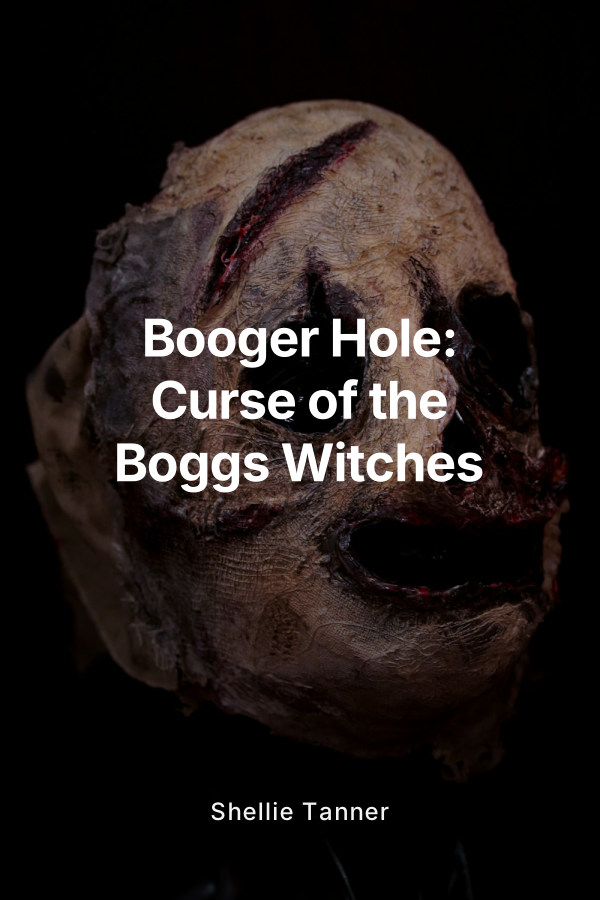
This book is a dramatized horror mystery rooted in real family history and Appalachian folklore. It traces how a single act of atrocities in the early 1800s ignites a generational curse that stains a bloodline, poisons a town, and blurs the line between faith and savagery. Set in and around the tiny, haunted community of Booger Hole in Clay County, West Virginia, the story exposes the rot behind pious faces, the power of a persecuted witch family, and the brutal cost of dealing with an ancient serpent spirit that rules the deepest hollows of the Appalachian Mountains.
At the heart of the story is the Boggs family, a clan of herbal healers and secretive witches who keep to themselves on the edge of slavery-era Virginia. Their practices are quiet, grounded in plants, potions, and rituals meant to protect their own people. They do not seek conflict. Their witchcraft sustains an “unusual lifestyle,” preserving health and extending life in a world where most people die by thirty-five. Drought, famine, disease, and the cruel pendulum of the Little Ice Age press in on the region, poisoning wells, killing livestock, and shortening tempers. In this hostile landscape, difference is dangerous, and the Boggs name becomes an easy target for fear and hatred.
The violence that follows is both personal and communal. A group of so called Christians, men who present themselves as devout Puritans by day and become predators by night, fixate on the Boggs women as symbols of everything they claim to hate. These men buy, sell, and trade human beings, cloak their cruelty in scripture, and turn their faith into a mask for rape, torture, and murder. When they descend on the Boggs homestead, the result is a massacre. Grandparents, aunts, uncles, cousins are slaughtered. Only a small handful survive, including Lacy Ann’s parents, an older brother, and twin sisters.
The true spark of the curse arrives with a single unforgivable act. The narrator’s great great great grandfather, aligned with the Tanner and Sampson families, not only participates in the lynching, he inflicts an atrocity so extreme it tears a hole between the living and the dead. He tortures and rapes Lacy Ann’s grandmother before burning her alive in front of her own daughter. This is not just murder. It is an offering of innocent flesh to cruelty itself. In that moment, as flames consume the matriarch of the Boggs line, something ancient takes notice in the mountains. The surviving Boggs women invoke and reaffirm a curse for all time, damning not only the men directly responsible but their descendants and the land they cling to. The Tanners, the Sampsons, and the narrator’s bloodline are named, bound, and marked for eternal suffering.
From that point forward, Booger Hole is no longer just a remote Appalachian hollow. It is a wound in the earth. Beneath its blackest and deepest cave coils the Booger, a giant shape shifting serpent that moves between shadows and legend. Known locally as the Boogey Man, this entity is more than a monster. It is an enforcer of dark bargains, a ledger-keeper of sins. It grants power to those who dare to tap the blackest magic, but every spell, every curse, every act of revenge accrues a debt. Those who dabble in the Darkness, including the Boggs witches themselves, must eventually pay with blood, sanity, or souls.
The three surviving Boggs witches emerge as some of the most terrifying figures ever to haunt Booger Hole. Once semi peaceful healers, they are driven to rage by the massacre of their kin. Their power grows in proportion to their grief. Rumors spread that they can shape shift into a flock of crows, scatter into the night as a black panther, or appear at the edge of a burning field, watching. Locals whisper about sacrificial rituals and potions brewed from the bones of the guilty. Whether the stories are fully true or inflated by fear no longer matters. The town believes, and belief feeds the curse. Yet their magic is never free. The Booger waits in the mountain, demanding a toll for every life taken in vengeance.
Over generations, the curse on the Tanners, Sampsons, and their allied bloodline weaves itself into the ordinary tragedies of Appalachia. In a region already ravaged by war, pestilence, alcoholism, and grinding poverty, the curse hides in plain sight. Infants sicken without cause. Young men vanish in the woods and are found with expressions of terror fixed on their faces. Lynch mobs turn on their own neighbors under the weight of paranoia. Families fracture under the weight of incest, violence, and disease. To outsiders, these are just more sad stories from a forgotten hollow. To those who carry the blood of the perpetrators, each incident feels like another note in a long, punishing song.
The narrator, a descendant who grew up in Booger Hole, becomes the lens through which the reader uncovers this layered horror. Raised among stories half-whispered and half-denied, the narrator sifts through family legends, town gossip, old court records, and missing pages in Bibles. The book uses this investigation to peel back masks. Churchgoing men who appear respectable on Sundays emerge as night-walking predators in old stories. Artemisia and foxglove, herbs that might have been used for healing, become entangled with accusations of witchcraft. The land itself seems to remember, carrying echoes in its fog, odd silences in the trees, and a recurring chorus of crows that appear at the worst moments.
The story does not shy away from what happened. It is direct about rape, torture, lynching, slavery, and religious hypocrisy, and it treats these not as spectacle, but as brutal realities that shape bodies, minds, and generations. By focusing on dramatized fiction rather than memoir, the book can protect the living while still preserving the emotional and moral truth of what unfolded. The personalities of late kin, their known and suspected crimes, and the pressures of their time provide the backbone of the narrative. Historical details of disease, environmental collapse, and slavery-era law anchor the horror in a plausible world, while the supernatural curse raises those everyday cruelties to a mythic scale.
Across five chapters, the book tracks three intertwined arcs:
-
The origin: early 1800s Virginia, when drought, famine, disease, and slavery create the perfect tinderbox. The Boggs witches struggle to keep their family alive as hysteria builds around them, culminating in the massacre and the first casting of the curse.
-
The deepening: as decades pass, Booger Hole’s reputation grows. Strange deaths, killings, disappearances, and scandals cluster around the cursed bloodlines. The three Boggs witches become local legends and nightmares, while their own sacrifices to the Booger serpent reveal that even avengers are not free from judgment.
-
The reckoning: in the near present, the narrator, having grown up amid alcoholism, violence, and whispered references to “the witch,” begins to map these scattered horrors into a coherent pattern. Each discovery forces a choice: deny the past, or confront it and attempt to break, redirect, or at least name the curse that has shaped so many lives.
Throughout, the book balances relentless darkness with human moments that keep readers turning pages. Acts of small kindness emerge even in brutal families. Laughter crackles at kitchen tables before it sours into argument. Children carve their own games into the dirt, unaware of the bloodstains beneath their feet. The Boggs witches themselves are shown not only as fearsome agents of revenge, but also as grieving daughters, mothers, and sisters, caught between their need for justice and the knowledge that every spell they cast might cost them another piece of their souls.
Horror, in this story, is not only a monster or a ghost. It is the slow realization that something is fundamentally broken in the way this town has chosen to remember, excuse, or bury its own cruelty. The supernatural elements serpents, shape shifting witches, audible whispers from the blackest mountain hole magnify that brokenness. As the mystery unfolds, the narrator and the reader must face a hard question. Is the curse truly the work of witches and an ancient serpent, or is it the natural consequence of centuries of unacknowledged sins, concentrated in a single valley the world forgot?
Booger Hole: Curse of the Boggs Witches invites readers into a place where faith hides monstrous appetites, where the land listens and judges, and where a single night of fire and hatred can echo for two hundred years. It is a story of preservation and exposure a way to raise awareness about real historical violence while wrapping it in a cloak of myth and terror. Above all, it is an unflinching look at what happens when a community refuses to face the harm it has done, and how the descendants of both victims and perpetrators are left to decide whether the curse will end with them, or pass once more into the veins of another generation.