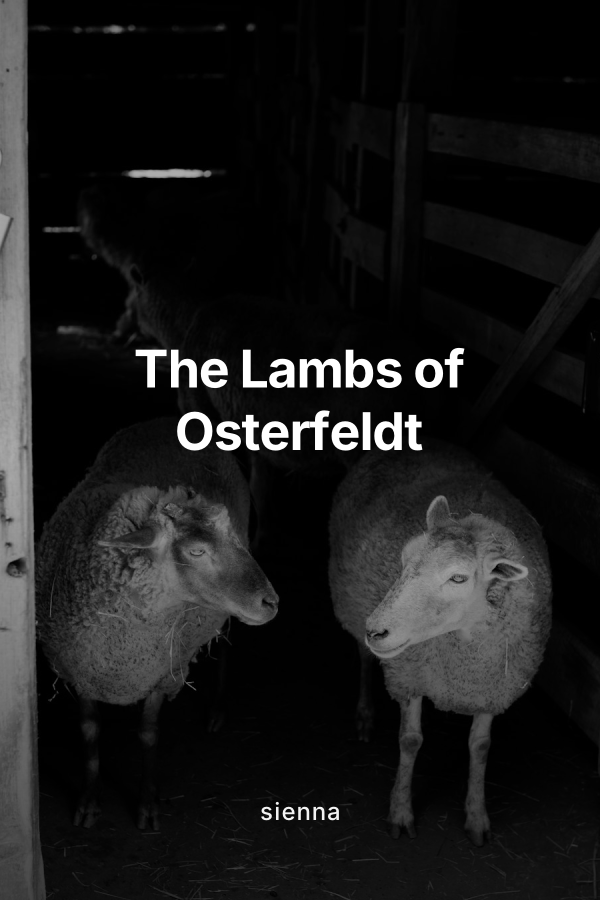
Mara Harrowen has always believed monsters belong on the page. In Osterfeldt, Pennsylvania, they tell you evil lives far away, in cities and headlines, not in your own church pews. Her town looks harmless at first glance: clapboard houses, harvest festivals, Friday night games where the Osterfeldt High Lambs charge the field under bright lights. The only thing that really unnerves her is the Chapel of the Damned, a stone relic at the edge of town with stained glass that swallows light instead of letting it through.
Mara is tall, smarter than people expect, a little too sarcastic for a girl in a town that prefers its women soft-spoken. She shelves books at the local library, breathes in dust and ink and leather, and hides in other people’s stories to forget her own stalled life. Her family is messy but ordinary: no prophecies, no miracles, just overdue bills and a mother who drinks too hard on Sunday afternoons. She has one solid anchor, her best friend Constance, who blows into the library like a storm, all laughter, braids, and unapologetic joy. Constance has just come back from a long honeymoon with her wife and is convinced Mara is destined to find someone who loves her that fiercely. Mara laughs it off. She knows better than to expect that kind of devotion.
Then Elias Drachenholtz walks into the library and into her life.
On paper, Elias is perfect. A senior at Osterfeldt High, top of his class, polite to every adult, patient with every child. He is boyishly handsome, with golden hair and watercolor eyes, the heir to the old Drachenholtz family whose name is carved into pews and donor plaques across town. People say his prayers sound like poetry. Teachers trust him. The Chapel of the Damned holds him up as proof that the town is doing something right.
From the start, something about him feels off. He moves through spaces like he already knows the exits. He speaks in careful, measured tones, as if every sentence is a test he is determined to pass. When Mara first meets him, it is at school, not church. Elias’s anxious, old-fashioned classmate Edgar, a nervous overachiever who has been orbiting Elias for years, introduces them without meaning to. Elias appears at the library, at the bay window seat where Mara reads on slow mornings. He asks about the book in her hands. He listens when she talks. He laughs at her sharp jokes instead of flinching at them.
Against her better judgment, Mara begins to fall.
The first chapter of the book lays the illusion of a gentle romance over something rotten. Mara and Elias talk for hours across the library desk, in the quiet corners between tall shelves. He tells her he has never met anyone who speaks her mind the way she does, never known a girl who is not afraid to challenge him. He does not punish her for her edges, and in a town that keeps sanding her down, that feels like oxygen. He shares pieces of his life in the Drachenholtz house: a strict father, an icily devout grandmother, a mother who lost herself in notebooks full of equations and chemical formulas before she vanished from the story. Mara hears generational dysfunction, the kind that can be survived with enough love. She does not hear what he is actually telling her: that he has been trained from birth to confuse devotion with obedience and cruelty with righteousness.
Buried under centuries of piety, the Drachenholtz family hides an older covenant.
Long before the Chapel of the Damned was a building, a man in their line met something that called itself Aurelith in his dreams. It promised knowledge beyond the senses, a way to pierce the skin of reality. All it wanted in return was a bloodline and belief. He agreed. Aurelith turned him into its first vessel and marked his descendants. The chapel was built around that bargain, scripture wrapped like white cloth around a wound that never heals. Every generation, one child is chosen as Aurelith’s lens. This time, the marked child is Elias.
Elias was six when Aurelith first made itself impossible to ignore. Eight when he vanished for a night and woke in his own bed with mud on his feet and no memory. Ten when his father stopped looking at him with uncomplicated love and started flinching at shadows only he could see. The chapel taught him that obedience is the highest good. His grandmother taught him that weakness is unforgivable. Aurelith taught him that love and sacrifice are the same, as long as they end in blood.
By the time Mara meets him, Elias’s moral compass has been shattered and rebuilt so often that he no longer knows where his own desires end and Aurelith’s will begins. Protection means control. Mercy and murder feel like twins.
Still, he clings to the idea that he can be good. That if he follows the rules, prays hard enough, and obeys every impossible command the Chapel of the Damned gives him, he can keep the people he cares about safe. Aurelith uses that hunger to twist him. When he sees Mara standing under the library’s fluorescent lights, spine straight, eyes guarded, laughing a little too loudly at Constance’s jokes, he does not simply like her. He recognizes an answer. She becomes, in his mind, both refuge and test.
The book tracks Mara’s slow entanglement with this boy and the power behind him. Early chapters move fast, scenes cut sharp and close. Mara’s world narrows: the library, the high school, the Chapel of the Damned glowing at the end of Main Street, and a hidden place Elias shows her one late afternoon.
It is an old tyre swing, hanging from a skeletal maple at the edge of a black lake where the treeline begins to thicken. The air there tastes colder, the water so still it is almost a mirror. To Mara, it feels like a secret she has been chosen to share, a storybook hideout that finally belongs to her. To Elias, it has always been an altar waiting for a purpose.
At the lake, between water and woods, they talk about escape. College. Roads that lead out of Pennsylvania. Towns without chapels that watch you from every angle. For the first time, Elias allows himself to think about futures that do not end at the chapel’s stone steps. Aurelith listens.
The wounded animal changes everything.
One day, the pair finds a creature mangled, dragging itself through dead leaves, whimpering. Mara is horrified, helpless. Elias, so gentle with her, kneels beside it and speaks soft words as if to soothe it. Then he kills it. Quickly. Efficiently. Too hard. Blood splashes across his hands. For a heartbeat, Mara sees something in him that is not grief, not revulsion, but focus. Precision. A predator’s stillness behind human eyes.
He sees her fear and reshapes it. He tells her it was mercy, that letting it suffer would have been worse. That no one else would have helped. He frames the act as burden instead of satisfaction, tells her he did the ugly thing so she would not have to. Mara, already half in love, already tired of feeling like the fragile one, decides she is overreacting. She chooses his explanation over her instinct. It is the first major red flag, and she waves herself past it.
From there, the book escalates through a series of small, sharp shocks. At school, she watches him snap at Edgar, then apologize with disarming tenderness, pulling the smaller boy back into his orbit with a whispered joke. She catches him lying smoothly to teachers, to his father, covering bruises on Edgar’s arm with practiced stories. Every time doubt pricks at her, Elias counters with vulnerability: late-night phone calls where he sobs about the chapel’s expectations, about voices and visions, about feeling chosen and cursed all at once. He never names Aurelith, but he describes it in the language of a failing mind rather than an invading god. “You’re the only one who doesn’t treat me like I’m broken,” he tells her. For a girl who has felt invisible her whole life, those words are a hook.
Constance notices the change first and becomes the book’s early alarm bell. Mara stops answering texts. Cancels plans. Mentions, almost casually, that Elias does not like clubs, does not want her going out alone, thinks bad things happen when girls drink and dance without chaperones. Constance calls it what it is: control. Mara calls it care. It is just worry, she tells herself. No one else has ever worried about her this much.
Meanwhile, the Chapel of the Damned tightens its grip on Elias. Sermons shift, growing harsher, more obsessed with purity and protection. Elders speak in vague but loaded terms about contamination, about outsiders who threaten the town’s safety. In cloistered meetings, they remind Elias of the Drachenholtz legacy and the weight of being chosen. They tell him the town’s safety rests partly on his shoulders, on his obedience. They warn him that attachment to anyone outside the bloodline is dangerous. A weakness. A vulnerability Aurelith will exploit and punish.
The doctrine is simple, poisonous, and perfectly aimed: what you love most must belong to God. If you cannot give it up, you are not truly His.
To Elias, raised on pain and scripture, this becomes a twisted gospel of loyalty. If he cannot sacrifice Mara, he does not deserve her. If Aurelith wants proof of his devotion, she is the only thing valuable enough to offer.
Chapters in the middle of the book interweave Mara’s perspective with glimpses into Drachenholtz history and Aurelith’s nature. Through old notebooks written in a mix of his grandmother’s cruel precision and his mother’s frantic scientific scrawl, Elias uncovers the roots of the Great: how the first Drachenholtz vessel believed he was expanding human understanding, not creating a predatory god. How Aurelith whispered through dreams about alternate realities and hidden structures beneath the skin of the world, offering a knowledge that came laced with horror.
Those sections echo the Tobias and Mr. Edburt mythology that underpins the wider universe the book inhabits: cursed children, Great beings called Contaminations, and a lineage of “marked” hosts whose lives dissolve under the pressure of powers they never asked for. But here, the names are changed, the family is Drachenholtz instead of Schneien, and the entity is Aurelith instead of Mr. Edburt or Lady Kiraba, harmonizing with the user’s request while preserving the core dynamics of grooming, possession, and sacrificial logic.
As autumn deepens, Mara’s world contracts to three points: the library where she once felt safe, the high school halls where Elias’s moods dictate the temperature of her day, and the tyre swing at the lake that has become their sanctuary. She misses warning signs she would have mocked in any other girl. Anonymous disappearances in the old part of town do not connect in her mind to Elias’s blackouts. Stories of drunk boys vanishing after stumbling down decrepit streets, last seen laughing and swearing before some blackened hand dragged them into empty houses, sound like urban legends to her, not Aurelith’s rehearsal runs.
The final chapters drive unapologetically toward the ritual at the lake.
By then, Elias’s toxic dependency has fully matured. He calls Mara in the middle of the night, voice raw, saying he cannot breathe, that the chapel will take everything from him, that he does not know who he is without her. He never outright threatens self-harm, but he speaks around it, implying that losing her would be the end of him. Mara absorbs the message. Leaving would not just be heartbreak; it would be cruelty. She vows silently to stay, to anchor him, to be the one good thing in his collapsing world.
What she cannot see is that he has already decided what “keeping” her really means.
Pressed by chapel elders and by Aurelith’s humming presence inside him, Elias becomes convinced that Mara is both his greatest love and his greatest flaw. The old notebooks frame it as a test: the marked child must prove absolute obedience by relinquishing what he holds dearest. Aurelith murmurs that if he can offer Mara up freely, he will finally be free of doubt, finally worthy of his role. His father’s fear and his grandmother’s cold praise intersect here. If he kills Mara, he is both dutiful son and perfect vessel.
Elias never tells Mara any of this. Instead, he spins a different story. The chapel is closing in. His family suspects her. There is only one way out: an older rite he has pieced together from half-burned notes and whispers in the chapel walls. If they do it together, at their place by the lake, they can sever his bond to the chapel and to Aurelith. They can run. They can be free.
Mara feels the wrongness as soon as they arrive. The air is too still. The trees too quiet. The tyre swing creaks in a breeze that never touches the water. The shadows under the lake’s surface look thicker, full of shapes that move without breaking the reflection. Elias, always a little fragile in his panic, is suddenly calm. Steady. It feels less like a breakdown and more like a ceremony.
He talks about everything she has done for him. How no one else has ever seen him as whole. How he cannot stand the thought of a world where she is not by his side. He weaves together every story he has told her over the months: the childhood traumas, the unfair expectations, the nights he nearly fell apart. “You are all I have,” he says, and after months of hearing variations of that line, after months of believing it, Mara steps closer instead of backing away.
He takes her hands and leads her towards the waterline. She follows, because by now her instincts have been retrained. For chapters, readers have watched her say yes when she should have said no, rationalize what cannot be rationalized, forgive him when he is testing how far she will bend. Here, the trap finally snaps shut.
Aurelith never speaks aloud. It moves through Elias’s fingers, steadies his grip, sharpens his sense of holy duty. In his mind, he is not killing Mara. He is freeing her from a corrupt world, proving that he can put destiny above desire. He is offering up the one thing that could tempt him away from God. He is doing what all his abusers taught him is right: sacrificing love on the altar of obedience.
To Mara, in her last seconds, the revelation is blinding and simple. He has never understood love the way she did. Her idea of love involved protection, compromise, future plans. His has always been tangled with death.
The book refuses to flinch away from the tragic loop the user requested. Mara does not escape. She is sacrificed at the lake, claimed by the same Great that has been threading itself through the book’s prologue and background horrors. Aurelith feeds. The power settles more deeply into Elias, fed by his grief and his warped conviction that he has done the right thing. The chapel absorbs her death into its mythology, filing it under misfortune or moral lesson, never naming what happened. The town returns to its routines. The Lambs take the field again under Friday night lights, their mascot a joke no one recognizes as a confession.
In the aftermath, side characters embody different kinds of complicity and resistance. Edgar stands on the fringes of Mara’s funeral, understanding too much but lacking the language to stop it from happening again. Constance turns her grief into rage, pounding on the closed doors of the chapel, shouting questions no one will answer. The library remains, full of stories Mara will never finish. Somewhere in the decaying streets of the old part of town, another boy stumbles drunk along a decrepit footpath, swearing and laughing with a bottle of Jack in his hand, as a spindly black hand reaches from a doorway and white pit-eyes fix on his face. Aurelith keeps practicing.
Across five fast, tightly plotted chapters, The Lambs of Osterfeldt follows Mara’s path from wary independence to total entrapment. Each chapter centers on a set of escalating choices: the library meet-cute and the sweetness that masks control, the tyre swing and the mercy killing that should have ended everything then, the late-night calls that cement Elias’s dependence, the chapel’s tightening doctrine, and finally the night at the lake where romance and ritual become the same thing. The pacing is relentless, the prose sharp and spare, with constant undercurrents of dread even in quieter moments.
The book draws on the broader mythos of marked children and Great beings like Aurelith to give Elias’s violence a terrifying context without absolving him of agency. It shows, in detail, how abuse and faith can warp a mind until murder feels like mercy, and how a clever, tough girl can still be maneuvered into her own destruction when love, loneliness, and manipulation converge.
At its core, this is a stalker romance turned sacrificial horror. A thriller about the dangers of mistaking obsession for devotion. A portrait of a town that hides its monsters inside its holiest places and calls them blessed.
In Osterfeldt, every lamb believes it will be spared. Mara Harrowen learns, too late, that the prettiest stories are often the hungriest.