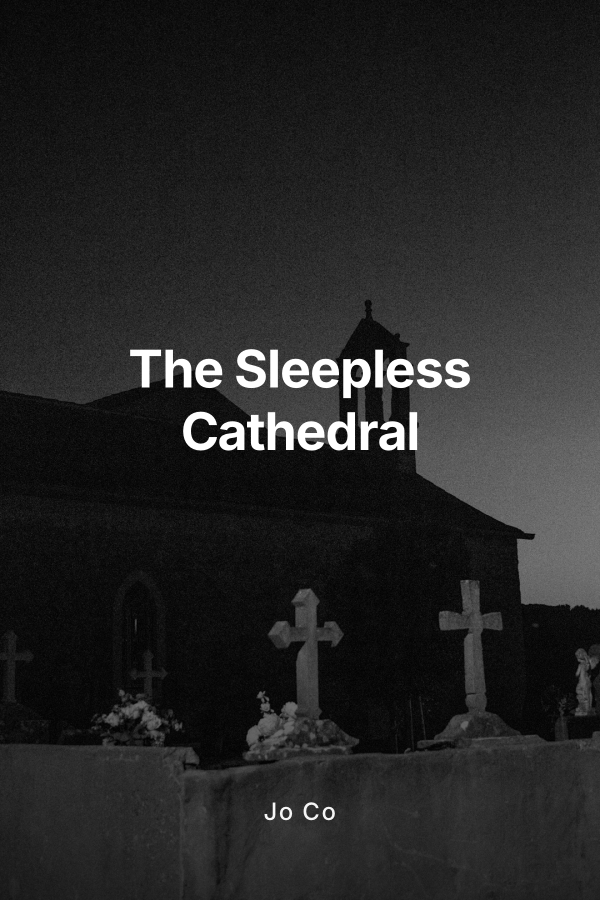
In a forgotten Australian town where the cathedral’s bell tower rules the skyline, twenty two year old Elias teaches in a struggling primary school and pretends his life is small enough to feel safe. He marks spelling tests in the empty staffroom, sneaks glances at his quiet coworker Francis, and trades messages with his older sister Lorraine, who keeps promising she will visit once she finally leaves her latest doomed relationship. The town feels stagnant, caught between the salt air from the distant coast and the shadows of the Gothic cathedral that feeds its economy and its myths. Locals say the church is a blessing. Others lower their voices and say it is a mouth that was never meant to open.
Elias has always been a light sleeper, but lately he does not sleep at all so much as submit to nightly visitations. Each time he drifts off he begins to glow, his skin suffused with a diffuse, unnatural radiance that seeps through his bedsheets and stains the walls. In this light his bedroom dissolves. The cramped rental flat falls away and he finds himself standing in warped hallucinations of his own classroom. Desks melt into pews, children’s drawings sag into fleshy, breathing wallpaper, and crucifixes elongate into spires punctured with spiraling holes. From somewhere above, from rafters that seem impossibly high, a voice speaks in the intimate rasp of a man who should be dead.
The voice belongs to the former cathedral preacher, the man at the center of the town’s half buried scandal, a charismatic cleric who led a sect that splintered away from the official church. Rumor insists he died during an obscure incident at the cathedral grounds, a quiet tragedy the diocese never clarified. In Elias’s dreams, the man is very much alive, his sermons reduced to parched murmurs that promise answers Elias does not remember asking to hear. The voice tells him of a god that lives not in heaven but in the spaces in between: between wakefulness and sleep, between earth and sky, between the cells of the body and the cavities of the cathedral’s stone. This god is a hunger made holy. It dwells in holes, in rot, in the soft decay behind plastered walls.
What begins as an inexplicable sleep disorder quickly becomes a haunting with rules and consequences. The glow that coats Elias in his sleep is not only light but a beacon. It calls to those who once attended the preacher’s secret sermons, believers who vanished into ordinary lives as sacristans, groundskeepers, and pious retirees. One by one they begin to appear at the edges of Elias’s days. He notices them loitering near the school fence, sitting immobile in the back pews during Mass, watching his front door from parked cars that never seem to leave. Their eyes carry the same spiraling symbol that haunts his dreams, carved crudely into flesh or inked in trembling lines.
When Elias confides in Francis, the other man tries to rationalize what he hears. Francis is a skeptic shaped by an upbringing in the church’s orbit, the kind of believer who left home without looking back. He thinks first of medical explanations. Sleep disorders. Neurological events. Side effects of stress. Yet he cannot explain the faint, bruiselike glow that still clings to Elias’s skin in the mornings like the memory of a sunburn. Nor can he explain why the children in Elias’s class begin drawing strange towers that float upside down over fields of staring pits, or why some of them claim to see their teacher shining in the corridor when the school is already closed.
Lorraine, by contrast, suspends her disbelief almost immediately. She knows her brother’s history, knows about the night years ago when Elias followed a group of older kids to the cathedral outskirts and returned home shaking, clothes spattered with something that might have been mud or might have been blood. The family never talked about it properly. Elias never fully remembered. The town’s only public trace of the incident is a sliver of gossip about a “disturbance” at the old monastic gardens and a quiet, immediate reshuffling of the church hierarchy. Lorraine always suspected there was more, a suspicion hardened into certainty when she finds among her mother’s hidden things a small pendant etched with the spiral hole symbol and crusted with some dark, unidentifiable residue.
As the dreams intensify, the warped classroom visits reveal more detail. The cult leader is not merely whispering. He is instructing. Each dream is a rehearsal, a guided tour of a place Elias once stood in as a terrified adolescent and somehow survived. He sees the original summoning ground, a ring of weathered stone at the edge of the cathedral property where the foundations meet raw earth. Reality near this ring frays. Walls curve into impossible angles, sound travels oddly, and the sky above seems closer, as if the heavens themselves have dented inward. The entity the cult worships bleeds through here more easily, warping the soil and the minds of anyone who lingers.
The preacher’s disembodied voice insists on a blood price. Years ago the first attempt to invite their hollow god into the world failed. Something went wrong, and whatever arrangement had been negotiated between cult, cathedral, and entity was left incomplete. Elias, stumbling into the ritual as a teenager, disturbed the choreography and lived when he should have been consumed. In doing so he altered the balance, leaving a debt the entity has never forgotten. Now it marks him as both trespasser and necessary key.
Elias’s glow is the proof and the instrument. The light is the entity’s way of tracing its own failed entrance, a residue of contact that never fully took root. By bathing the town in this radiance, the entity tests the thin walls that keep waking reality separate from its domain. It also draws the hidden cultists back into motion. They consider Elias chosen, not for salvation but as the human hinge of their god’s renewed arrival.
As strange deaths begin to trouble the town abandoned cars left on country roads with the seats soaked in blood but no bodies, parishioners found in locked rooms with their faces neatly removed the police turn inevitably toward Elias. His presence or absence near each scene seems too consistent to feel like coincidence. Witness reports speak of a figure glowing faintly in the dark or of a young teacher seen wandering near the cathedral grounds at hours he cannot account for. Elias wakes with mud under his nails, unfamiliar bruises, and the taste of old stone in his mouth. He has no memory of where he has gone, but he fears he has become the entity’s unwilling emissary.
Francis’s role shifts from detached observer to the only person still willing to believe Elias’s innocence. As he digs into old parish records and speaks with elderly townsfolk who remember the cult’s emergence and apparent disappearance, he uncovers hints that the cathedral was never entirely separate from the sect that supposedly broke away from it. The cathedral’s construction contains anomalies: sealed side chapels, bricked over ossuaries, staircases that rise toward blind walls. It is as if the building itself is a palimpsest, a sacred structure built atop an older and more blasphemous design. The cult is not an outside infection but an inner organ the church tried and failed to remove.
Lorraine is drawn to the pendant she discovered, an object that seems to thrummm faintly when Elias’s glow is at its brightest. She begins to wear it, initially as a protective charm and later as a kind of addiction. The pendant affects her dreams, connecting her to Elias’s warped classroom visions and letting her eavesdrop on sermons never meant for her ears. Through it she learns that the entity the cult serves does not appear as a single, stable form. It prefers to invade by suggestion, by absence. It exists as a pattern of holes in reality, as a swarm of voids stitched together by consciousness. What the cult calls “the Hollow God” is more like a disease of perception, a deity that grows stronger each time a human mind learns to love what should repel it.
To complete the ritual left unfinished, the cult must reopen the original summoning site at the cathedral’s foundations and feed the entity a precise offering. Blood alone is not enough. They require a willing guide, someone whose mind already contains a map of the place where the worlds brush against each other. Elias, whose teenage panic once tore through the ritual and marked him as liminal, is the perfect candidate. With the town’s gaze already turning against him, the cult’s job becomes easier. They position him as a monster in the public story so that he might finally agree to become one in truth.
The summary of the book unfolds across five escalating movements.
Chapter 1 will steep the reader in the town’s oppressive atmosphere, the physical and moral gravity of the cathedral, and Elias’s fragile routines. His glow emerges as an unexplained disturbance that he tries desperately to hide. We see his first vivid nightmares in the warped classroom where the cult leader’s voice seeps through, and we meet Francis and Lorraine as temperamental opposites in his life. This opening builds dread from the ordinary: flickering lights at school, children’s unsettling drawings, parish gossip that stops mid sentence whenever the old preacher’s name might be spoken.
Chapter 2 will deepen the supernatural rules and the psychological toll. Elias’s nightly transformations grow brighter, his dreams more invasive. Cult symbols begin to appear around town graffiti etched into lampposts, prayer cards slipped between pages of hymnals, spiral carvings discovered under old paint in Elias’s flat. We learn about the past incident at the cathedral grounds and watch as police attention begins to settle uneasily on Elias after the first unexplained death. Francis’s skepticism starts to fracture as the evidence mounts, while Lorraine’s discovery of the pendant binds her more directly to the entity’s influence.
Chapter 3 will push the story into open conflict as the cultists step from the edges of the frame into the foreground. Their aesthetic and belief system come into sharper focus: they worship not darkness itself but the purity of absence, the sacred relief where something has been removed. Clad in vestments that incorporate deliberate gaps and piercings, they see the human body as raw material for carving spiritual windows. Through the pendant and the dreams, Lorraine is courted by the cult as a potential ally, even as she believes she is infiltrating them for Elias’s sake. Francis, poring over architectural plans and old church minutes, discovers the sealed chambers beneath the cathedral where the first summoning took place. The police, working with incomplete information and mounting fear, move closer to arresting Elias, whose own sanity erodes as flashes of missing time and blood scented hallucinations infect his waking hours.
Chapter 4 will converge all personal and supernatural threads at the reopened ritual site. The cult successfully lures Elias, Francis, and Lorraine to the cathedral grounds under different pretenses. Reality there has begun to break, the air humming with a barely visible lattice of voids that tug at light and sound. The entity’s presence manifests as shifting deformations: pits appearing where stone should be solid, fleeting silhouettes shaped from missing pieces of the night sky, voices that sound like loved ones speaking from behind walls. Elias must decipher whether the cult leader is truly alive or only a mouthpiece animated by the Hollow God. The blood price is named with terrible precision, and each character is offered a bargain. Francis can trade his life to close the breach. Lorraine can surrender the pendant and everything she has learned, condemning the town to ignorance. Elias can embrace his role as the entity’s permanent anchor in the human world, trading his autonomy for the illusion of control.
Chapter 5 will deliver a climax that leaves scars. The ritual is attempted, interrupted, and warped again, but this time the interruption is not an accident. Elias, recognizing that he has always been the gap through which the entity peers, chooses how that gap will be used. Whether he succeeds in containing the Hollow God, redirects it into the pendant, or allows part of it to spill irrevocably into the town, the resolution will maintain an atmosphere of haunting ambiguity. The official narrative might say the deaths were the work of a lone killer, that a teacher suffered a psychotic break, that an old chapel fire damaged part of the cathedral’s substructure. The reader will know that some doors have been closed but not locked, that some holes have been covered but not filled. Elias, Francis, and Lorraine will not emerge untouched. At least one of them will be gone, one transformed into something not entirely human, and one left to walk the town’s streets knowing the bell tower above is not only a symbol of faith but also the spine of a buried god still twitching in its sleep.
The book as a whole will sustain a dark, suffocating tone, focusing on sensory details that make the unseen feel palpably near. The texture of old stone, the weight of sleeplessness, the hum of fluorescent lights in an empty corridor, the cold geometry of the cathedral’s silhouette against a starless sky all will serve as conduits for escalating dread. Psychological tension will arise from the slow collapse of boundaries: between sacred and profane, victim and culprit, dream and waking, human and something carved hollow for a god to step into. As Elias’s glow spreads across the pages, readers will be drawn to ask what it illuminates more clearly the world around him, or the gnawing emptiness waiting patiently beneath.