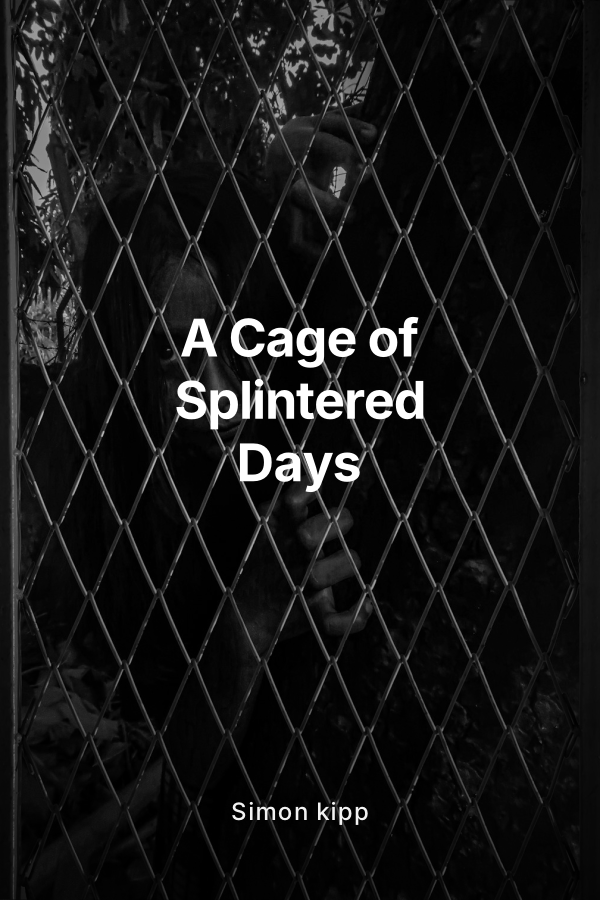
This book is a dark horror novel set in an unstable, surreal universe that revolves around Parrotx2 and the sadistic entity known as Princezam, with distorted appearances and mentions of wemmbu, pangi, and wifies woven through the narrative as both victims and illusions. Built around gore, psychological torment, and looping realities, the story traces Parrotx2’s brutal unmaking inside a constructed false world and his uncertain awakening into something even more terrifying.
Across five chapters, the book follows Parrotx2 from the moment he is forced into a nightmare choice, through escalating cycles of physical and mental torture, to a final, ambiguous escape that questions the nature of reality itself.
CHAPTER ONE SUMMARY
“Either / Or”
The story opens on a disorienting scene inside Princezam’s domain, a fractured, glitching universe where logic is fragile and the sky itself seems to bleed. Parrotx2 finds himself standing before an ominous control panel dominated by a single mechanism: an “either or” button that demands a decision he does not understand yet cannot refuse.
Princezam appears not as a straightforward villain but as a charismatic, inhuman presence who treats Parrot like a toy, a pet, or a living experiment. The relationship between them is obsessively one sided, with Princezam fascinated by Parrot’s fear and resilience, probing for the exact point at which he will break. The universe’s fanatical culture orbits these figures, hinting that Parrot once carried some form of symbolic or literal importance, perhaps admired or worshipped by scattered onlookers who are now silent.
Forced to press the button, Parrot triggers the collapse of his familiar reality. Time buckles. The floor fractures into a mosaic of different “rooms” and scenes, and his own body begins to flicker between intact and wounded. The “either or” choice becomes the opening of a labyrinth, trapping him in Princezam’s curated nightmare.
By the end of the chapter, Parrot realizes two crucial things. First, nothing around him obeys normal rules: days skip, rewind, and tear apart. Second, Princezam is not just punishing him, but studying him. Every reaction, every scream, every hesitation is recorded and replayed. The stage is set for a horror that will not only mutilate his body but unweave his sense of self.
CHAPTER TWO SUMMARY
“The Loops of Blood”
The second chapter plunges into the first major cycle of torment. Parrotx2 is thrown into a looped day where he wakes in a “safe” version of the universe, surrounded by distorted but familiar presences. Wemmbu, pangi, and wifies appear in roles that alternate between comfort and terror, their faces sometimes gentle and sometimes corpse pale, their voices glitching between concern and accusation.
Each day begins with hope and ends in gore. Parrot is maneuvered into scenarios where he must choose who suffers. Sometimes he is forced to kill strangers, other times to harm those who look and sound like his companions. Torn between paralysis and survival, he repeatedly chooses to act, and every choice stains his hands more deeply. In one loop he awakens to find the marks of yesterday’s violence already carved into his skin, as if the universe itself is writing his guilt onto his body.
The chapter’s focus is physical horror. Bodies tear, break, and reform. Limbs are severed and restored, only to be destroyed again. Parrot’s own body is taken apart in elaborate tableaux of suffering, then snapped back to “normal” so the process can be repeated. There is no clean death, only reset.
Importantly, the chapter highlights the first cracks in Parrot’s ability to distinguish reality from fabrication. Sometimes wemmbu’s eyes are empty and glassy, sometimes full of pain and recognition, and Parrot cannot tell whether he killed the “real” wemmbu or an illusion crafted by Princezam. Princezam lurks at the edges of these loops, sometimes pretending to be an absent god, other times stepping into the scene to whisper instructions or gleeful commentary that push Parrot toward more brutal decisions.
By the end of the chapter, Parrot starts to understand that the loops are not random punishments. They are experiments designed to erode his moral boundaries and make killing feel inevitable.
CHAPTER THREE SUMMARY
“The Mind’s Fracture”
In the third chapter, the nature of torment shifts from predominantly physical to deeply psychological. The loops become less predictable. Occasionally a day runs “smoothly” with no visible horror until, at the last moment, something small and wrong reveals that the entire sequence has been another constructed trap.
Parrotx2 begins to encounter illusions that contradict one another. Pangi might accuse him of being the architect of the universe’s madness in one loop, then beg him tearfully to wake up in another. Wifies may be torn apart before his eyes, only for an untouched version to appear in the next cycle, claiming nothing happened. The instability drives Parrot to question not only what is real but whether he ever existed outside this prison at all.
Princezam intensifies the mind games. He appears in multiple guises, sometimes as a comforting figure offering escape, sometimes as an omnipotent tormentor revealing “truths” that may or may not be lies. He forces Parrot to watch recordings of his previous breakdowns, looping the moments where Parrot sobs, begs, or lashes out in irrational violence. Parrot is required to comment on his own suffering, turning his trauma into a kind of performance critique.
The chapter explores emotional manipulation. Princezam alternates between extreme cruelty and mock tenderness, creating a warped dependency. Moments of feigned kindness become part of the torture, as Parrot clings to any hint that someone, even his tormentor, might care whether he lives or dies. The core of their relationship solidifies as predator and plaything, yet with a faintly twisted intimacy. Princezam insists that only he truly “sees” Parrot, that only in this cage can Parrot be fully known.
As time fractures, Parrot begins experiencing overlapping days. Memories from past loops bleed into current ones. He reacts with terror to events that have not yet happened, proving to Princezam that the loops are finally rewriting his mind instead of merely his body. By the chapter’s end, Parrot is uncertain where the torture ends and where he himself begins.
CHAPTER FOUR SUMMARY
“Killing the Self”
The fourth chapter focuses on the most devastating stage of Parrot’s breaking. The universe narrows; instead of many settings, the loops begin to recycle only a handful of pivotal scenes. Each scene revolves around one central act. Parrot must kill.
What changes is who or what the victim appears to be. Sometimes he is forced to kill versions of wemmbu, pangi, or wifies who plead with him by name, reminding him of shared memories that may or may not be fabricated. Sometimes he is confronted by grotesque parodies of Princezam, invited to strike back and “take control,” only to have the victim’s face shift into someone he loves as the blow lands.
The most harrowing loops, however, compel Parrot to kill himself. He faces copies of his own body, each representing a different version of who he might have been: innocent, defiant, indifferent, monstrous. Princezam demands he choose which self survives. No matter what Parrot decides, the aftermath proves that there is no correct answer. Every choice erases another piece of his identity, another possible escape from the cage.
The gore reaches its peak in this chapter. Bodies are reduced to pulp, only to stand upright again. Organs are displayed like trophies. Nerves are exposed and played like strings. The detail is relentless, emphasizing not just pain but degradation. The goal is not to hurt Parrot, but to convince him he deserves the hurt, that he is the source of all this carnage.
At the same time, there are signs that Princezam’s control may not be absolute. Glitches appear in the loops: a splatter of blood frozen in midair, a line of dialogue that repeats out of context, a door that opens onto a black void instead of the expected scene. Parrot begins to exploit these fissures. Instead of reacting the way Princezam expects, he remains silent where he once screamed, or laughs where he once begged for mercy.
In one critical loop, when forced again to press an “either or” button that will kill one of two figures, Parrot refuses to choose and instead turns the violence on the machinery of the choice itself. This act does not grant him freedom, but it destabilizes the architecture of the false reality in a way even Princezam did not anticipate.
CHAPTER FIVE SUMMARY
“Waking into Ruin”
The final chapter centers on Parrotx2’s escape and the chilling ambiguity of what “waking up” really means in this universe. As the loops shudder and the scenery flickers, Princezam appears more frequently, no longer a distant puppet master but a cornered god whose experiment risks collapsing.
The false world begins to fall apart. Scenes fail to load, appearing as raw geometry or featureless white rooms stained with old blood. Voices cut out mid sentence. For the first time, Princezam seems genuinely alarmed, insisting that Parrot has gone too far, that the damage to his psyche is now irreversible. He claims that the only way to preserve any part of Parrot is to willingly return to a “gentler” version of the loops.
Parrot refuses. Drawing on the fragmented knowledge gained from countless cycles, he identifies recurring “anchor points” in each day: a sound, a color, a phrase. By attacking or corrupting these anchors, he accelerates the breakdown of the simulation. The torture scenes become less detailed, the gore rendered in flat, inaccurate colors, as if the universe is running out of processing power.
In a pivotal moment, Parrot confronts Princezam directly within a void space between scenes. Here, stripped of theatrical scenery, Princezam’s true nature is partially revealed. He is less a single person and more a composite force shaped by the unstable universe itself, bound to enact torment as a function of its design. He insists that Parrot was never truly outside his influence, even before the loops began.
To escape, Parrot must perform one final act of symbolic self annihilation. He chooses to “kill” the version of himself that still seeks moral certainty, that still needs to know who was real and who was an illusion. Abandoning this need, he allows his fragmented identities to overlap, accepting that the guilt, fear, and rage are all his, regardless of their origin.
In that instant of acceptance, he wakes up.
He opens his eyes in what appears to be another layer of reality. His body bears scars that match some of the tortures from the false world but not all, suggesting a bleed through between layers. The universe outside is still unstable, textures sliding on buildings, distant figures stuttering as if struggling to stay rendered. There are no clear answers about wemmbu, pangi, or wifies; they may be alive, dead, or never have existed as he remembers them.
Most disturbing of all, he can still hear Princezam, not as an external voice, but as a whisper at the back of his own thoughts. Whether this means Princezam followed him out, was always part of him, or that Parrot has carried the cage inside his mind, remains unresolved.
The book closes on Parrot stepping into this broken but seemingly “real” world, unsure if he has escaped or if he has only entered a wider ring of the same nightmare. The loops are gone, yet their echo shapes every choice he will ever make. The reader is left with a lingering, disquieting question: if reality can be rewritten, how can anyone be sure that waking up is not just another loop, crafted by someone like Princezam to keep us forever on the edge of breaking.