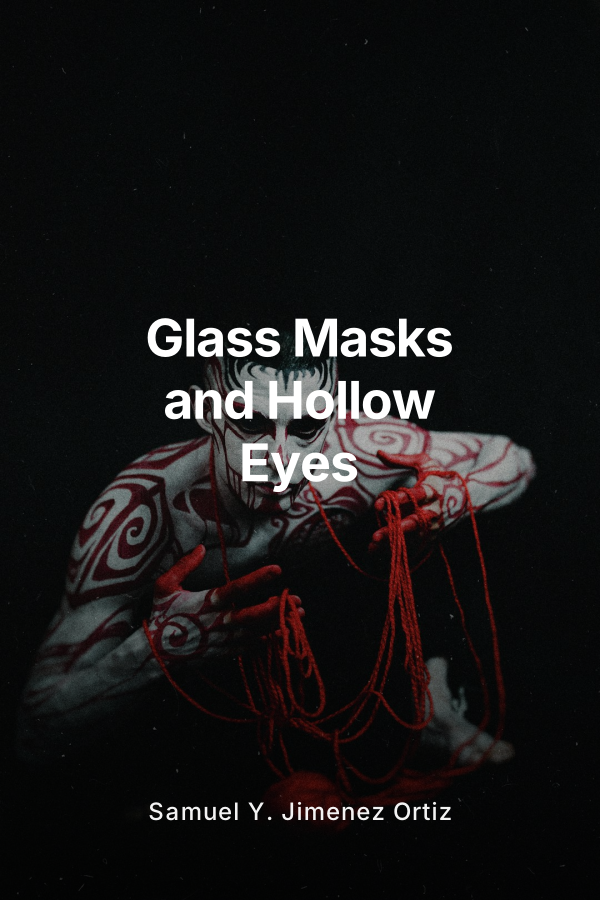
In a rain-soaked town that pretends not to remember, two children are dead and everyone is lying.
Charlie’s body was found first, dumped and soaked, the evidence washed clean by the storm. The police called it random violence, a tragedy with no clear link to the local diner, Fredbear’s Family, and no suspect worth naming. The case file closed quietly. The town tried to move on.
Then Evan died.
His death was not quiet. It happened in front of people, in a place that promised safety and smiles. Masked bullies in company-themed costumes turned a cruel joke into an irreversible horror. Security footage was lost in the chaos, witness accounts fractured into conflicting stories. The only thing everyone agreed on was the scream.
The diner’s name should have been ruined forever, but somehow it was not. The official statements were neat. The explanations were clean. Too clean.
Michael Afton knows this. He feels it in the way the adults talk around him, never to him. He feels it in the way his father, William, comes home after the incidents.
William used to fill a room. Loud, confident, the kind of man who made decisions and never apologized. After Evan and Charlie, something in him turns off. He moves through the house with eerie calm, his expressions clipped and mechanical, his grief rehearsed instead of lived. He is most unnerving when he is doing nothing at all.
He should be broken. He is not.
He should be mourning. He is not.
He should be present. He is not.
Michael stops speaking to people his age. He avoids the employees from the diner. He shrinks away from conversations, from the front of the house, from his father’s eyes most of all. Silence becomes his shield. At first it is fear. Then it becomes observation.
He starts to notice things.
Snatches of late‑night phone calls. A smear of grease on William’s cuff that should not be there. Company paperwork left out only once, then never again. A change in how the town looks at their family, like everyone is waiting for someone else to accuse them first. Michael realizes that whatever his father lost, it was not control.
Meanwhile, Henry, William’s quieter partner in the business, cannot escape his own voice. Before everything went wrong, he recorded a safety tape for the employees, a dull, procedural lecture on rules that no one liked to sit through. After the tragedies, the words become unbearable. He remembers every line, every warning, every “this must never happen” echoing over images he cannot erase. He had begged them to listen. He knows now that they did not listen enough.
Henry’s tape becomes a phantom.
Playing in his memory during the chaos of Evan’s last moments.
Whispering through his guilt as the media tears the diner apart.
Replaying in interrogation rooms where investigators ask why his own systems failed.
The town feeds on rumor.
Parents whisper at kitchen tables about masked culprits and missing footage. Some swear the costumes belonged to the company. Others insist it was a sick prank with no corporate link at all. Conspiracy theories split along fault lines of loyalty and fear. Was the diner cursed or simply reckless? Was Evan the victim of a freak accident or a predictable failure no one wanted to see coming?
Charlie’s death fuels more stories. People invent connections, shadows in the gaps where evidence should have been. Some say she was targeted because of her link to the diner. Others swear it was coincidence. Officially, Charlie and Evan are separate tragedies. Unofficially, they become two halves of the same whispered legend.
The company responds like a cornered animal. Carefully worded press releases. Tight smiles. Apologies that never admit fault. Children’s entertainment cannot afford the stain of blood, so the narrative has to be managed. Grief is choreographed. Outrage is rebranded as determination to “do better.”
Someone has to stand in front of the cameras, and William steps up when he must. In public, he can perform just enough grief to satisfy the headlines yet not enough to invite deeper questions. In private, in the quiet hallways of his house, he is blank. The numbness is more terrifying than any visible rage could be.
Henry considers a different path. He debates whether to defend the diner loudly or accept the avalanche of blame. Whether to hold a press conference and explain the safety measures he insisted on, or retreat into the background and let the brand absorb the damage as a faceless entity. Every choice feels like a confession. Every silence feels worse.
Caught between these men stands Michael.
He is not ready to confront his father. Not yet. The fear runs too deep. The memory of Evan is too raw. One wrong question could break whatever fragile balance keeps their house from collapsing entirely. So Michael watches instead.
A misplaced file in William’s office.
A strange gap in the official story he sees on the news.
A memory of Charlie’s smile that does not fit with what the police report said about where she was last seen.
The more he notices, the more impossible it becomes to look away.
Around him, the town spirals. Protests crop up outside the diner. Some people demand closure and justice. Others angrily defend the brand, arguing that accidents happen, that the place gave the town good years before the bad ones. Older kids spread half-true stories in school hallways. Younger kids whisper “cursed” with a thrill they do not understand.
No one knows the full truth.
No one wants to, not really.
Knowing would mean choosing a side.
The book follows this pressure cooker from the inside.
Across five tightly wound chapters, the narrative traces three parallel descents: Michael’s slide from frightened withdrawal into sharp, dangerous suspicion. Henry’s slow collapse under the weight of his own ignored warnings. William’s transformation into something colder than grief, a man who learns that if you let the world shape the story, you can walk through carnage untouched.
Chapter by chapter, the reader is pulled deeper into the tension between what the town believes and what actually happened in the shadows of Fredbear’s Family. Each chapter raises the stakes: more rumors, more internal fractures, more small clues that suggest Charlie’s “random” death and Evan’s public horror are not as separate as everyone insists.
At the core sits the tape.
Henry’s safety recording, initially just background detail, becomes the structural spine of the story. Key lines echo at critical moments, tying past negligence to present catastrophe. Employees remember pieces of it and realize, too late, that those sections foreshadowed the exact failures that killed Evan. The tape is not only a symbol of what went wrong, it is a map of how preventable everything was.
By the time Michael finally steels himself to question his father, the world around them is already boiling. Lawsuits. Protests. Friends who will not look him in the eye. Every rumor points in a different direction, yet they all circle the same dark center. The truth, when it arrives, will not feel like clarity. It will feel like a decision. Who deserves to be saved. Who deserves to be believed. Who deserves to be punished.
“Glass Masks and Hollow Eyes” is a fast, relentless thriller of aftermath rather than the crime itself. A story of how a town metabolizes horror, how corporations learn to absorb blame without changing, and how a boy who sees too much can never go back to being a child.
The masks the culprits wore were literal. The ones everyone else wears are not.