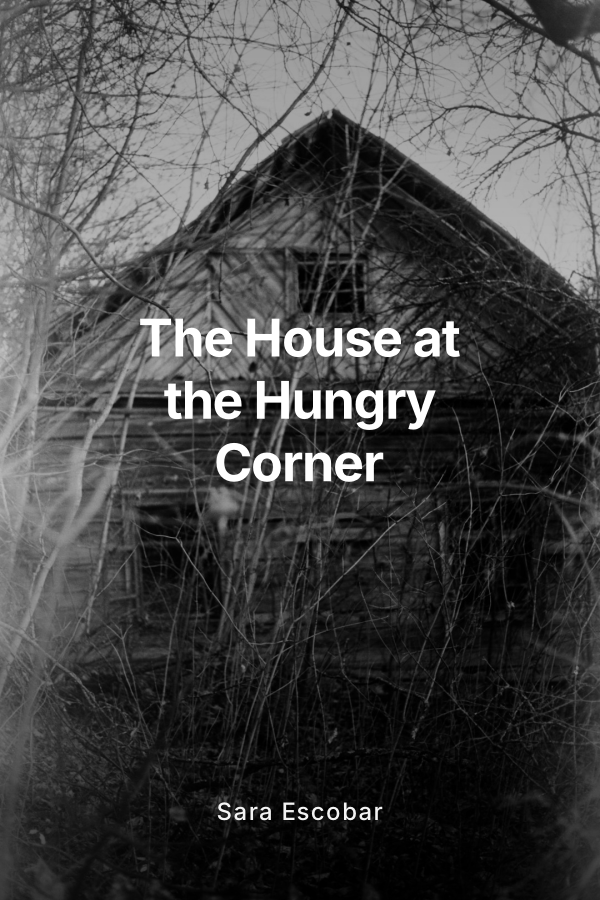
In a quiet residential neighborhood, a seemingly ordinary house becomes the epicenter of an impossible infection. It starts with a single corner of the living room that should not exist, an angle that feels slightly wrong to the eye and cold to the touch. Soon the paint wrinkles like chapped lips, drywall softens like bruised skin, and the plaster parts just enough to reveal a wet, dark opening. The corner is not structural. It is a mouth, and it does not lead into the walls. It leads into a world of bodies.
This book follows the slow, terrifying consumption of the house as the corner grows, fed by fear, proximity, and flesh, until it becomes clear that the entire building is being digested from the inside. At first, sounds rise from within the opening: distant, overlapping heartbeats, the slick slide of flesh over flesh, a chorus of breaths that never quite synchronize. The inhabitants try to rationalize it as plumbing or pests, but the corner will not stay still. It bulges, sighs, twitches. The walls around it begin to pulse. Every attempt to patch or barricade it only embeds the house deeper into its hungry anatomy.
As the story advances, the corner reveals itself not as a simple portal but as an invasive organ that rewrites architecture into living tissue. Floorboards soften into cartilage, wallpaper puckers like scar tissue, and the basement becomes a dripping esophagus that swallows light. The house itself becomes a body in transition, a new organism forming between realities. Those trapped inside experience escalating body horror: bones that itch as if they are being threaded with foreign nerves, skin that reacts to the corner’s breaths, teeth that ache when it opens wider. The book lingers on full body transformation, intrusive textures, and the visceral terror of losing agency over one’s own flesh.
At its core, the narrative explores how people respond when their most intimate environment, the home, turns predatory. Each chapter tightens the focus on the inhabitants’ physical and psychological unravelling: denial that the corner is changing, arguments over whether to flee or fight, experiments in feeding it in order to buy time, and the dawning realization that the infection is not contained by doors or property lines. The characters are forced to confront the possibility that they are not merely witnesses but raw material, that their bodies are blueprints the corner means to copy, fuse, and repurpose.
While most of the book claustrophobically charts the transformation of this single house, the final chapters peel back the scale. Flickering television screens, half-heard news bulletins, and clips shared online begin to hint at reports of “strange, organic corners” appearing in other buildings. One station shows an emergency segment about a family who broke through a warped wall and found only glistening tissue instead of studs and insulation. Another report hints at an apartment complex sealed by authorities after “anomalous structural growth” consumed several units overnight. Each account sounds fragmented and unbelievable, but together they trace the outline of an expanding phenomenon.
The book ends on an implication that is far larger and more dreadful than the original house. This was never an isolated haunting. The corner is a symptom of a deeper shift, a spreading anatomy that has learned the architecture of human dwellings and is replicating itself across neighborhoods, cities, and possibly beyond. The final image, whether through a news report playing in the background or a casual description of someone moving into a new home with a slightly too-dark, too-deep corner, leaves readers with the sense that the world is quietly sprouting mouths, and that nowhere constructed by human hands is truly safe anymore.
Across four chapters and roughly 8000 words, “The House at the Hungry Corner” will:
- Introduce the uncanny corner and the intimate horror of a single corrupted house, focusing on sensory detail and mounting dread.
- Deepen the body horror as the house is consumed and transformed, exploring in graphic, full body detail how the flesh-world asserts itself over wood, stone, and human anatomy.
- Follow the inhabitants’ desperate strategies to understand, halt, or bargain with the growing mouth while their own bodies betray them.
- Expand to a chilling, near-apocalyptic vista with news, rumors, and scattered testimonies hinting at similar corners appearing elsewhere, suggesting that the infection is only beginning.
The result is a visceral, slow-burn horror experience for adult readers who seek intense, graphic body horror and creeping cosmic dread. Without relying on familiar monsters or external lore, the book transforms the most mundane feature of a room into an unforgettable, all-consuming presence, leaving readers with the disturbing question of what might already be growing, unseen, in the corners of their own homes.