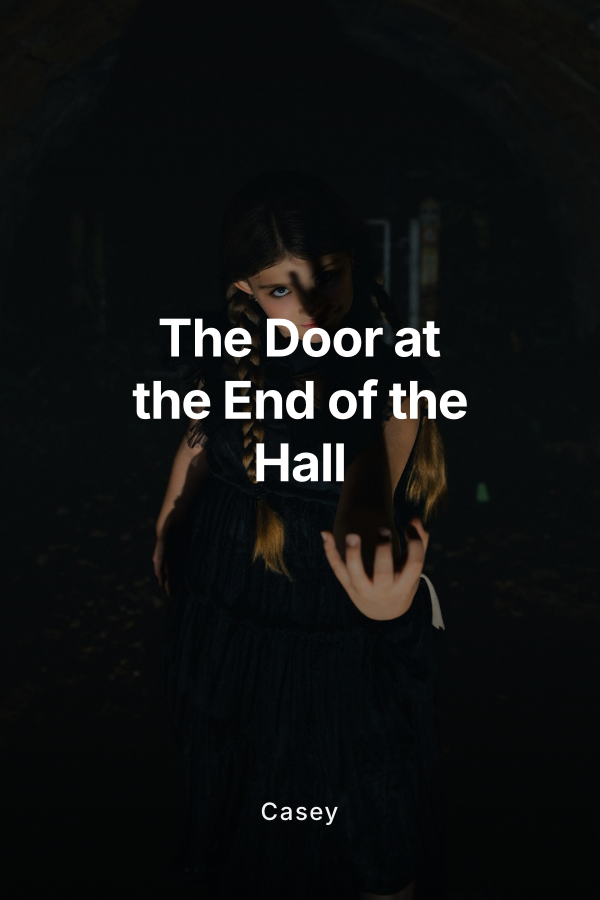
The Door at the End of the Hall is a psychological horror tale for older teens that begins as a simple trip to the bathroom and unspools into a story about trust, survival, and the way monsters sometimes wear the faces we most want to love. It follows a reliable, top‑of‑the-class girl who vanishes through an impossible door at school, the soft‑spoken boy who “rescues” her, and the slow, sick realization that the hero and the monster are one and the same.
Set against the ordinary chaos of a modern secondary school, the book uses a single impossible doorway and a subtle alternate dimension to crank up tension, rather than gore. For readers aged sixteen to seventeen, it leans into psychological fear, manipulation, and betrayal instead of graphic violence, keeping the horror in the mind rather than on the page.
At its core, the story asks one question: how well can you ever know the person who saves you?
Chapter 1: The Girl Who Was Always on Time
The story opens on an ordinary school morning that feels slightly off in a way no one can explain. The hallways smell of disinfectant and too many bodies. Laughter ricochets off beige walls. Teachers carry coffee cups like shields. It is all aggressively normal, which makes what happens next feel like a stain on white fabric.
Our protagonist, a punctual, quietly high‑achieving girl, is the sort of student teachers trust to lock up a classroom, stack the worksheets, remind them when they forget to assign homework. She prides herself on being early to every lesson. It is not just a habit. It is a promise to herself, one she has never once broken.
On this day, though, as the bell looms, she raises her hand, asks to go to the bathroom. The request is so simple that no one remembers it clearly afterward. They remember her chair scraping back, the click of the classroom door. They remember the teacher glancing at the clock and assuming she will be back before the bell rings.
The corridor she walks into is quieter than it should be. Lockers stand in straight metal lines, some half‑open, some plastered with stickers and faded photographs. There is a soft hum in the fluorescent lights that she has never noticed before. She thinks about homework, about an argument she overheard between her parents, about nothing of importance.
Then she sees it.
At the far end of the hall, where there should be only a blank stretch of brick, a door waits. It is old and wrong, a style that belongs to a much older building, the paint blistered and pale. She has walked this corridor every day for years. This door has never been there. Her brain tries to file it under renovation, prank, dream. None of the labels fit.
She tells herself she will just walk past it. She tells herself she is not that girl in horror movies who goes toward strange things. But her feet, those neat, obedient feet that have carried her to class on time since she was eleven, slow down. Curiosity is a thin, insistent hand at the back of her neck.
Up close, the door is worse. The frame seems slightly skewed, as if the building resents holding it. The handle is black and cold to the touch. As she leans in, the gap along the jamb widens, just a fraction, like an eye cracking open. A breath of air moves across her face. It smells like dust and wet stone and something sour under the sweetness, a smell you might find in a room that has not been opened for many years.
She tells herself to turn away. She reaches for the familiar comfort of the bathroom door a few steps back. Then the strange door shivers in its frame.
It opens.
Not all the way. Just enough to make the corridor tilt beneath her, enough to suck the light from overhead, enough to pull at the loose edges of her composure. The whisper of air becomes a steady pull.
She grabs for the wall. Her fingers scrape painted brick, then find nothing at all. The world pitches forward. As the main bell slams through the school, echoing from every classroom and corridor, the girl who is never late is yanked off her feet and swallowed.
The hallway is empty again.
Back in the classroom, her absence is, at first, only an oddity. The bell has rung. Desks are filled. The teacher’s voice rolls into the start of the lesson. Someone cracks a joke about her breaking her own record, probably stuck chatting in the corridor.
A minute passes, then three. The teacher glances toward the door with mild annoyance. By the ten‑minute mark, the annoyance has curdled into something colder. She does not do this. She is not the kind of girl who wanders.
At first, the concern is polite and procedural. The teacher sends a student to check the bathroom, then the nurse’s office. They come back with a nervous shrug. No one has seen her. The head of year is called. The corridors are walked, her name spoken in rising, echoing voices.
By the time the first chill settles over the staff, by the time a deputy head whispers the word “missing” into the air of the front office, she is already somewhere else entirely.
The world on the other side of the door is not hellish so much as wrong in small, insistent ways. She wakes on a floor that feels like wood but looks like stone, under a sky that has no sun yet manages to glow a dull, oppressive gray. The air has weight to it, as if she has walked into a room where someone has recently cried.
Hallways stretch out ahead of her, like the school but not, familiar and distorted at once. Some doors lead to classrooms that seem to be holding their breath. Desks stand empty, chairs slightly pulled out, as if whoever was sitting in them simply evaporated mid‑lesson. Other doors open onto streets that should not exist, lanes lined with leaning houses whose windows are too dark, too still.
She moves because the alternative is to lie there and sob.
There is only the sound of her own breathing, loud in her ears. Each step sets up a small echo that comes back a little wrong, a fraction too late. The place feels like a memory of her school that someone has copied badly, getting the major strokes right and filling in the rest from guesswork.
After what feels like hours, she sees the house.
It waits at the end of a narrow path, crooked but somehow inviting, the way a stranger’s living room might look warm from the outside. Light spills from one downstairs window, a single rectangle of yellow on gray ground. The rest of the street stretches away in a geometry that makes her eyes hurt.
Instinct screams to stay away. Hunger, thirst, and the animal need for company push her forward.
Inside, the house is cramped but neat, smelling of tea and old books. The walls are lined with shelves, though most of the spines have no titles she recognizes. The ceilings feel slightly too low. Dust dances in the air in slow spirals, as if gravity works differently here.
Then she hears a voice.
The owner of the house is mild at first glance, older than a student but younger than the teachers she knows, with a softness around the eyes that invites trust. He is the first living person she has seen since tumbling through the door. He tuts over her scrapes, clucks about parallel spaces and hungry thresholds with the practiced calm of someone who has lived with them a long time.
He offers tea. He offers explanations. Most of all, he offers hope.
Yes, there are ways out of this place. Yes, the door can open again. It is tricky, of course. It needs balance. It needs an exchange. Every magic has a price. His manner is gentle and patient, his voice just the right mix of authority and sympathy. He tells her he can help her find the way back to her world, to her classroom, to the parents who are surely tearing the town apart looking for her.
He asks almost nothing in return.
Just a small favor, he says, as he sits behind her, comb in hand. He has always liked hair. It calms him. It helps him think. If she will let him braid her hair while they talk, if she will just sit still and trust him for a while, he can plan a route home, thread it together like strands in a plait.
The request is minor on the surface, almost silly. She has let friends braid her hair at sleepovers, on buses, in boring assemblies. She tries to tell herself that this is no different.
Still, something in her stomach curls.
His hands are careful and skillful. Each stroke of the comb tugs at her scalp with a precision that begins to feel almost clinical. He talks as he works, and the more he talks, the more his words drift away from her questions. He circles back to the same phrases, the same insistence that she is safe here, that the world on the other side of the door is ugly and careless, that she should be grateful someone found her.
She opens her mouth to ask again about the way out, to say that the braiding is nice but she really has to go, that people will be worried.
The room tilts.
A black curtain slams across her vision. Her body goes loose and heavy. The last thing she registers is the feeling of her own hair wrapped tight in someone else’s fingers.
Back in the ordinary school, the search spirals from concerned to frantic. Staff sweep the grounds, then the nearby streets. Police are called. Parents arrive white‑faced and trembling. Her reputation for reliability, for always being before the teacher, turns like a key in everyone’s mind. This is not a girl who skips. This is not a girl who disappears.
It is in the second sweep of the corridor that someone spots the door.
A deputy head, flanked by another teacher, stops in front of it with a frown that quickly sharpens into something like fear. The door sits where no door should be, smug and solid. The paint looks older than the building around it. No one remembers it being part of last year’s renovations, or any year’s.
They exchange a look that says, wordlessly, “Have you ever seen this before?” and receive only the same question mirrored back.
The handle resists. The frame does not budge. In frustration and growing dread, they call for the site manager, who turns up with a ring of keys and a stubborn jaw. Metal scrapes metal. Curses are muttered. After long, sweaty minutes, the door yields a fraction.
It opens on a wall.
Brick, clean and fresh, fills the frame from edge to edge. It is as if the building was finished yesterday, the doorway sealed in from the other side with brutal efficiency. There is no gap, no draft of air, no sound.
The door is senseless. Worse than that, it is useless.
In the parallel space, the girl wakes.
She cannot move at first. Her body is a dead weight held together by ropes that bite into her wrists, her ankles, her chest. Panic arrives in a stuttering rush, all heartbeat and choked breath. She tries to scream and finds her voice small and dry.
She is tied to the floor of the house.
The wood beneath her is warm where her skin touches it, as if the building itself has a pulse. The room is bare now, stripped of the cozy details she remembers. No books. No tea cups. No soft lamp glow. It feels like an operating theatre abandoned mid‑procedure.
Footsteps move somewhere above her, slow and unhurried.
In the normal world, the school shudders on its axis. Assemblies are held. Police interviews are conducted. Rumors breed in the gaps. Some students whisper that she ran away. Others insist someone must have taken her. Teachers, trying to project calm, walk the corridors with new tension in their shoulders.
Days blur.
Then, on another morning that tries too hard to feel ordinary, the door opens again.
This time it does not call attention to itself. It does not inhale or flex. It simply waits until a boy, late for class and hurrying down the same corridor, notices it with a flicker of irritation. He is the kind who keeps his head down, who exists at the edges of social maps, neither bullied nor adored. He has seen a lot by keeping quiet. He has learned when not to ask questions.
The new door, where no door should be, is the kind of question he usually walks past.
Today, curiosity wins.
He touches the handle. The air squeezes around him. For a second, his vision tunnels. Sound drops out. When he blinks, the corridor is gone.
He finds himself in the other world, the gray‑lit maze of wrong classrooms and silent streets that holds the girl prisoner. The place hums faintly under his skin, like a phone on silent in a pocket.
He follows instinct, and something more than instinct, along paths that seem to open for him. The house at the end of the path is waiting, its window a single yellow eye in the gray.
Inside, he finds her.
She lies bound to the floor, hair braided too tight against her scalp, eyes wide and disbelieving. For her, his arrival is a miracle in worn trainers, the first crack in a nightmare that has tried very hard to convince her it is permanent. For him, the moment is an entrance he has rehearsed in his mind.
He moves to help her.
As he loosens the ropes, his hands are gentle but efficient. He tells her who he is, what year he is in, how he has heard about her disappearance every day since it happened. His voice trembles in all the right places. He swears he will get her out. There is a steadiness in him that she clings to like a raft.
They are nearly at the door when the house’s owner returns.
The confrontation is sharp and vicious, a sudden storm in a cramped space. The man’s mildness is gone, replaced by a cold annoyance at having his ritual interrupted. He moves fast. The boy moves faster.
The fight is ugly. No one comes out of it unmarked.
In the end, the boy knocks the man out cold.
The victory feels raw and unreal. The girl, half in shock, leans on him as they stumble their way back through the warped corridors, guided by his strange certainty. The world shivers, the air thickens, and then, in an instant that feels like falling both awake and asleep, they are on the floor of the school corridor, gasping under familiar fluorescent lights.
Students gather in a ring around them, phones half‑raised, faces pale. A teacher shouts. Someone calls her name.
The boy shakes her shoulder, voice urgent in her ear, pulling her back from the gray space still echoing in her mind. She wakes fully to a wall of eyes and the mortifying realization that she is sprawled almost on top of him, his arm still around her. Heat floods her face. Shame and gratitude tangle in her chest.
Her parents arrive in a rush of tears and accusatory questions. Police wrap her in blankets and ask if she remembers anything. Every adult in sight casts the boy a look of raw, uncomplicated gratitude. He is the hero of the moment, the miraculous rescuer who brought back what the world had nearly given up on.
That night, in her own bed, she cannot sleep. The sheets smell of laundry powder and comfort, but her body remembers the feel of rope. Every time she closes her eyes, she is back on that floor in the other house, feeling fingers in her hair, hearing a voice that kept repeating she was safe, she was safe, if only she would stay still and let him work.
The boy’s face keeps sliding over the other man’s in her mind, two expressions flickering in the same set of eyes. It is a trick of trauma, she tells herself. Her brain is stitching fear into new shapes.
The next day at school, she goes looking for him.
She wants to say thank you in a way that does not involve a crowd, to offer him words that belong to only the two of them. Instead, everywhere she turns, she hears his name. Students pat him on the back. Teachers beam at him. He is the center of a story everyone is telling slightly differently.
He is surrounded before she can reach him, swallowed by a ring of awe and questions. She hovers at the edge, then retreats before anyone can drag her into the spotlight.
Later, she bumps into him in the hallway.
The moment is small and private. For a few seconds, the crowd falls away. They stand close enough to feel each other breathe. Her thanks, when it comes, is raw with everything she cannot articulate. His smile is shy and self‑deprecating. He tells her anyone would have done it.
She knows that is a lie. No one else did.
They agree to meet on the roof after school, somewhere above the noise and scrutiny. Up there, under an open sky that suddenly feels too big, they talk with a strange, intense honesty that only people who have shared a nightmare can manage. They compare notes. They circle around the gaps in her memory, the places where the house goes blank and her body goes strange.
The sun sinks. The roof cools.
At some point, the conversation shifts. They are no longer talking about the house, about fear, about the door. They are talking about each other. About the way she always sits near the window. About how he notices things no one else does. Confessions slip out like breath. By the time they part, both of them know this is not just survivor’s bonding. There is something else here, something tender and dangerous.
Only the reader is allowed into the final truth.
In the closing pages, the story draws back just enough to show the boy alone. His posture changes when no one is watching. The softness in his face smooths into something blank and intent. In his bedroom, or perhaps in a shadowed stairwell no one uses, he runs his fingers slowly through a length of braided hair that is not his own, expression calm and thoughtful.
Memories surface, clear and sharp.
The house. The ropes. The endless patient braiding. The way her fear tasted in the air.
He remembers all of it, because he was not just the boy who pulled her out. He was the one who lured her in, the one who tied the knots, the one who has learned to move between faces and roles as easily as stepping through a door.
He is human and something else, a predator who understands that the easiest way to keep hold of someone is not with ropes, but with gratitude.
The final image belongs to him.
He walks down the now‑ordinary corridor where the impossible door once stood, footsteps echoing. At the end of the hall, just for a heartbeat, the smooth brick ripples like water. A faint outline of a door appears, then fades, as if taking a breath.
He smiles, small and secret.
Somewhere in the building, a girl who trusts him glances at the clock and feels a shiver run up her spine for no reason she can name.
The world stays ordinary.
For now.