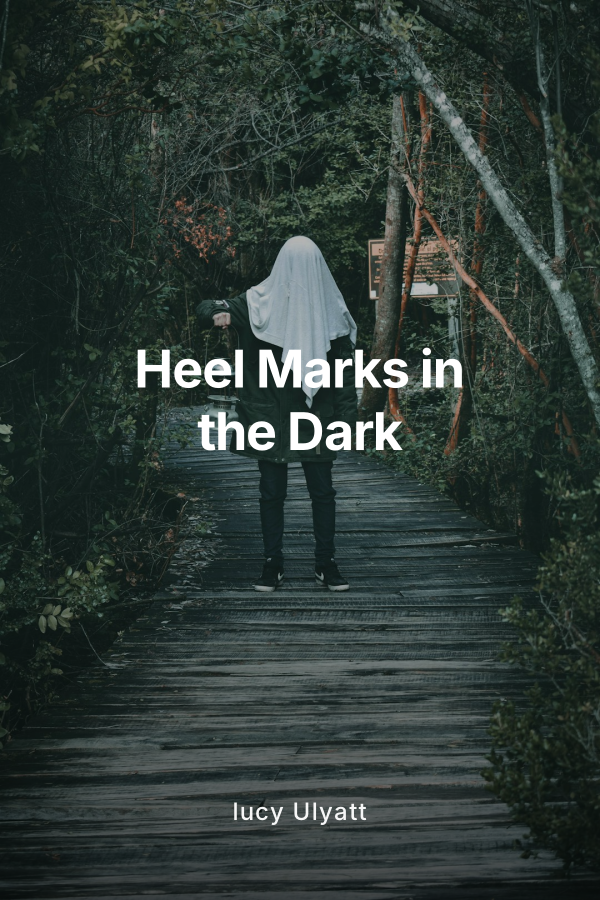
Zyrella walks where she does not belong.
In ruined warehouses, forgotten parking structures, filthy alleys that chew up stilettos and spit them out as broken plastic, she arrives in immaculate lace and polished heels. Her corsets are tailored, her gloves are silk and bone-white or funeral black, and her knife carries a single delicate engraving near the hilt: the curved outline of a high heel. She brings elegance into decay like a blasphemy, a moving contradiction that turns every crime scene into a private runway of blood.
“Heel Marks in the Dark: The Gothic Descent of Zyrella, Lady of the Last Step” is a standalone gothic horror novel that follows one woman entirely on her own terms. There are no comforting origin stories, no redemptive arcs, no softening explanations of what broke her. Zyrella simply exists: a presence, a taste, a hunger. The reader is not invited to understand her in order to forgive her, but to stand on the same edge she does and feel something raw and terrifying stir inside.
The book unfolds in a series of intimate, suffocating perspectives: Zyrella’s own cool, predatory gaze, and the brief, frantic snapshots of the people who see her last. Victim chapters arrive like flashes, just minutes or hours before a kill. They are jagged, compressed, and already haunted by something they cannot name. A stranger’s footsteps behind them. The sound of heels where heels should never be. A hint of perfume that does not match the grime around them. The reader knows what is coming. The victims do not. That gap is where the dread lives.
Zyrella’s chapters are different. Inside her head, the world is not chaos but choreography. Every setting that rejects her beauty becomes a stage she intends to own with blood. A crumbling stairwell becomes a place to test the echo of her stilettos against the reedy whimper of a man who thought he could cross her. A rooftop of rough gravel is transformed into an altar where a body can fall forever into the city’s indifferent throat. A fluorescent-lit storage unit, stacked with anonymous boxes, becomes a private gallery for screams. Her elegance is never diluted by her surroundings. If anything, the uglier the environment, the more fiercely she shines.
The novel centers around one overarching hunt and one orbiting echo, rather than a catalog of endless deaths. The first major murder introduces Zyrella as she truly is: not a rumor, not a silhouette, but a living, breathing weapon wrapped in lace. We watch through Marcus’s dying eyes as she carves, twists, and silences, her boots clicking against rooftop concrete and her knife working with deliberate, surgical cruelty. Here we see her signature for the first time in full: the heel tattoo, etched into living flesh, claimed from the victim and left behind as a strip of exquisite horror. Sometimes it is a piece of skin. Sometimes an entire limb. Always a mark. Always a message.
From that act forward, the book is less a crime story and more a study in aesthetic obsession. Zyrella is not killing to survive, or to right a wrong, or even to climb a criminal ladder. She is building a private mythology, one heel stroke at a time. She chooses places where she does not fit on purpose, savoring the dissonance. Damp stairwells, graffitied underpasses, budget motels with buzzing neon. The contrast between her immaculate presentation and the filth she walks through sharpens the horror. Readers are constantly reminded that she does not belong in these spaces and yet, by the time she leaves, she owns them more completely than anyone else ever has.
The second central murder is not just another kill. It is the echo of the first, shaped by what Zyrella has learned about her own appetite. The victim’s POV is a brief, flashing panic, while Zyrella’s own chapters stretch every moment around the act, slowing time to a viscous drip. Every cut has intention. Every scream is tuned. The gore is not background; it is the language she speaks. Blood patterns across concrete, flesh becomes material, and bodies are canvas and clay. She engraves the heel, takes her trophy, and arranges what is left with reverent, terrible care.
Throughout the book the investigation exists only as distant noise. Sirens in the background. A news report flickering on a television in the corner of a dingy bar. An overheard argument about a “heel mark killer” who leaves skin behind. Zyrella listens, sometimes, not out of fear but out of curiosity. How are they describing her? What parts of her art do they miss? She is a ghost in her own case file, a rumor elevated to urban legend before she is ever seen.
What binds everything together is the way the novel recruits the reader’s own shadow. The violence is graphic, detailed, and relentless enough that anyone with a pulse will want to look away. Yet the narrative’s intimacy with Zyrella’s inner world makes looking away feel like a betrayal of a secret self. Her detached focus, her fascination with the gap between beauty and rot, whispers to the parts of a reader that are tired of pretending to be gentle. As her kills unfold, the reader is pulled into complicity, feeling the heels beneath their own feet, the weight of the knife in their own gloved hand. Horror is no longer just witnessing; it becomes a quiet, shameful identification.
Because Zyrella has no backstory spelled out in neat scenes, she becomes less a single person and more a mirror dressed in lace. The glimpses we get are oblique and atmospheric. A childhood memory might flicker in the shape of a stair railing. An old humiliation might surface as a passing adrenaline spike when someone looks at her too long. Nothing is explained in a way that lets readers file her away as “broken by X” or “damaged by Y.” She simply is. To understand her is to accept that there may be no reason, only appetite and aesthetic.
By the time the narrative bends toward its final act, the city has begun to whisper about her in earnest. Papers call her monstrous. Online forums fetishize the crime scene photos and speculate about the meaning of the heel tattoos. People talk about the elegance of the killer’s rumored attire. The myth of Zyrella starts to float free of the actual woman, and she watches this with a curious, nearly amused detachment. Others are painting over her art with their own fantasies. She decides she deserves the last word.
The climax unfolds on a night that feels carved out of the world. The city is awake yet muted, its noises held at a distance as if behind heavy velvet drapes. Zyrella dresses with ceremonial care: a black dress that skims her curves, a black corset pulled tight enough to make every breath deliberate, lace gloves that hide nothing and announce everything. Her heels are perfect, sharp, and unapologetically impractical for wherever she is going. She steps out not for another victim, but for herself.
What follows is not a frantic chase but a slow, deliberate walk toward the edge of everything. The police are closing in. We taste it in the rhythm of far-off sirens, in the low hum of radios, in the way headlights sweep across brick as if searching for her shadow. Yet from her perspective, it is all distant, muffled, irrelevant. For the first time, she is not staging someone else’s death. She is staging her own.
The final sequence is not chaos. It is stillness sharpened into a blade. She reaches the chosen height, feeling the roughness of the ledge under her heels, the night air stroking the hem of her dress. Blood on her corset, the memory of her last kill still warm on her skin, she turns toward the void with a smile that is as much invitation as farewell. The book lingers there: on the curve of her lips, the way the city lights catch the faint film of red, the odd serenity in her chest as gravity waits.
There is no explained motive for her suicide, no sudden flash of regret or revelation. The police draw nearer. The reader can almost hear doors slamming open in stairwells, boots pounding on metal steps. But Zyrella’s attention is elsewhere, focused entirely on the exquisite sensation of choosing her own last step. For once, the heel will not tattoo someone else’s skin. It will mark the empty air.
The novel ends in mid-descent. Time stretches, language becomes almost lyrical. We feel the fabric of her dress flutter, the wind threading through her hair. Her bloody smile does not falter. Instead of screaming, she narrates how right, how clean, how beautiful this moment is to her. She has turned herself into her final artwork, an image that no one can seize as evidence, a fall that can never be completely reconstructed. The sirens swell but never overtake her. The text cuts out in the dead of night, on the sensation of falling and the certainty of her happiness in that fall.
No landing. No body. No neat confirmation.
Just the echo of heels, the memory of blood, and the disquieting realization that some part of the reader has traveled with her over the edge.
“Heel Marks in the Dark” is designed to unsettle on more than one level. It is a gothic descent without a handrail, a love letter to the friction between beauty and horror, and an invitation to stare directly into the part of yourself that watches Zyrella work and feels, in spite of everything, disturbingly understood.