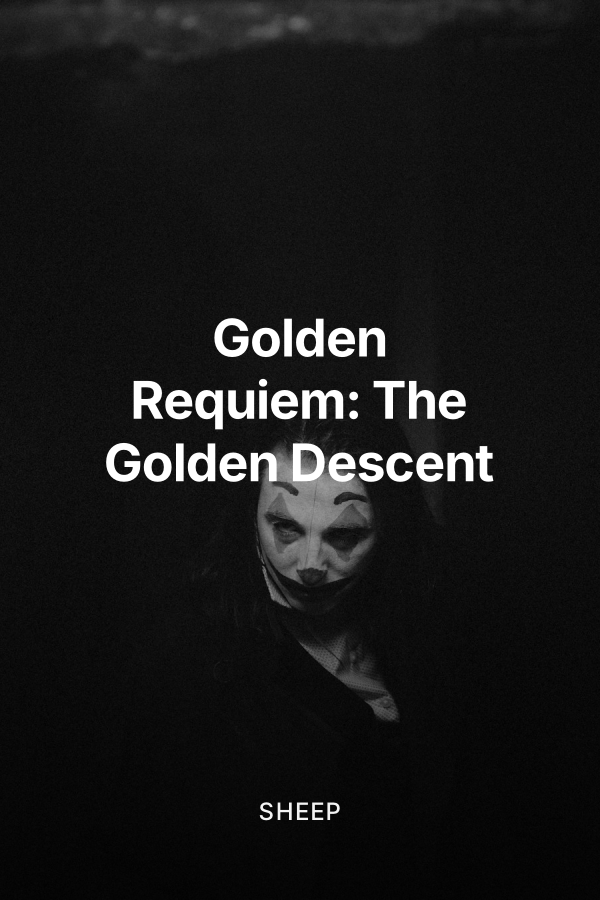
Golden Requiem: The Golden Descent is a visceral horror novella that serves as the opening movement of a larger symphony of ruin and recovery. It follows Goldwyn, a once‑royal Bromino Egypia who remade herself into a living weapon and demanded worship as a god, only to be lured into a cursed forest, devoured by a golden apple, and crushed alive inside her own gleaming tomb.
The story begins in a forest where trees bleed real blood and the ground is carpeted in pale, lunglike mushrooms. Goldwyn patrols this territory with mechanical confidence, nanoskin feet grinding fungal bodies beneath her. She is hunting cultists or being hunted by them; it hardly matters. Whatever crosses her path dies in the name of her self‑proclaimed divinity. That certainty fractures when she finds an impossible sapling of metallic bark bearing a single golden apple. Her mind recognizes the trap, but her godhood refuses restraint. She eats.
The apple blossoms into liquid metal inside her, turning her prized organic stomach and modified body into a crucible. Gold floods her organs, bones, and plating, hardening into an external shell while filling every space within. She is encased, compressed, and yet unable to die, kept conscious by a core designed to outlast any trauma. This is the central horror of The Golden Descent: not death, but the refusal of death. Goldwyn becomes a statue in the forest clearing, an icon of arrogance caught mid‑struggle, while cultists chant in adoration at her final expression of rage and disbelief.
From here the narrative abandons comfort. The bulk of the novella traps the reader inside Goldwyn’s undying awareness. The crushing never stops. Her plating folds like paper. Her organic lungs and stomach rupture and compact into paste. Time ceases to function in any human sense; seconds bloom into eternities, eternities collapse into moments. Warnings flood her brain, yet her engineered core insists on survival. She cannot move, cannot scream, cannot even cry, only feel.
To cope with the unending compression, Goldwyn’s mind fractures into analog‑horror dreamscapes that run parallel to the physical torment. She finds herself in a white garden of impossible pillars carved with living hieroglyphs that rearrange into accusations: fraud, tyrant, worthless, alone. She sees her reflection vomit gold. A chorus of voices, all wearing her voice like damaged audio, mocks her as a “little god in her golden tomb.” These visions are not respite. They are curated torments drawn from her own history and self‑image, looping and distorting like a broken tape.
The novella shifts between spaces that feel like channels on a haunted television:
- A flickering white garden with moving script and a golden pool that shows her many faces.
- A palace on her home world where faceless servants bow, only to reveal there was never love, only fear. A black cat sits on her throne and calls her nothing.
- A sterile laboratory where scientists dissect, modify, and evaluate her as a subject rather than a sovereign, discussing her resilience and psychological data while ignoring her desperate, unheard screams.
- The modification chamber where her body was first stripped, mechanized, and turned from royal flesh into a weaponized experiment.
Each scene exposes another layer of her former cruelty and hubris while mirroring her current helplessness. The result is a sustained, claustrophobic psychological horror in which reality and hallucination grind against each other.
Gradually, the analog horror pattern becomes clear: every escape is another loop of the same spiritual trap. Goldwyn relives the forest and the apple multiple times, each iteration faster, more inevitable, framed as an endless rerun of her own mistake. She sees a cosmic archive of other golden statues, realizing with nauseating awe that she is not unique, just one of countless crushed beings who took the same bait. In this mass graveyard of divinity and desire, even her suffering loses the luxury of uniqueness.
As her mind deteriorates, the voices go from mockery to revelation. She realizes that the torturer, the judge, the jeering god‑chorus is her as well. The golden prison is not only around her but within her; she has become her own eternal tormentor. Her identity splinters into rooms inside her psyche: one filled with victims who only stare; one filled with all her past selves blaming and devouring her; one final room with a mirror that shows the truth that remains after pride, cruelty, and divinity are stripped away. What is left is not a god, not even a villain, but a void shaped like a person, defined entirely by need.
This is the true descent of the novella: Goldwyn’s transformation from tyrant to supplicant. The crushing does not just destroy her body; it re‑writes her. Isolated for an unmeasurable span, tormented by her own mind’s analog nightmares, she is processed down to raw hunger for connection. She would surrender anything once treasured—status, dignity, identity—for a single genuine touch. Her fear of being alone eclipses every other fear.
At the heart of this pit lies a small, terrible pivot. When a figure appears in her garden of white, holding out a hand, she takes it. The contact is shattering in its simplicity: warmth, solidity, otherness. She collapses into their arms and thanks them without even knowing who or what they are. When they vanish, that one moment of comfort becomes the cruellest gift. Now she knows what she is missing, and she will do anything to feel it again.
By the final movements of the book, Goldwyn openly abandons her former persona. The god who ruled through fear begs to be ruled. She declares herself broken, desperate, and willing to submit to anyone who will promise presence over solitude. She pleads not for power, but for the torture to have meaning, for any being to stay with her in the dark. Her prayer is not to be a god again, but to be held.
The climax comes as the crushing finally, almost imperceptibly, shifts. External voices break through the gold, announcing “extraction protocol,” speaking clinically of trauma and survival. Light seeps in through hairline fractures. Air grazes ruined lungs. Goldwyn comprehends with sick dread that revival is coming. The horror turns a new face: she must now reenter a world as the shattered thing she has become, aware that the proud self she clung to is gone.
The voices in her mind remind her of every vow she made in terror: to grovel, to obey, to abandon every claim to superiority if only she is not alone. She accepts that the gold has done its work. She is no longer a god, no longer royalty, but a creature of need, permanently rewritten by the tomb that held her. As the golden shell cracks, she whispers “Please” one last time, no longer sure what she is asking for. Freedom? Death? Ownership? Connection? The plea itself has become her identity.
The novella ends on the moment of breaking. The golden tomb splits. Light, sound, and the taste of air rush in. What emerges is explicitly not a god. It is Goldwyn in her new, ruined state, the subject of the next book’s story: a being crushed beyond old repair, yet still alive enough to ache for affection. Her core still beats. Her mind still remembers every second of the crushing. And somewhere beyond the shattering shell waits the next movement of Golden Requiem, where an analog‑horror deity that used her as a toy and a wary monk who finds her limp beside a cracked statue will shape what she becomes.
Positioned as the series’ prelude, The Golden Descent is not about redemption yet. It is a requiem for the old Goldwyn, a slow, methodical stripping away of divinity until only a begging heart remains. The book closes at the precise threshold between tomb and world, between endless inner crushing and the first uncertain touch of outer reality. The revival has been foretold. The craving for warmth has been carved into her soul.
Golden Requiem begins here, with a god unmade and a question left hanging in the air between the cracks of a golden prison: when a tyrant has been broken into pure need, what kind of world will take her in?