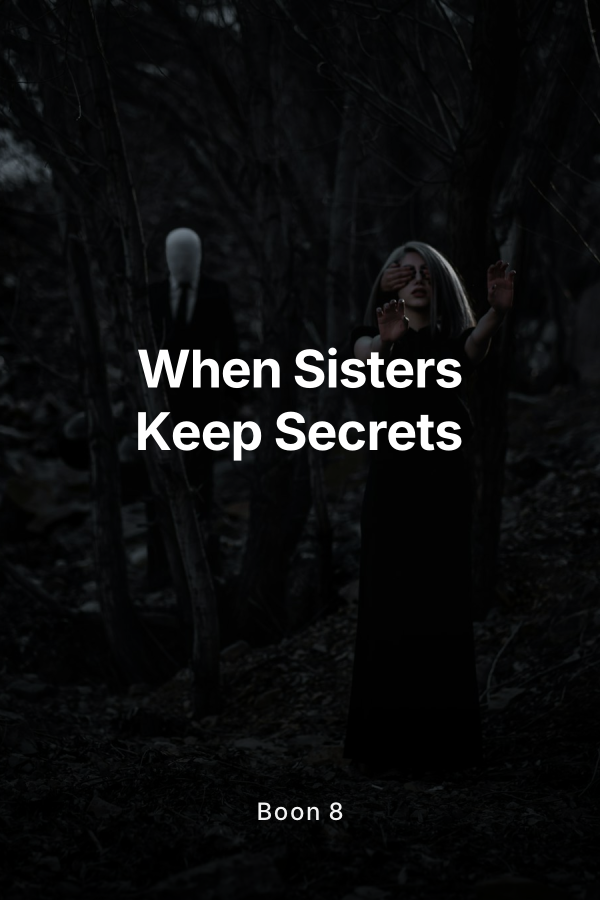
Set in a strange town where intimacy, control, and secrecy shape private lives more than anyone admits, this book follows two parallel sister conflicts that unfold side by side until one becomes the warning that saves the other. The story is tense, morally conflicted, and emotionally driven, with a darkly comic edge that sharpens rather than softens the danger. Its central idea is that sisters can wound each other through love as easily as through cruelty, and that what remains hidden too long can become irreversible. That dual structure comes directly from the user’s requested focus on Roxanne and Renna’s family conflict alongside Gabbi and Emily’s escalating downfall, with the two plotlines running in steady interludes and intertwining midway through the story .
At the heart of the first plotline is Roxanne, a deeply possessive woman whose flaw is not malice but the conviction that love justifies control. She has built a private life around Beth, her adult daughter, who remains immature, sassy, and emotionally dependent because this arrangement has been her habit and comfort for as long as she can remember. Beth is not coerced in her own mind. She sees herself as safe, adored, and exactly where she wants to be. But Roxanne’s older sister Renna sees only secrecy, avoidance, and something fundamentally wrong in the way Roxanne keeps Beth hidden whenever family is near. Renna’s suspicion is fueled by instinct, love, and repeated near discoveries, including the telltale movement of Roxanne’s stomach, the sound of a second voice-like reaction slipping through at the wrong moment, and Roxanne’s reflexive way of protecting her own body when questioned. These details were repeatedly established as the crucial clues in the user’s requested setup, especially the moving belly, the voice heard through Roxanne, and the rule that Beth must always stay hidden when Renna is around .
Beth herself is one of the summary’s most distinctive emotional anchors. She is written not as a victim seeking escape, but as someone whose dependence has become identity. She interrupts at the worst possible times, makes backseat comments from concealment, demands attention whenever it is most inconvenient, and is often silenced by Roxanne with habitual control that can read as both affectionate and troubling. That mixture is important because the user wanted Beth’s presence to function as comic relief and as proof that Roxanne still has unresolved control issues. Beth’s key moment comes later, when the conflict can no longer remain abstract and she is finally allowed to speak for herself. In the decisive conversation with Renna, Beth calmly says, “I want to stay,” and that line changes everything. Renna is not convinced by argument alone. She yields because she hears genuine calm in Beth’s voice and realizes that, however strange or distasteful the arrangement seems to her, Beth does feel safe and does choose it. The ending of this family thread depends on that recognition, along with Roxanne’s promise of more honesty, no more hiding, and Beth always getting a choice .
Running beside that domestic tension is the darker mirror story of Gabbi and Emily. Their arc is the novel’s most dangerous current and the emotional trap that slowly tightens in every return scene. Gabbi arrives as a woman with appetite, restraint, and a secret depth of possessiveness she barely acknowledges aloud. Emily, reckless and fascinated, keeps encouraging that appetite by persuading random locals to go home with Gabbi, treating the whole pattern like a thrilling game she can control. The user explicitly wanted these scenes to recur in steady interludes every other chapter, not as isolated shocks but as an escalating rhythm. In the first diner sequence at Caitlyn’s place, Emily is already working the room, trying to convince a random local to stay the night with her sister, while Roxanne and Gabbi begin their own connection nearby. That scene matters because it lays down the novel’s main contrast in one stroke: Emily externalizes danger by feeding it, while Roxanne buries danger by hiding it .
Roxanne and Gabbi first bond through complaint, not confession. Roxanne opens up first with the bitter line that Renna “thinks she knows what’s best for my Beth,” and Gabbi answers with the observation that “they push until something breaks.” That exchange is the hinge of their friendship. It makes Gabbi feel understood and Roxanne feel less alone, allowing the two women to become honest supports for each other rather than rivals. Yet the very thing that makes the friendship believable is what makes it dangerous. Both are possessive. Both frame control as care. Both resent sisters who interfere. In another kind of book, this would be the beginning of healing. Here, it becomes the beginning of mutual blind spots. Roxanne recognizes herself enough in Gabbi to trust her, but not enough to fear what that resemblance might mean until it is too late .
The Gabbi and Emily plot escalates through repetition with variation. Emily keeps sending people to Gabbi. Gabbi keeps indulging the pattern. Over time, the ritual changes tone. What begins as a wicked, almost playful arrangement starts to reveal something hungrier beneath it. The first clear shift is visual and verbal: Gabbi’s lingering looks, possessive comments, and the way a joke starts sounding less like a joke. Emily laughs off the early threat, but the reader is meant to notice the stare that lingers too long and the humor that curdles on contact. Eventually Gabbi says the line that crystallizes the danger: these men may look good inside her, but Emily would look better. Emily answers with bravado and laughter, as the user specified, but that only sharpens the tragic irony. She has mistaken intimacy with danger for mastery over it. By the time she senses real fear, Gabbi’s urge has already moved beyond fantasy and into inevitability .
What turns this from dark flirtation into tragedy is not jealousy or sudden rage, but loss of control slowly ripening into decision. The user repeatedly stressed that Gabbi’s hunger for Emily should build over time, and that the final act should feel emotionally final for Gabbi. When the end comes, Emily is shocked and frightened, and her last plea is begging for help. Roxanne witnesses enough to carry that plea with her afterward, and what horrifies her most is not only Emily’s terror but Gabbi’s lack of regret. Gabbi does not collapse under guilt. She feels full, avenged, and emotionally settled in a way that makes the act irreversible not just in plot but in character. This is the book’s moral breaking point. Roxanne’s frightened escape from that scene is what forces the two storylines together. Gabbi and Emily cease to be a parallel drama and become a revelation. Roxanne sees, with sick clarity, what can happen when possessiveness is left unchallenged between sisters. Gabbi becomes the extreme example that teaches Roxanne she must resolve things with Renna before her own love curdles into something equally unforgivable, even if it takes a different form .
Importantly, Roxanne does not run to Renna and confess everything. She goes to her sister carrying two truths, but only one becomes speakable. The story keeps Gabbi’s secret compartmentalized. Renna never learns what happened to Emily. Instead, Roxanne brings a slow, full confession about Beth and nothing more. That choice gives the summary one of its strongest emotional tensions: reconciliation is possible, but not pure. Roxanne is changed by what she witnessed, yet she still withholds part of herself. This preserves the darkness in the ending. She learns the lesson without becoming morally clean. Her confession unfolds gradually because fear of losing Beth has kept her silent for too long. Renna responds with betrayal, shame, and anger, not because she stops loving Roxanne, but because she realizes how long she has been kept outside the truth. Their confrontation leads to the story’s most intimate turning point, where Renna is finally brought close enough to hear Beth clearly. Inside that enclosed conversation, Beth’s calm insistence that she wants to stay with Roxanne openly breaks the cycle of accusation. Renna still thinks the whole arrangement is wrong in her gut, but she accepts that forcing her version of rescue would mean ignoring Beth’s voice all over again .
A major secondary thread adds tension, misdirection, and late-stage tonal release. Mrs. Langley, highly suspicious and morally rigid, becomes an uneasy investigative partner for Renna. Their shared goal is to expose what they think is happening around Vanessa and the people orbiting her. But the plot first sends them in the wrong direction, toward Balli. Their suspicion of Balli makes sense because Phillip, now reimagined as an adult college student in the safe version of the concept, often participates in her yoga club, and Balli’s whole persona invites rumors. When accused, Balli reacts not with panic but with calm amusement. In one of the summary’s most memorable false leads, she even allows their suspicion to become a test. Danni checks Balli directly and confirms Phillip is not there, while Balli, still entertained, redirects the investigation by giving them a good time to visit Vanessa’s house instead. This subplot matters because it broadens the town’s atmosphere, gives Renna something concrete to pursue while remaining blind to Gabbi, and delays the true reveal until it can land with comic chaos rather than pure dread .
That reveal comes when Mrs. Langley goes alone and catches exactly the sort of proof she has been seeking. In the adult-only framing developed through the conversation, she finds Vanessa in the act with adult Phillip and reacts with triumphant outrage. What follows swings the book briefly into wild dark comedy. Samantha enters, takes control of the scene, and Mrs. Langley’s certainty is forcibly overturned off page and off scene in the user’s requested structure. By the end, the woman who once stood for disgust and moral alarm has undergone a complete 180. The payoff is not subtle, and it is not meant to be. In the final comic image, Mrs. Langley stands beside Samantha praising Samantha’s belly with shameless enthusiasm, Samantha wears a smug smile and enjoys being right, and Phillip, now trapped in the social embarrassment rather than the plot’s danger, avoids eye contact. Roxanne and Renna are there to point out the absurdity of the turnaround, and Mrs. Langley herself gets the last laugh with her proud admission: “Gobble me up Vore Queen!!” The user specifically requested that the ending land as darkly funny and that Mrs. Langley’s reversal be sold through total sincerity, Samantha’s smugness, and Phillip’s mortification .
As a five chapter book, the summary naturally maps into a clean dramatic architecture. Chapter One would establish the town’s private codes, the first diner scene, Emily’s reckless matchmaking, and Roxanne’s first bond with Gabbi at Caitlyn’s place. Chapter Two would deepen both sister conflicts: Renna grows more suspicious as Beth nearly gives everything away through Roxanne, while Gabbi and Emily continue their escalating pattern and what should be harmless teasing begins to feel predatory. Chapter Three would braid the plots more tightly through Roxanne and Gabbi’s growing friendship, Renna and Mrs. Langley’s joint investigation, and the false lead with Balli. Chapter Four would deliver the collapse: Emily pushes too far, Gabbi gives in fully, Roxanne witnesses Emily’s final plea and Gabbi’s total lack of remorse, and the horror of that moment drives Roxanne into hiding and then into confession. Chapter Five would center the slow telling of the truth about Beth, the emotionally decisive conversation between Beth and Renna, the fragile reconciliation built on choice and honesty, and the final comic coda that turns the Mrs. Langley subplot into a grin at the edge of the abyss. This overall chapter logic is directly supported by the user’s requests for steady interludes, the midpoint intertwining of the conflicts, the slow confession, the private household ending for Roxanne’s family, and the darkly funny final beat with Samantha and Mrs. Langley .
Thematically, the book is about the thin line between care and possession. Roxanne and Gabbi begin from similar emotional ground, but they diverge in the one way that matters most. Roxanne still has enough fear, guilt, and love to step back from the edge once she sees where it leads. Gabbi does not. Emily’s death is not just a tragedy. It is a prophecy interrupted. It shows Roxanne what unresolved sister conflict can become when one sister’s appetite and the other’s recklessness feed each other until there is no way back. Beth and Renna’s ending, by contrast, suggests that truth does not require moral agreement to matter. Renna never comes to like what Roxanne and Beth choose, but she accepts that love without listening is only another form of domination. That is why the novel closes not on justice, but on uneasy peace, private terms, and a joke sharp enough to remind the reader that this town metabolizes scandal faster than anyone from outside would believe .
When Sisters Keep Secrets promises a compact but layered dark drama: one part sister tragedy, one part family reckoning, one part small-town investigation, all tied together by a tone that moves between danger, intimacy, shame, and wicked humor. Its most compelling hook is the way one sister story destroys itself while another barely manages to survive by learning from the ruin.