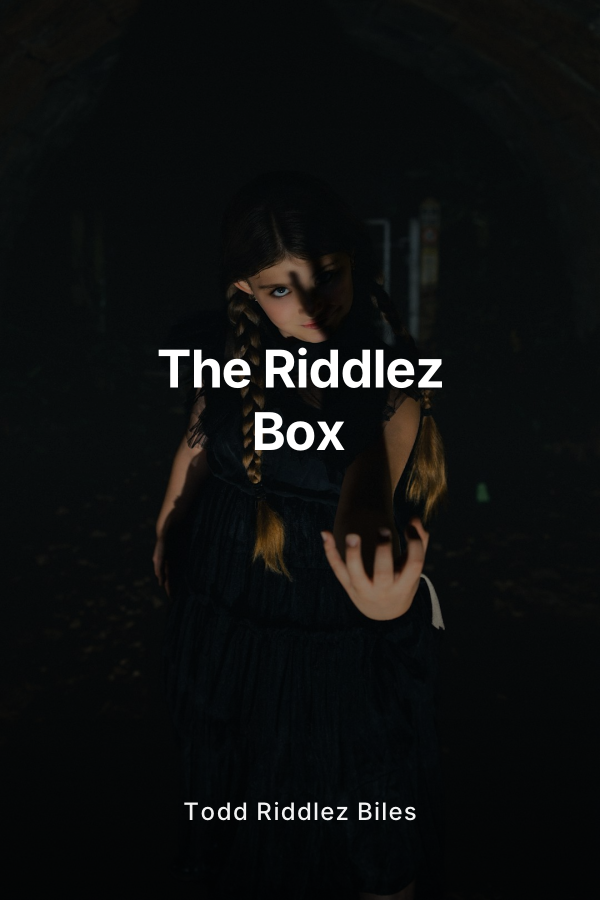
In the haunted woods outside New London, where broken tents rot beneath tangled roots and the wind seems to remember the dead, a legend waits to be reopened. Long before the town became a place of silence and superstition, a carnival once bloomed there in the early nineteenth century, bringing color, music, and wonder to a fearful community. At the center of it all stood Riddlez, the carnival’s first clown, a strange and charismatic figure whose riddles entertained the crowds and unsettled the town’s most cautious minds. But fear has a way of curdling wonder into violence. When the townspeople turned on the carnival out of terror for the unknown, they burned the grounds on Halloween night and believed they had erased Riddlez forever. In the ashes, however, they left behind one final relic: a charred jack-in-the-box known as The Riddlez Box, a cursed object bound to his rage and his return. The legend that grew from that night became the kind that children whisper and adults dismiss, until five college friends decide to test it for themselves.
Drawn by curiosity, bravado, and the intoxication of urban myth, the friends venture deep into the woods to the abandoned carnival site, where the ruins still seem too intact to be natural. Their arrival marks the beginning of a nightmare that is less about ghosts than about punishment. When one of them turns the handle of The Riddlez Box, the ground seems to shudder with memory. From the charred darkness comes the first sign that Riddlez has awakened, and what follows is not a simple haunting but a calculated campaign of horror. Carnival music begins to play from nowhere, tinny and warped as if emerging through a century of smoke. Then comes the sound of screaming, not from the woods around them, but from somewhere deeper, as though the echoes of the long dead townspeople have been trapped inside the ground itself. And finally, Riddlez speaks, not in plain threats, but in riddles that twist every warning into a trap, turning language itself into a weapon.
What makes Riddlez so unforgettable is not only the legend of his murder, but the grotesque form of his revenge. He returns wearing neon green and black makeup smeared across a mask made from the skin of his victims, a nightmarish disguise that turns clown imagery into something grotesquely ceremonial. He is no longer merely a man killed by fear. He is the embodiment of fear made intelligent, theatrical, and hungry. He does not simply chase his victims. He isolates them, toys with them, and forces them to unravel under the pressure of dread, guilt, and mistrust. The five friends, already uneasy in the face of the legend, begin to suspect one another as the woods shift around them and the carnival ruins reveal hidden passages, dead ends, and relics of the past. Each step forward feels like a mistake, and each attempt to escape only draws them deeper into the performance Riddlez has prepared for them.
As the night advances, the group’s confidence collapses into panic. Riddlez manipulates the terrain and their senses, using carnival music, shadows, and whispered riddles to make them question what is real. The old grounds become a stage where the past is violently reenacted, and the friends are forced into the same role as the townspeople who once destroyed him. But unlike the fearful villagers of New London, the students cannot burn away what they do not understand. Their disbelief becomes a weakness, then a liability, and finally a death sentence. One by one, the truth of the legend closes around them: Riddlez did not merely survive the fire in spirit. He has been waiting for the handle to be turned, for the curse to be renewed, and for fresh victims to feed the rage buried beneath the carnival ash.
The story drives toward a twisted and horrifying end, one that leaves no comforting survivor and no clean moral lesson. The final revelation is that the box was never just an object to summon him. It was a lock, a promise, and a warning, and by opening it, the students have not awakened an old monster so much as released the unfinished vengeance of a wronged killer clown who has spent generations learning how to turn fear into art. In the end, New London’s oldest sin is repeated by a new generation: the refusal to respect the dark when it asks to remain buried. The result is a descent into madness, carnage, and a final image of the carnival alive again only in screams, where Riddlez stands at the center in his skin-faced mask, grinning beneath neon paint as the box continues to play.