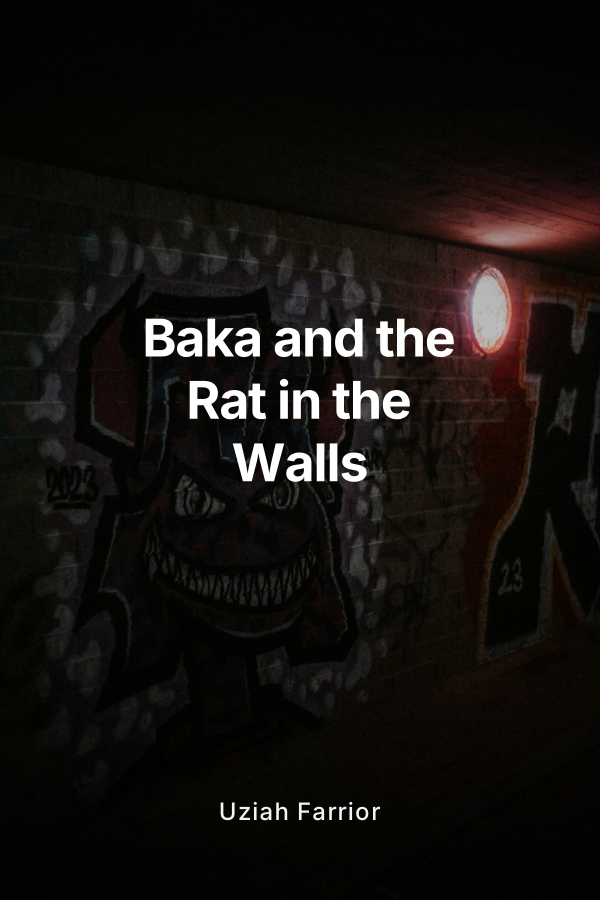
In a collapsing high school overtaken by filth, panic, and a living infestation in the walls, a foul talking rat terrorizes students with a campaign of stalking, slobbering pursuit, and graphic violence. The creature is not just an animal. It is a nightmare with a voice, a taste for fear, and a cruel intelligence that turns the school into its hunting ground. It lurks in vents, emerges from ceilings, chases shrieking teenagers through dark corridors, and feeds openly on the weak, transforming the school into a nest of dread and decay. The user-defined premise centers on this disturbing horror setup, along with the rat’s habit of chasing children, the students’ fear, the school-wide nest, and the body horror tone
At the center of the story is Baka, a 14-year-old Ghanaian boy whose courage is born not from heroism, but from grief and rage. While the other students flee, Baka has a reason to stand and fight. The rat personally reveals that it killed Baka’s father, Big Baka, turning the horror from a school massacre into a personal war. This confession becomes the emotional core of the story. Baka is no chosen savior in the beginning. He is a frightened boy cornered by trauma, trapped inside a school being consumed from within, and forced to face a creature that has already devoured part of his life. The uploaded context specifically establishes Baka’s age, Ghanaian identity, and the rat’s confession about killing Big Baka
The setting is not a normal school gone bad, but a full infestation zone. Hidden behind lockers, above ceiling tiles, and inside ventilation shafts is a sprawling rat’s nest that has spread like a disease. The nest is described as a grotesque territory filled with trash, rot, fan-obsession paraphernalia, and degrading debris, including Miku posters, a filthy PS4, and stained socks, making it feel both absurd and revolting. This detail gives the horror world a distinct identity: disgusting, surreal, and steeped in the habits of a monster that is not merely savage, but bizarrely human in its tastes. The school becomes less a building than a body being hollowed out and repurposed by vermin. These nest details are explicitly present in the provided file context
As the terror escalates, Baka is isolated by fear, disbelief, and the sheer abnormality of what he is facing. Adults are ineffective. Students are prey. The rat dominates the halls through speed, filth, and psychological cruelty, speaking to its victims and turning every pursuit into a performance. It does not simply kill. It humiliates, toys with, and consumes. The summary’s horror remains committed to a disturbing tone rather than comic relief, in line with the user’s instructions for a graphic, scary story where the rat eats kids and the terror stays intense
The turning point arrives late and with wild unpredictability. Baka, pushed to the edge, eats fufu, and this ordinary act triggers an extraordinary transformation. Rather than a solemn mythic awakening, the power comes suddenly and strangely, matching the requested tone of unexpected chaos. From this meal, Baka gains a supernatural weapon: a flaming rat tongue, a grotesque and fiery mutation that becomes his only means of matching the monster’s unnatural power. This transformation shifts the story from survival horror into creature confrontation without losing its brutality. The user’s concept clearly specifies that Baka only gets his power late in the story after eating fufu, and that in the final struggle he manifests a flaming rat tongue
Another major figure in the climax is Spedyetta, the rat’s sister and lover, a transgressive and disturbing character whose presence makes the horror even more warped. She enters as an unstable ally, turning against the rat after being degraded and cast aside by him. Her motives are not noble. They are rooted in humiliation, resentment, and the ugly politics of monstrous intimacy. By joining Baka in the final conflict, Spedyetta adds tension rather than comfort, because her allegiance is based on chaos, not morality. Her role in the final battle, and the ugly emotional logic behind her betrayal, are both part of the user-provided concept preserved in the context file
The climax is a savage confrontation deep inside the school’s infected interior, where Baka and Spedyetta face the rat among the refuse of its nest. Fire, saliva, violence, and revenge collide as Baka unleashes his flaming tongue in a grotesque counterattack against the beast that murdered his father and devoured his classmates. The fight is not clean, noble, or triumphant. It is frantic, ugly, and soaked in disgust, exactly in keeping with the requested disturbing horror style. Baka is not transformed into a polished hero. He survives by becoming just monstrous enough to answer the thing in the walls.
Spedyetta’s end is as bleak as her existence. After helping in the struggle, she turns to dust. Baka does not mourn her. Instead, in a final gesture of disrespect and revulsion, he spits on what remains of her. This act underscores the emotional tone of the ending: not healing, not redemption, but contempt, exhaustion, and spiritual damage. The user specifically defined that Spedyetta turns to dust and that Baka responds by spitting on her out of disgust and disrespect
Yet the rat is not truly finished. The ending embraces a cliffhanger in which the apparent victory collapses into one last obscene reversal. The rat announces, “I’m not really dead, chat,” preserving the exact internet-tainted line requested by the user. In the final absurd and surreal beat, Hatsune Miku appears and saves him at the last moment, pushing the story into an intentionally chaotic final image that blends horror, parody, and unresolved menace. The result is not closure, but escalation. Evil survives. Reality bends. The audience is left with the sense that the school nightmare has only changed shape and that Baka’s war may not be over. The exact cliffhanger line and Miku rescue are directly specified in the conversation context preserved in the uploaded file
Overall, this book summary presents a high school horror novel designed as a filthy, graphic, and relentless creature story. Its core appeal lies in its escalation from fear to infestation to revenge-driven confrontation. Thematically, it is less about moral lessons than about terror, grief, bodily corruption, and a teenager’s transformation under pressure. Its tone is deliberately offensive, grotesque, and chaotic, shaped by the user’s stated preference for disturbing horror with a Ghanaian teen protagonist, a talking killer rat, a sprawling school nest, supernatural fufu-triggered powers, and a cliffhanger that refuses to let the nightmare die