In the haunted shadow of Brackenmoor, where fog swallows sound and the earth seems to remember every sin committed upon it, young detective Corven Blackthorn returns to the town he once fled. He is in his early twenties now, hardened by discipline, distance, and the cold comfort of reason. Years ago, he lost his older brother, Darius Blackthorn, to what the town still recites as a tragic death on the moors. They speak of it with too much detail, too much rehearsed sorrow, as though grief can be memorized. Corven has lived with the weight of that day ever since, carrying guilt like a second skeleton beneath his skin. He tells himself he has come back only to investigate a new disappearance. In truth, Brackenmoor has been calling him home for years.
What begins as a single missing person quickly unfolds into a pattern of vanishing townspeople, each one tied to the old lie about Darius’s supposed death. As Corven digs deeper with the rigid instincts of a detective who trusts evidence more than people, he finds the town unchanged in the worst ways. Doors close when he approaches. Witnesses repeat the same polished story. Faces tighten at the mention of the past. Beneath the village’s damp stone streets and brittle courtesies lies a community built on terror, its members held together not by loyalty, but by blackmail, silence, and the memory of what Darius made them do.
The return also forces Corven into the path of Jasper Lorne, his childhood friend and the one human connection he has never fully buried. Jasper is twenty one, watchful, wounded, and far more entangled in the town’s hidden history than Corven realizes. He becomes the emotional center of the story, the one person capable of seeing through Corven’s detachment to the panic and grief rotting underneath. Their reunion is quiet at first, edged with old hurt and unspoken care, but it deepens as the horror closes in. Jasper gently guides Corven toward the truth, nudging him toward old documents, hidden case files, and blackmail notes without ever revealing just how much he already knows. He does not confess that Darius once murdered his family. He does not reveal that he himself was meant to die that night and escaped. Instead, he chooses to protect Corven in silence, even as silence has already poisoned both their lives.
As the investigation continues, the town becomes stranger and more hostile. Corven’s sleep thins into scraps. Streets feel wrong. Rooms seem altered when he looks back. People deny words they said the day before. Grief and exhaustion warp the edges of reality until every sound in the fog feels like a footstep and every shadow might be watching him. The horror here is not only violence, though the violence is vivid and cruel. It is the feeling that truth itself is unstable, that memory can be manipulated, that an entire town can be trained to perform false mourning while the real monster still breathes somewhere beyond the heather.
The disappearances grow more personal. Corven discovers that those going missing are not random victims, but people who helped spread the lie of Darius’s death. One by one, they are erased by the man they once protected. Darius is alive, and he has spent years exerting control through fear, stalking anyone who threatens his concealment. He leaves cruel messages for Corven, each one designed to wound. He mocks Jasper. He blames Corven for everything. He confesses, eventually, that he loved control more than blood, more than family, more than life itself. His killings are not impulsive. They are systematic, intimate, and possessive. He destroys anyone who comes too close to Corven, driven by jealousy and the need to own the shape of his brother’s life.
The central horror of the novel is the collapse of Corven’s belief that logic can save him. He treats the case like a puzzle at first, believing evidence will be enough, that if he remains detached he can survive the return intact. Instead, the truth dismantles him. He learns that the brother he mourned was never lost, only hidden. He learns that the town’s grief was staged. He learns that Jasper has suffered horrors connected to Darius that he cannot yet imagine. Most devastating of all, he comes to understand that isolation has made him vulnerable. Every wall he built to protect himself has also made Jasper easier to target.
Jasper is the main target from the beginning. Darius has always known Jasper survived, always known he carried dangerous knowledge. As Corven and Jasper are drawn back together, that threat becomes immediate. The attacks sharpen. The messages become uglier. Violence moves from rumor to flesh. Darius uses fear as theater, arranging scenes meant to break Corven psychologically before he ever reaches him. Corven’s obsession deepens into sleepless compulsion. He grows unkempt, frayed, increasingly desperate. The more he tries to control the hunt, the more he feels himself slipping toward the same darkness he sees in his brother.
At the midpoint of the story, a terrible chain of discoveries locks into place. Hidden witness notes and matching victim patterns in old case files connect Darius not only to the current disappearances, but to the slaughter of Jasper’s family. Corven realizes that Jasper was never merely a bystander to the town’s corruption. He was one of Darius’s intended victims. That revelation changes everything. The case ceases to be about solving a mystery and becomes instead a race against a predator who has been shaping the town’s nightmares for years. It also turns Corven’s emotional restraint into a liability he can no longer defend. For Jasper to survive, Corven must stop treating love and vulnerability as weaknesses.
The final act carries Corven toward the ruined building on the moors where Darius waits, surrounded by the rot of his own hidden kingdom. The confrontation is brutal, psychological, and intimate. Darius strips away every illusion with his words before Corven ever raises a hand. He mocks Jasper’s pain. He blames Corven for abandoning him. He revels in his own mastery, admitting that control was always the point, that fear was sweeter to him than loyalty, and that every death was a message. In that place, with the wind howling through broken stone and the moor yawning like an open grave around them, Corven sees his brother clearly at last. Not a lost boy. Not a wounded ghost. A monster.
Corven kills Darius deliberately, not in panic, not by accident, but as an act of revenge and protection. It is a dark, decisive moment that severs the story’s deepest wound. In taking his brother’s life, Corven ends the cycle of blackmail, murder, and terror that has held the town captive. The disappearances stop. The truth, long buried beneath rehearsed grief and communal cowardice, finally rises into the open.
Yet the novel does not end with vengeance. It ends with aftermath, confession, and the first fragile steps toward healing. The town, stripped of its excuses, becomes ashamed and admits guilt. Its people can no longer hide behind the tale of Darius’s death. Corven, however, is left with scars that are not visible. He is haunted by nightmares in which Jasper stands in Darius’s place. He fears becoming like the brother he killed. He must reckon with what revenge has cost him, and with the years he spent shutting out anyone who might have helped him bear the weight.
In the quiet that follows horror, Jasper remains. When they are finally alone, Corven opens up fully about why he shut everyone out, about guilt, fear, and the belief that closeness only gives death another target. Jasper answers not with judgment, but with loyalty. He tells Corven, “You don’t have to carry this alone. I’m not leaving your side ever.” In that moment, the novel’s emotional heart resolves. Jasper becomes more than the friend who survived, more than the witness to Corven’s unraveling. He becomes the person beside whom Corven can begin again.
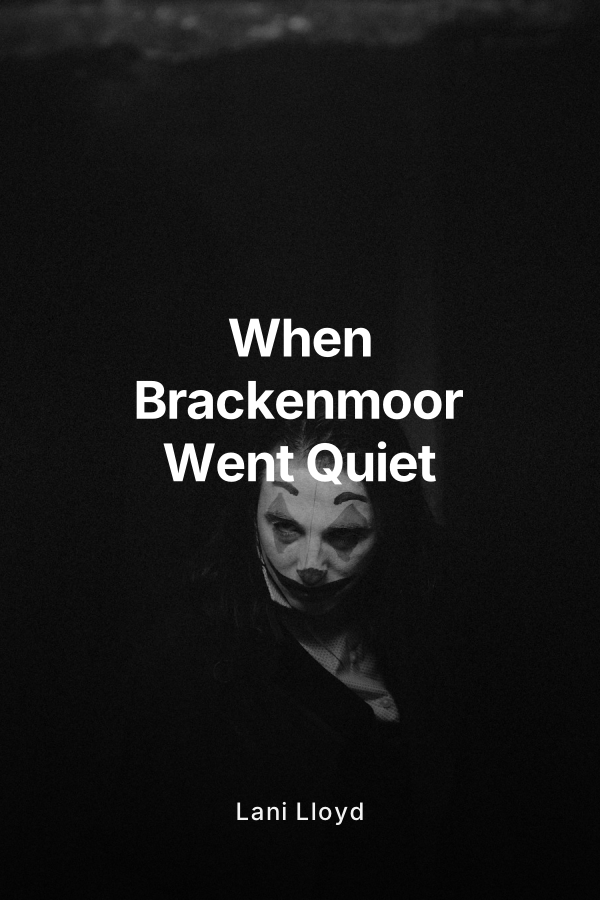
When Brackenmoor Went Quiet is a dark atmospheric horror story rooted in dread, violence, grief, and psychological collapse, but it is ultimately also a story about choosing connection over isolation. Its terror comes from blood ties twisted into obsession, from a town that traded truth for survival, and from the intimate cruelty of being hunted by someone who knows exactly where to press. Its healing comes slowly, honestly, and without false comfort. Corven does not emerge untouched. He emerges changed, carrying guilt, nightmares, and the knowledge of what he has done. But he also emerges alive, with Jasper at his side, learning at last how to trust people again.
The final image is one of hard won peace. After confession, bloodshed, and truth, Corven and Jasper leave the moors hand in hand. The horror behind them has not vanished from memory, but it no longer owns their future. Jasper gives him the only words that matter now. Let’s go.