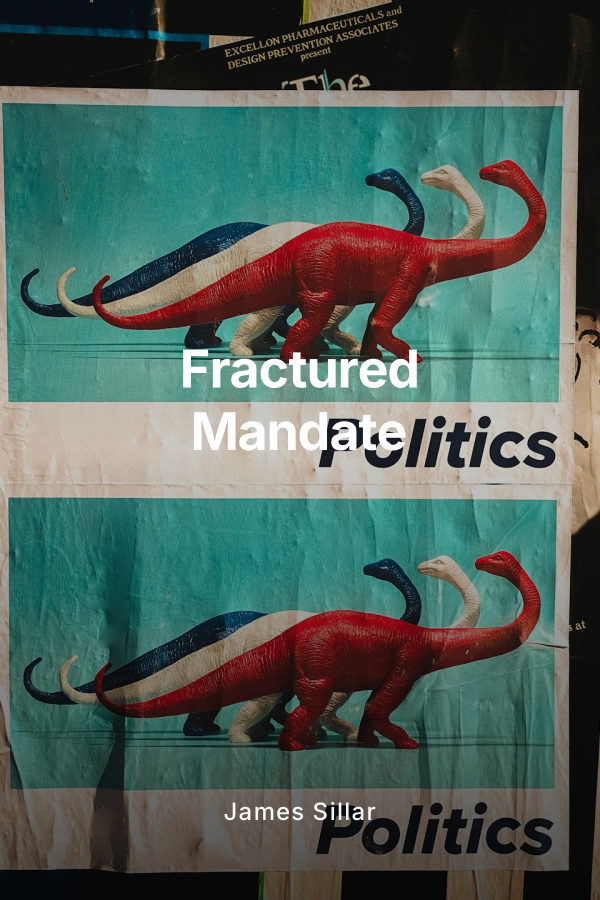
This book examines the turbulent unravelling of the UniTeam coalition and traces how the clash between dynastic power, digital populism, and fragile institutions is reshaping the Philippine political landscape. Grounded in recent events but written for a general audience, it blends narrative political analysis with a clear authorial voice, guiding readers through a fast shifting terrain of scandals, geopolitical tensions, and economic anxieties.
The central thread is the reconfiguration of Philippine democracy. Rather than focusing on a single scandal or personality, the book argues that the breakup of the UniTeam is the visible symptom of deeper structural contests. These include the crisis of accountability surrounding the Duterte dynasty, the evolving power balance between the Marcos and Duterte camps, the sharpening conflict between populist leadership styles and democratic institutions, and the rise of “algorithmic war” as political struggle moves decisively into digital space.
Across three chapters, the narrative moves from coalition to confrontation, then from confrontation to systemic transformation. Each chapter zooms out from headline events to show how they intersect with long running patterns in Philippine politics, allowing readers to see individual controversies not as isolated shocks but as part of a broader reordering of power.
Chapter 1, “The Promise and Fragility of UniTeam,” opens with the 2022 electoral victory that seemed to consolidate a formidable alliance between the Marcos and Duterte dynasties. It reconstructs the hopeful rhetoric of unity and continuity, then contrasts it with the latent tensions already present in their competing bases, political interests, and narratives of historical grievance. The chapter examines how the UniTeam brand sought to fuse different strands of populism into a single national project, and why this synthesis proved unstable once confronted with questions of accountability, international scrutiny, and divergent policy priorities.
This first chapter also explores how dynastic politics shaped the internal logic of the coalition. The Marcos project of political rehabilitation and the Duterte project of punitive populism were never fully aligned. Their partnership rested on an electoral calculus that masked unresolved disputes over legacy, control of key institutions, and strategies toward foreign policy and domestic security. As initial goodwill faded, these internal contradictions started to manifest publicly through conflicting statements, veiled criticisms, and subtle shifts in alliances within Congress, the bureaucracy, and the security sector.
Chapter 2, “Cracks in the Wall: CIF, Impeachment Rumblings, WPS, ICC, and the Eagle Effect,” turns to the flashpoints that converted a fragile partnership into open fragmentation. Here the book analyzes how controversies around confidential and intelligence funds (CIF) and early impeachment talk became arenas where deeper anxieties over corruption, impunity, and executive overreach surfaced. These episodes revealed not only personal rivalries but also conflicting understandings of what “strong leadership” and “decisive governance” should look like in a constitutional democracy.
The chapter then moves to the West Philippine Sea disputes and the International Criminal Court question. These issues placed the administration at the intersection of domestic political risk, historical grievances, and international pressure. Debates over maritime rights and global accountability did not simply pit the Philippines against foreign powers or international bodies; they also exposed divisions within the ruling elite about national strategy, legal exposure of past leaders, and the acceptable limits of presidential immunity. The ICC proceedings, in particular, cast a long shadow over the Duterte legacy and complicated any effort at a clean, unified narrative of continuity from the previous administration to the current one.
Interwoven through these policy battles is what the book describes as the “Eagle Effect,” a metaphor for the volatile mix of economic expectations, investor sentiment, and public perception in a post pandemic, high information environment. Economic narratives now collide instantly with viral content, and minor signals can trigger outsized reactions in markets and social media. The Eagle Effect captures how economic confidence in the administration can rapidly rise or fall depending on perceptions of governance, corruption, and geopolitical alignment. It also shows how the state’s attempts to manage economic messaging interact with digital ecosystems that it cannot fully control.
Chapter 3, “Algorithmic War and the Reconfiguration of Democracy,” situates all of these conflicts within the wider shift to a politics increasingly fought through data, platforms, and influence operations. Building on earlier patterns of online campaigning, this chapter details how the Marcos and Duterte camps, along with other political actors, now contest narratives through coordinated digital strategies, influencer networks, and weaponized algorithms. “Algorithmic war” here names the escalating effort to frame reality itself, where control over what trends, what is suppressed, and what is believed becomes a primary arena of power.
In this environment, the traditional institutions of democracy struggle to keep pace. Legislative hearings, judicial proceedings, and formal investigations are continuously anticipated, reframed, or undermined online before they can produce stable outcomes. The chapter shows how accountability mechanisms are both weakened and strangely magnified: weakened when disinformation erodes trust in any fact finding process, yet magnified when digital exposure forces previously untouchable issues and actors into public scrutiny. The same tools that shield power can also unexpectedly turn against it.
The book closes by arguing that the breakup of the UniTeam, taken together with CIF controversies, impeachment signals, WPS tensions, ICC developments, economic volatility, and the maturing of algorithmic warfare, amounts to more than a passing political crisis. It is a reconfiguration of Philippine democracy, where dynasties must now navigate a landscape in which their traditional ground game is inseparable from the logic of platforms and global norms. The central question is no longer whether populism will dominate, but what kind of democracy can emerge from a system where populist energy, institutional resistance, and digital architectures all converge.
Fractured Mandate invites readers to look beyond personalities and partisan loyalties, and instead see patterns that will likely shape the country’s political life for years to come. By weaving together narrative, analysis, and a forthright authorial stance, it equips citizens, students, and observers with a framework to understand not only what has already happened, but what the next ruptures may look like, and how democratic agency might still be reclaimed within a system caught between dynastic resilience and digital upheaval.