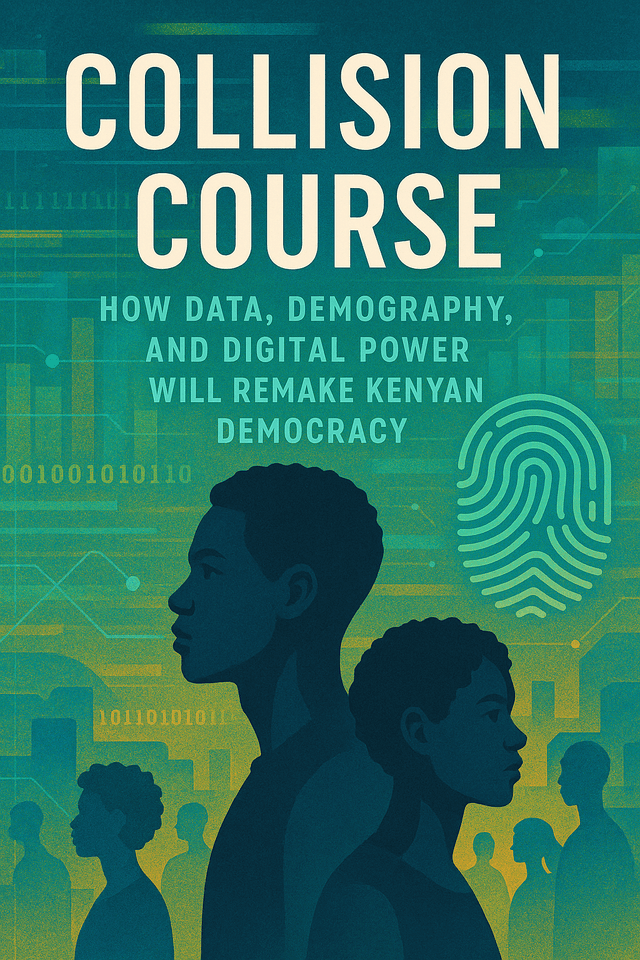
Volume 3 asks whether Kenya is edging toward a “third republic” in everything but name. After “Collision Course” mapped how data, demography, and digital platforms collided around elections, and “Pathways of Power” followed youth into work, activism, and migration, this book zooms out to the systems those youth keep crashing into. It argues that parliament, ministries, courts, big business, unions, universities, and regulators now sit at the center of a slow, contentious redesign driven by a digitally fluent, impatient generation.
The anchor question is simple and radical: what would it mean to hard‑wire youth representation and power‑sharing into the core institutions of a digital Kenya by 2040. Rather than treating young people as a “stakeholder group” to be consulted or mobilized at election time, this volume treats them as a constitutional force. It shows how their everyday tactics in the platform economy, hashtag politics, and transnational mobility (traced in Volume 2) are already destabilizing inherited arrangements between state, market, and citizens. Those arrangements, forged in the era of the 2010 constitution and earlier, are now misaligned with the realities of AI, datafied services, and a majority‑youth society.
Structured as a systems book with a social‑contract edge, “The Third Republic?” covers roughly 2020 to 2040, with flashbacks to key constitutional moments. An introductory chapter situates the argument in Kenya’s recent history: the promise of the 2010 constitution, the digital disruptions of the 2013–2022 election cycles, and the rise of youth‑led digital work and activism. It recaps the three pillars introduced in Volume 1 (digital civic literacy, ethical training, and an Election Tech & Data Lab) and the three youth pathways from Volume 2 (work, activism, mobility), then asks what happens when these forces push directly against the architecture of rule‑making, rule‑applying, and rule‑contesting.
Three substantive chapters follow, each organized around a function of governance and anchored in specific institutions.
The first examines rule‑making, focusing on parliament and political parties. Through the story of a reform‑minded MP and a young party digital operative, it shows how laws on data, AI, platforms, and labor are debated in bodies whose demographics and internal cultures lag far behind the country they claim to represent. Youth wings remain mostly symbolic, while real agenda‑setting often occurs in informal WhatsApp and Telegram networks that cut across parties. The chapter explores proposals for youth quotas, age caps, and digital assemblies linked directly to parliamentary committees. It asks how far Kenya could go toward institutionalized youth co‑decision on questions such as data rights, automation in public services, and platform regulation, and what is required to make such mechanisms more than cosmetic.
The second chapter turns to rule‑applying, examining what the book calls the “digital state”: key ministries such as ICT, Interior, Education, and Labour, along with data protection and competition regulators, courts, and constitutional commissions. Here, a senior civil servant, a young public‑interest lawyer, and a regulator working on data and AI governance serve as recurring guides. The analysis traces how these bodies have handled biometric databases, surveillance technologies, digital ID rollouts, and AI pilots in health, education, and policing. It then asks what youth power‑sharing would look like in this domain: youth seats on data councils and ethics boards, co‑designed algorithmic impact assessments, and mandatory youth consultation in regulatory sandboxes. Echoes from Volume 1’s Election Tech & Data Lab reappear in proposals for a broader “AI and Democracy Lab” able to audit tools across sectors, with youth researchers and organizers embedded in its work.
The third chapter focuses on rule‑contesting, where markets and knowledge institutions meet youth movements. Big business and platform firms, employer associations, emerging unions and worker associations, universities, and TVET institutions form the backbone of this section. A young platform‑worker organizer and a tech founder trying to build fairer digital services illustrate how contestation is shifting from street protests alone to boardrooms, shareholder meetings, and accreditation bodies. The chapter shows how universities and training institutions are being forced to rethink curricula under pressure from AI‑driven labor markets and youth demands for relevant skills and civic competence. It asks whether co‑governance arrangements, such as youth co‑management of university councils, worker representation in platform governance, and structured bargaining forums between youth associations and employer bodies, can move from experiment to norm.
Across all three chapters, the book keeps youth representation and power‑sharing at the center, while treating three other social‑contract questions as inescapable companions. First, what new guarantees around work and income will be necessary in an economy where automation and platforms can both create and destroy opportunity at scale. Building on labour statistics and platform‑economy research flagged for later citation, the book explores options such as portable social protection for gig workers, targeted income guarantees tied to civic engagement or skills programs, and youth‑led funds financed partly from data‑driven corporate profits.
Second, who owns and governs the data and AI systems that increasingly mediate access to services, credit, and security. Drawing on Kenyan and comparative developments in data protection, competition law, and digital trade, the book argues that youth cannot be shareholders in their own future if they remain only data sources rather than data governors. It outlines potential institutions, such as youth‑inclusive data trusts, algorithmic registries, and cross‑border data councils in which Kenyan youth would have formal seats as both rights‑holders and innovators.
Third, how democratic accountability will function when much rule‑making happens in technical standards, contracts, and code rather than in statutes alone. Here, the volume connects courts and commissions to the bottom‑up accountability practices described in Volume 2: digital activism, strategic litigation, and transnational campaigns. It sketches how youth lawyers, researchers, and movements could institutionalize their role through standing rights‑of‑data and AI litigation clinics, youth amici in constitutional cases on technology and rights, and permanent youth observer status in key regulatory processes.
The conclusion pulls these threads together and asks whether such a reconfiguration would amount to a “third republic” in substance if not in formal constitutional language. It offers three 2040 scenarios that differ not in their technology but in their power‑sharing design. In the first, youth power remains mainly oppositional, expressed through protests, viral campaigns, and exit via migration, while core institutions remain gerontocratic and reactive. In the second, a narrow technocratic elite manages data and AI through deals with global firms, sidelining both youth and older citizens and entrenching inequality. In the third, the most ambitious, youth representation and co‑governance have been built into parliament, regulators, platforms, universities, and large employers, supported by mature civic literacy systems, robust ethical training, and an expanded Lab infrastructure.
Throughout, the book maintains the hybrid style of the series: short narrative vignettes followed by dense but accessible analysis, with signposts to empirical work on youth labour, platform economies, civic tech, and AI/data governance so proper sources can be added. “The Third Republic?” is written for an international audience of policymakers, scholars, and practitioners, but it keeps Kenyan youth and institutional actors at its emotional core. It argues that the most important question for Kenya’s digital future is not what technology can do, but who has standing to shape, constrain, and benefit from it. Whether the answer looks like a new republic or a deepening of the current one will depend on whether youth power is invited into the engine room of institutions or kept knocking at the door.