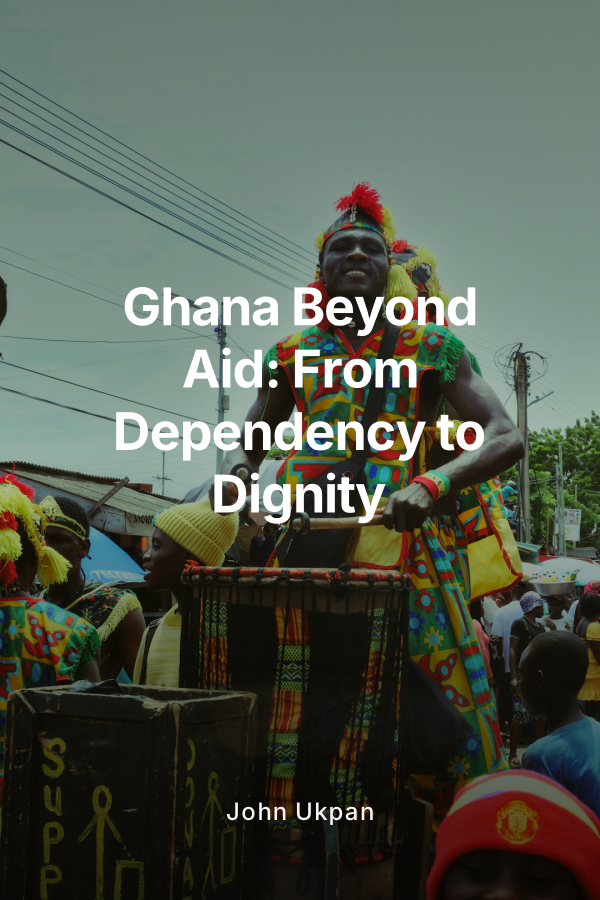
This book is a citizen’s manifesto in plain language, written for ordinary Ghanaians who are tired of slogans and want to understand why our country is still dependent, and what we can do about it in our homes, workplaces, communities, and institutions. It does not romanticize the past or demonize aid. Instead, it argues that aid did not fail Ghana; weak systems, poor incentives, and a dependency mindset did. The central claim is simple: Ghana’s future will not be donated. It must be built, mainly through production, strong institutions, and a new role for our youth as builders rather than job seekers.
Across two in-depth chapters, the book combines hard truths and realistic hope. It blends analysis with concrete checklists for citizens at the end of each chapter so that schools, book clubs, and community groups can turn discussion into practical action. The tone is that of one Ghanaian speaking honestly to fellow citizens, forward looking and solutions focused, but never pretending that change will be easy.
Chapter 1, “From Dependency to Reality Check,” opens by challenging the comforting story that aid is either our curse or our saviour. It argues that the real problem is the mindset that waits for projects instead of building productivity, and waits for grants instead of strengthening institutions. The chapter traces how Ghana’s economy has remained heavily based on exporting raw materials and importing finished goods we could reasonably produce ourselves. It asks blunt questions: Why should a leading cocoa producer import most of its chocolate? Why does an agricultural country import basic foods like rice and tomatoes at such scale? Why do so many young people chase certificates that do not translate into skills the economy actually needs?
This chapter does not simply blame politicians. It shows how citizens, businesses, and institutions all participate in a culture that celebrates consumption over production and short-term gains over long-term capacity. It distinguishes real leadership from routine politics, arguing that leadership means service, sacrifice, and building systems that outlast individuals, while politics often collapses into a winner-takes-all contest for state resources. Corruption is unpacked not as something “in our blood” but as a behavior that survives because it is repeatedly tolerated, excused, and rewarded.
From there, the chapter explores how dependency thinking shapes our choices, from local assemblies that wait for donors to build basic infrastructure, to ministries that design projects around what external partners are funding rather than around Ghana’s own priorities. It confronts the illusion that rejecting aid alone creates independence, insisting instead that a country that cannot reliably produce what it needs will remain vulnerable, no matter how proudly it talks about sovereignty. Real-life Ghanaian cases are used briefly but concretely throughout: public projects that stalled once donor funding ended, factories that collapsed due to inconsistent policy and power supply, and local initiatives that quietly succeeded because communities took ownership instead of waiting for outside saviours.
To help readers place Ghana in a broader context, the chapter includes short side notes on other West African countries that have made specific gains or repeated similar mistakes. These comparisons are used both as inspiration and warning, showing that progress is possible within our region, but also that losing focus can quickly erase hard-won gains. The chapter ends with a concise, practical checklist titled “For Citizens.” It outlines simple, realistic actions individuals and groups can start now: how to question dependency narratives in everyday conversations, how to reward integrity in local leadership, how to support locally productive businesses in small but consistent ways, and how to use community pressure to demand institutional accountability. The aim is not to overwhelm readers, but to give them a starting point for personal and collective responsibility.
Chapter 2, “Youth as Builders,” forms the spine of the book and is deliberately more expansive. It begins from a national moment that many Ghanaians recognize: a new cohort of graduates celebrating their certificates while simultaneously lamenting a lack of jobs. This scene is used to challenge the widespread assumption that the role of education is only to secure a salaried position, and that the role of government is to provide jobs directly rather than to create an environment where productive work can flourish. The chapter argues that Ghana’s youth are not a burden; they are the country’s most underused asset.
The discussion moves through the education system, highlighting how it often trains young people to pass exams, memorize notes, and collect credentials instead of solving real problems in their communities. It calls for a shift towards valuing technical and vocational skills, applied research, and entrepreneurship that addresses local needs in agriculture, energy, housing, transport, health, and technology. The book shares short, grounded examples of young Ghanaians who have created small but meaningful enterprises in different regions, from agro-processing and fabrication to digital services and local manufacturing, showing what is already possible when mindset, skills, and minimal enabling support come together.
At the same time, “Youth as Builders” does not romanticize entrepreneurship. It recognizes the constraints of unreliable power, limited credit, bureaucratic red tape, and markets flooded with cheap imports. It uses these obstacles to reinforce the earlier argument that institutions must be stronger than individuals, even the most innovative ones. Young people can only build sustainably when policies are predictable, systems are fair, and corruption does not punish those who refuse to play along. Here, the chapter revisits themes of leadership and culture: how older generations in public and private sectors either open doors for youth to lead and innovate, or shut them with suspicion and gatekeeping.
The chapter also stresses that “Ghanaian solutions to Ghanaian problems” does not mean isolation or rejection of knowledge from abroad. It means starting from local realities and designing answers that fit, while using external ideas and resources to strengthen, not replace, local capacity. Community-driven development, local innovation hubs, and partnerships between universities, technical institutes, and industry are presented as ways to align education, research, and production so that knowledge does not die on shelves but lives in factories, farms, and service businesses.
A brief comparison is again made with selected West African peers that have made notable investments in vocational training, local industry, or youth-led innovation ecosystems, showing practical lessons Ghana can adapt while also avoiding paths that trapped others in new forms of dependency. Throughout, the tone remains grounded: this is not a promise of overnight transformation, but a call for work, honesty, and courage across generations.
“Youth as Builders” closes with another targeted checklist “For Citizens,” written with young readers especially in mind but relevant to all. It turns the chapter’s arguments into concrete next steps: how students can choose skills and fields that solve real problems; how parents can support practical learning rather than only chasing prestigious certificates; how workers can volunteer time and expertise to mentor younger people; how communities can create small local platforms for youth initiatives instead of waiting for central programs; and how every reader can measure their own contribution not by titles held, but by value created.
Taken together, these two chapters lay the foundation for a larger, future series of work on Ghana’s transformation. Some themes are intentionally left open for further exploration, such as detailed sector-based strategies, deeper historical analysis, and expanded policy roadmaps. Yet the book stands on its own as a clear, focused statement: Ghana beyond aid will not come from speeches, slogans, or foreign blueprints. It will come from a culture shift in how we think about dependence and dignity, from an economy that takes production seriously, from institutions that outlast personalities, and from a generation of young Ghanaians who no longer see themselves only as job seekers, but as the builders of the country they want to live in.