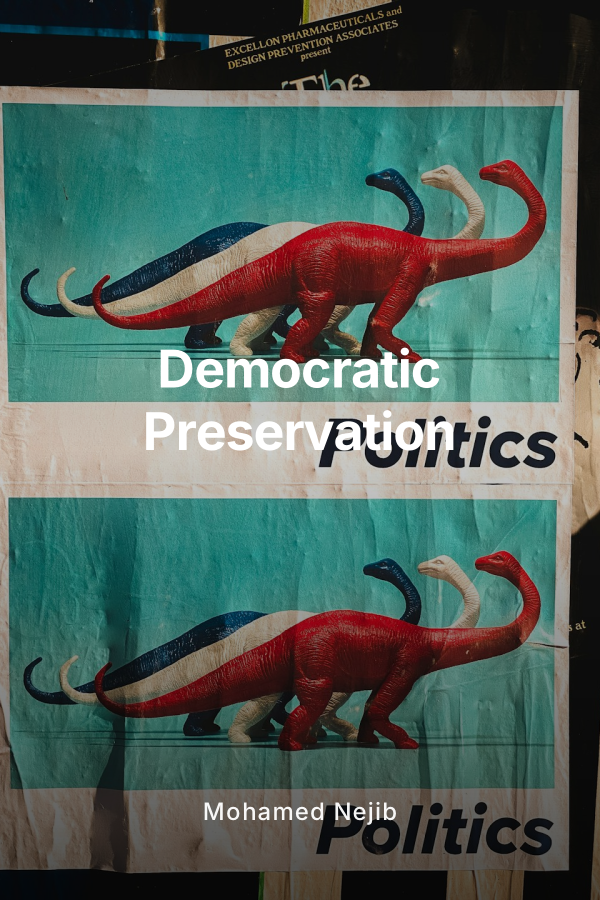
This book offers a new language and roadmap for defending democracy in an era defined by democratic fatigue, creeping authoritarianism, and profound citizen distrust. It introduces “democratic preservation” as a distinct and urgently needed paradigm, separating it from the older focus on democratic consolidation that primarily addressed transitions away from authoritarian rule. Instead of asking how fragile new democracies become stable, the book asks how any democracy, even the most established, can be protected from subtle but accumulating forms of erosion and how global democratic momentum can be revived rather than merely defended.
The core argument unfolds in three moves. First, it defines democratic preservation as a long-term, proactive project aimed at safeguarding institutions and norms from internal and external threats, not only preventing breakdown but also reigniting democratic ambition. Preservation, in this conception, has two core dimensions: shielding democracies from backsliding and actively expanding democratic possibilities at home and across borders. That means resisting the normalization of illiberal practices, as well as investing in civic energy, institutional reform, and international cooperation that can restart a stalled “third wave” of democratization on a firmer, more resilient footing.
Second, the book dissects the anatomy of democratic backsliding. Backsliding is treated not as a sudden rupture, but as an incremental process that often unfolds behind a façade of legality and electoral continuity. The analysis traces how executive overreach, judicial politicization, hyper-partisan media ecosystems, disinformation campaigns, and growing economic inequality interact over time to hollow out checks and balances, restrict civil liberties, and degrade electoral integrity without open coups. It distinguishes internal threats like polarization, norm erosion, corruption, and civic disengagement from external pressures such as cyber operations, election interference, propaganda, economic coercion, and cross-border support for anti-democratic actors.
To make these dynamics analytically tractable, the book proposes a staged backsliding framework that tracks movement from stable democracy through early erosion and accelerated backsliding to entrenched competitive authoritarianism. Each stage is associated with identifiable institutional, societal, and international indicators: weakening oversight bodies, declining trust in institutions, rising hate speech and disinformation, narrowing media pluralism, and increasingly manipulated elections. These indicators form the basis of a diagnostic toolkit that scholars and practitioners can use to monitor democratic health and to detect early warning signs of deterioration.
Third, the book shifts from diagnosis to strategy. It develops a multi-level framework of preservation mechanisms that operate at institutional, legal, societal, and international levels. At the institutional level, preservation means entrenching checks and balances, insulating independent oversight bodies, strengthening electoral management, and designing adaptive institutions capable of resisting capture by elected autocrats. At the legal level it highlights constitutional safeguards, judicial independence, and strategic litigation as central tools for defending the rule of law and preventing “abusive” legal reforms. At the societal level it emphasizes civic education, political socialization, inclusively designed party systems, robust civil society, and independent media as foundations of democratic resilience. At the international level it stresses the importance of coordinated democracy support, norm enforcement, and multilateral responses to transnational authoritarian influence.
The book is organized into five chapters, each building a different layer of this argument and together providing a coherent 10000-word treatment aimed primarily at academic political scientists while remaining accessible to practitioners and engaged citizens.
Chapter 1, “The Imperative of Democratic Preservation,” sets the conceptual stage. Drawing on recent patterns of backsliding in both newer and long-established democracies, it explains why the consolidation paradigm is insufficient when democracies are eroding from positions of apparent strength. Preservation is defined in contrast to consolidation along several dimensions: temporal scope, threat profile, target cases, and normative ambition. Where consolidation is relatively short-term and domestically focused, preservation is long-term, continuous, and unabashedly global in its outlook. The chapter argues that taking preservation seriously requires foregrounding internal threats like polarization, disinformation, and inequality, and recognizing that a democracy can regress without any formal change in regime type.
Chapter 2, “From Consolidation to Preservation: Building a New Lexicon,” introduces the book’s conceptual building blocks. It formally distinguishes preservation from related ideas such as resilience, resistance, and repair, and lays out a lexicon of key terms. These include: preservation strategies (institutional, societal, and international); internal versus external threats; democratic norms versus formal rules; and threshold concepts like “minimum liberal guarantees” that define when a system has slipped into competitive authoritarianism. Each concept is specified with necessary and sufficient conditions to give researchers and practitioners clear analytical tools. The chapter also positions democratic preservation in relation to existing scholarship on regime change and democratic quality, identifying where the new framework extends or revises earlier theories so that future empirical work can properly attribute and test its claims.
Chapter 3, “Anatomy of Backsliding: Threats, Stages, and Mechanisms,” turns to the mechanisms through which democracies erode. It presents a four-stage model of backsliding (stable democracy, early erosion, accelerated backsliding, entrenched competitive authoritarianism) and ties each stage to specific institutional and societal vulnerabilities. The chapter identifies mechanisms such as norm breaking by incumbents, strategic manipulation of electoral rules, politicization of courts and law enforcement, use of disinformation and online harassment, and exploitation of inequality and identity cleavages. It shows how these mechanisms interact, for instance how disinformation accelerates polarization, which in turn weakens gatekeeping by parties and courts. Drawing on a wide but carefully selected set of country illustrations across established, hybrid, and third-wave democracies, the chapter highlights both convergent patterns and context-specific variations without anchoring the analysis in any single case.
Chapter 4, “Mechanisms and Strategies of Preservation,” maps out how democratic actors respond. It introduces a three-level matrix of preservation strategies: institutional mechanisms (such as redesigning veto points, empowering independent oversight, and protecting electoral integrity), societal mechanisms (such as civic mobilization, cross-partisan coalitions, and media reform), and international mechanisms (such as election monitoring, targeted sanctions, and transnational support for civil society). The chapter emphasizes that preservation rarely succeeds through a single instrument. Instead, effective defense tends to involve overlapping efforts, for example coupling electoral reforms with civic education and external pressure against overt manipulation. It also considers failed or counterproductive preservation attempts, including reforms that look protective on paper but are easily captured or that unintentionally deepen polarization.
Chapter 5, “Reigniting Global Democratic Momentum,” widens the lens beyond defense to recovery and renewal. Starting from the premise that simply holding the line is not enough, it asks what it means to rebuild a sense of democratic possibility after years of perceived stagnation. The chapter links domestic preservation strategies to broader global trajectories: how successful preservation episodes can radiate outward as models, and how international cooperation can move beyond reactive crisis management toward proactive support for democratic innovation. It examines the role of multilateral organizations, regional bodies, and cross-border networks of activists, journalists, and legal advocates in supporting preservation and recovery, while also acknowledging the constraints and unintended consequences of external involvement. Finally, it offers a set of forward-looking policy principles and research agendas, urging scholars and practitioners to treat democratic preservation as both a normative commitment and an ongoing empirical project.
Across these chapters, the book speaks to three overlapping audiences. For academic political scientists, it provides a sharpened conceptual vocabulary, a staged model of backsliding, and a structured way to think about internal and external threats at institutional, societal, and international levels. For policymakers and civil society leaders, it translates those concepts into diagnostic tools and strategic options, emphasizing practical mechanisms for strengthening resilience and countering erosion. For concerned citizens, it offers a clear, persuasive narrative of what is going wrong in many democracies and what can still be done to set them on a more just and democratic path.
Ultimately, the book insists that democracy is not a passive inheritance but a demanding and continuous practice. Preservation, in this sense, is not nostalgia for a supposed golden age, but a forward-looking project that faces hard truths about democratic vulnerabilities while refusing resignation. The central message is both sobering and hopeful: democratic backsliding is real, pervasive, and often subtle, yet it is neither inevitable nor irreversible if societies can recognize its stages early and mobilize the institutional, legal, societal, and international resources required to confront it.