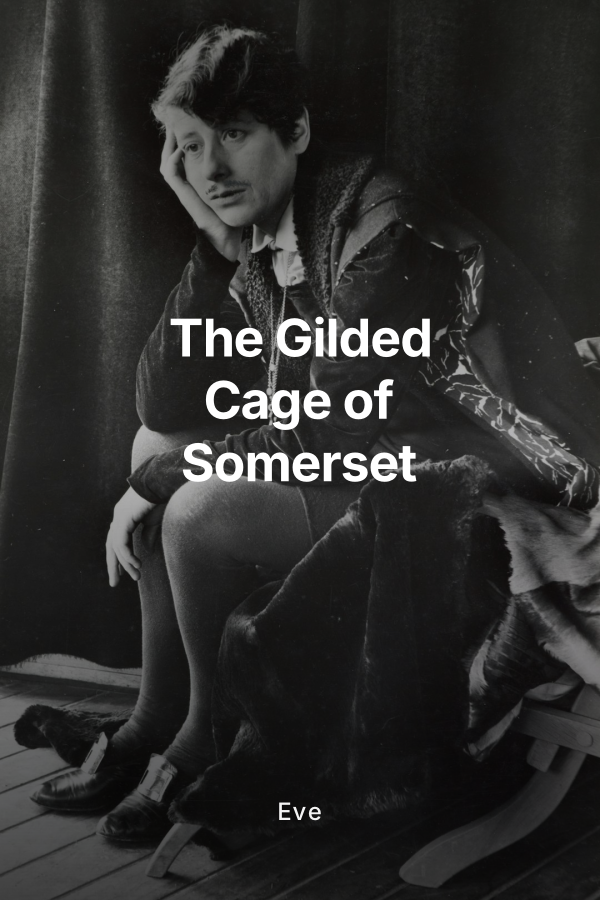
In the glittering parlors and candlelit ballrooms of Regency London, Abigail Pembroke’s life appears charmed. At seventeen, the only daughter of the Viscount and Viscountess Pembroke enters her first Season with every advantage beauty, breeding, and a substantial dowry. Her parents, Edward and Catherine, have raised her and her twin brother Andrew to be flawless ornaments to their own ambition, withholding affection while demanding perfection. For Abigail, the reward for this lifelong training is meant to be a brilliant match and her parents are determined to sell her to the highest, most powerful bidder, with no concern for her heart or safety.
On the night of her debut, Abigail dazzles society. Gentlemen cluster for a dance, matrons whisper approvingly, and even the most jaded eyes turn toward the viscount’s lovely daughter. Among them is Richard Sinclair, the formidable Duke of Somerset, a man more myth than fixture in London. At forty two, he has long resisted marriage, retreating to his vast country estate and appearing in town only at the start of each Season to survey the offerings. When he sees Abigail, he decides, with the silent certainty of a man accustomed to absolute power, that she will be his. They share a single dance, almost wordless, his expression unreadable, his interest seemingly tepid. Abigail retires that night uneasy but unalarmed.
By morning, her world has already been sold. Her father informs her, as if announcing a business merger, that she is to become the Duchess of Somerset. The arrangement has been concluded between men, sealed with the promise of her youth and her dowry. No argument, no tears, no desperate pleading can move her parents. Abigail’s future has been decided in a single conversation to which she was never invited. Her mother, meticulously focused on appearances, offers no counsel, no warning, and no comfort. The only person who truly grieves with her is Andrew, her twin, who loves his sister but has been taught since childhood that his power stops at the edge of his father’s will.
From this forced betrothal, the novel unfolds as a relentless psychological and emotional descent. The story is told entirely in Abigail’s point of view, capturing each stage of her entrapment: the day she meets the duke, their swift, grand wedding arranged to impress society, and the wedding night that rips away every illusion she had left. Raised in deliberate ignorance of marital intimacy, Abigail enters the bridal chamber frightened but trusting that duty will be bearable. Richard, discovering her innocence, is “overcome” not with tenderness but with an almost exultant satisfaction. He will teach her, he decides, in his way. He takes what he wants, shaping her body and mind to his pleasure alone, making clear that she belongs to him entirely and that there is no escape.
After the hurried honeymoon departure to Somerset, the shadows swallow Abigail’s life. The duke’s country estate, sprawling and grand, becomes a gilded prison. For the first months of marriage he keeps her confined to her rooms, visiting only to exact what he calls her wifely duties. There is no romance, no gentleness, only a systematic breaking of will. When Abigail discovers she is pregnant, Richard’s interest in her body shifts. He reduces the sexual assaults but replaces them with physical blows and unrelenting psychological cruelty. He strikes when angered, belittles her at every turn, and drills into her the conviction that she should be “seen and not heard,” that all of her from thought to fingertip is his property. He insists she address him as “My Grace” and refuses to call her anything that acknowledges agency or respect instead she is “wife,” “girl,” an object, never a partner.
The outward world remains willfully blind. Staff at Somerset House witness more than society ever will but they are bound by fear and by a social order that places a duke beyond reproach. Richard does not bother to hide his temper within the household. Servants see bruises, hear raised voices, and watch their young duchess flinch at a footstep in the corridor. Still, no one can intervene without risking dismissal or worse. In London, during the short stretches of the Season when Richard permits Abigail to accompany him, he dons impeccable charm. Society sees a powerful nobleman and his fragile young wife, perhaps a little shy, perhaps a touch delicate, but unquestionably fortunate. The cruelty that defines Abigail’s private world evaporates in public, replaced by an urbane mask that earns Richard admiration and respect.
Abigail seeks help in the only directions available to her. She writes, then tears up, letters to her parents. When she manages to speak with them, they dismiss her terror as hysterics or fault. Her father believes she must have provoked such treatment, her mother chides her for ingratitude. They both view the duke’s power as a triumph for their family name and her suffering as irrelevant. With each rebuff, Abigail’s hope shrinks. The social and legal structures of the time offer her nothing; she is a wife, and wives are possessions. The threat of scandal, loss of children, and total ruin hangs over any thought of resistance.
Amid the horror, a single fragile strand of kindness threads through her days: Eloise Shepherd, her lady’s maid. Eloise has attended Abigail since she was sixteen, first in her father’s house, then following her into marriage. She cannot stop the duke, but she can bear witness. She tends to hidden injuries, conceals evidence of violence from prying eyes, lies when needed to protect Abigail from further punishment, and brings her books, small anchors of sanity in a life governed by fear. Within the constraints of class and survival, Eloise becomes Abigail’s principal source of human warmth, though even this companionship is intermittent and dangerous. A maid who defies a duke risks the loss of her livelihood, perhaps her safety.
Andrew, far away in London, struggles under his own web of expectations. Groomed to inherit his father’s title, encouraged to indulge in youthful vices as long as he maintains the correct veneer in public, he knows his sister suffers but has been trained to obedience as thoroughly as she has. His efforts to help are halting and ultimately futile, reinforcing one of the novel’s bleakest truths powerlessness is not only Abigail’s curse but that of anyone who stands beneath the duke’s rank. The very men who might speak for her are entangled in the same hierarchy that preserves Richard’s impunity.
Motherhood deepens, rather than relieves, Abigail’s captivity. She endures three successful pregnancies, each a new ordeal. The first labor is long, harrowing, and complicated, pushing her to the edge of death. The later births pass with fewer complications but still extract their toll. Scattered among these are miscarriages and a stillbirth, losses that cut her to the bone and are treated by Richard not as tragedies but as inconveniences or failures. Her children grow in the same atmosphere of dread. The two sons and one daughter who survive learn early to fear their father’s temper, to speak softly, to avoid notice. They are both Abigail’s greatest love and a constant reminder of the cycle she is trapped in: they bind her more tightly to the duke yet offer her the only reason she still clings to life.
Richard Sinclair emerges as a chilling portrait of inherited brutality wielded through absolute social power. Raised by an abusive father and deprived of a mother who might have softened him, he has internalized cruelty as a form of control and pleasure. He enjoys hunting, gaming, and the company of questionable peers, but nothing delights him so much as watching his young wife’s fear, bending her reactions to his will, and demonstrating again and again that her body, her time, and her choices exist solely for him. Even brief absences in London serve only to escalate the terror when he returns, refreshed and ready to reassert his dominance.
Across the novel’s arc, the tone remains unflinchingly dark. There are no reassuring fades to black, no comforting promise that love or courage will eventually free Abigail. The narrative is a slow, suffocating descent, designed so the reader feels a constant, tightening dread. Moments of almost-hope flicker a sympathetic glance from a guest, a rumor that a magistrate once intervened in another household, the idea of a distant refuge yet every glimmer is systematically extinguished. Each crushed possibility engraves deeper the understanding that, in this world, a young duchess has less agency than the horses in her husband’s stables.
Abigail’s inner voice charts the slow erosion of self. At first she reaches for explanations, trying to negotiate with her reality, blaming herself, promising greater obedience in hopes of winning a milder fate. Over the years, through beatings, humiliations, complicated labors, and the constant weaponization of her children, her thoughts fracture and flatten. She clings to small rituals reading whenever she can, counting steps along the corridor, memorizing lines and characters from her books to build an interior refuge that Richard cannot touch. Yet even that sanctuary is fragile. His taunts about her reading and his contempt for her mind seep into her own beliefs until she questions whether she deserves anything better than this carefully curated hell.
Thematically, the book functions as a gothic psychological tragedy set within the silk and constraint of Regency society. It interrogates duty, consent, and the monstrous breadth of male power in a system where a woman’s legal identity is effectively consumed by her husband’s. It explores the cycle of abuse and how class and gender norms not only permit cruelty but dignify it, turning private violence into a socially protected secret. Concepts related to patriarchal control, marital coercion, and the legal erasure of wives have been widely discussed in historical and feminist scholarship, and any direct alignment with specific theories would need appropriate attribution in a critical context, though the novel itself focuses on lived experience rather than explicit commentary.
By its end, The Gilded Cage of Somerset offers no dramatic escape route, no sudden legal remedy, no heroic lover to sweep Abigail from her prison. Fidelity to the user’s vision keeps the narrative rooted in unbroken horror. Abigail remains trapped, her hope slowly extinguished, her resistance reduced to the bare act of enduring for her children’s sake. The final impression is that of a young woman who has been methodically stripped of every avenue of freedom, left alive but spiritually entombed within the beautiful, brutal world that claimed her.
Intended for readers who are drawn to unflinching, deeply psychological dark fiction within a historical setting, this novel does not comfort. It confronts. In five chapters spanning Abigail’s introduction to society, her hasty marriage, the unfolding years of domestic terror, her pregnancies and losses, and the hardening of her despair, The Gilded Cage of Somerset holds a mirror to a world that names abuse as privilege and calls ownership love.