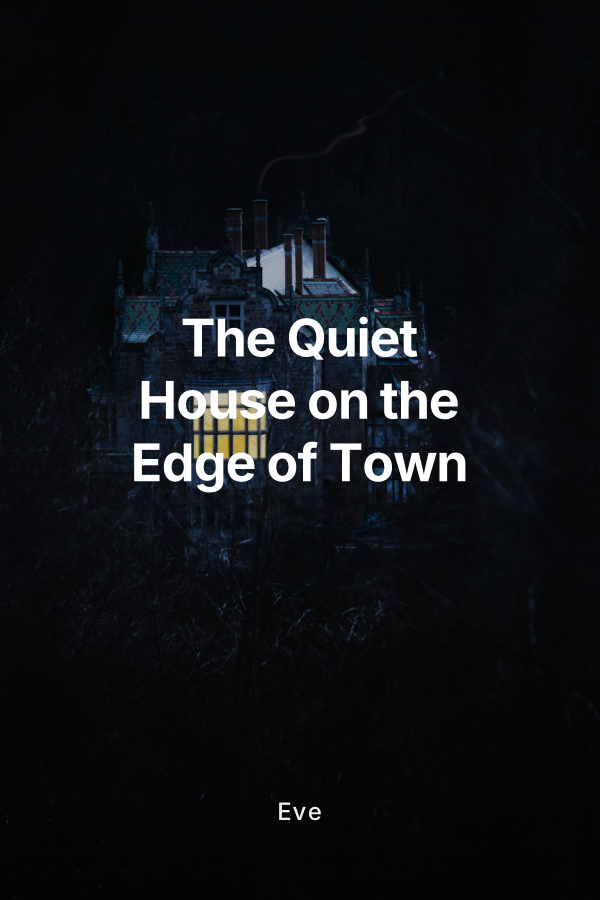
This book is a dark, intimate psychological drama about long term survival inside an invisible war. It follows Abigail Maddox, a twenty six year old mother trapped in an extraordinarily well hidden cage, and her three children, as they navigate daily life under the absolute control of Richard Maddox, the village’s beloved doctor and secret tyrant. The story is written entirely from Abi’s point of view, with a gritty, unvarnished focus on the reality of coercive control, physical violence, and the quiet strategies of a woman who plans for freedom yet never quite reaches it.
Set in a small English village where everyone knows everyone, the book uses the deceptive calm of rural life to sharpen the horror that unfolds inside one renovated cottage on the outskirts of town. The village sees a perfect family: a successful doctor, his pretty housewife, three bright children, and a beautiful home with a big garden and a warm kitchen. They see Richard as a pillar of the community, always ready with medical help or friendly advice. They see Abi only in passing as the polite, quiet wife who has everything. Nobody looks closely enough to see the bruises, the flinches, the terror behind her smile, or the way she never seems to be alone. The village remains almost entirely oblivious to the truth, leaving Abi isolated and unable to trust anyone with her reality.
Beneath that polished surface, the inside of the Maddox home is a battlefield. Since their eldest son Leo was four months old, Richard has systematically broken Abi down, using every kind of abuse to keep her obedient and afraid. He restricts her world to the house, the children, and himself. He controls the money, the documents, the car keys, the medical supplies, and even what she eats. He walks into her private moments, supervises her showers and baths, and turns everyday routines into opportunities for humiliation and terror. He keeps her in a permanent state of tension where a misplaced word, a speck of dust, or a child’s meltdown can trigger punishment.
Abi’s entire identity has been eroded. Once a teenager who believed she had fallen for a charming, older man, she is now a quiet, hollowed out woman who has learned to survive by being small, compliant, and invisible. Richard has taught her that she is to be seen and not heard, that the safety of the children depends on her obedience, and that there is no life for her outside his control. He has stripped her of income, friends, and confidence, until her world shrinks to the cottage walls and the routines that must be perfectly maintained to reduce his rage. Her only true joy remains her children, and it is for them that she absorbs the worst of his anger.
The book explores the complex emotional landscape of abuse that does not end in rescue or clean resolution, but instead lingers year after year as Abi fights a war measured in tiny sacrifices and unfulfilled plans. She quietly prepares for an escape that never quite happens. She hides small amounts of money when she can, memorises numbers and routes, studies bus timetables, and even packs and unpacks bags in secret. Yet each time she gets close to acting, the terror of losing everything material for herself and the children, combined with Richard’s iron hold on every practical aspect of their lives, pulls her back. Long term survival, rather than escape, becomes the story’s central spine.
At the heart of the narrative is Abi’s relentless effort to protect her children from the worst of Richard’s violence. Whenever danger looms, she steps forward and redirects his fury onto herself. When Leo talks back, when Teddy has a meltdown related to his autism, when Maeve clings to her instead of going to her father, when the house falls short of Richard’s impossible standards, Abi places herself in the path of harm. Her body becomes the shield. The price she pays is enormous, yet she accepts it as the only way she knows to keep the children alive and as untouched as possible.
The children each carry their own, age appropriate scars. Leo, at nine, feels the crushing weight of being the oldest and the son of a respected doctor. Expected to be an example and to excel in everything, he begins to simmer with anger he does not fully understand. He loves both his parents, especially admires his father in some ways, yet senses that something beneath their family life is terribly wrong. He notices more than anyone else, watching Richard’s moods, watching Abi’s flinches, and slowly assuming that it is his job to protect his younger siblings. That misplaced sense of responsibility deepens his rage but also his courage.
Teddy, one of the seven year old twins, is a quiet, artistic child diagnosed with autism. In public, Richard presents himself as the supportive father of a neurodivergent son. In private he has almost no tolerance for Teddy’s sensory overloads, meltdowns, or needs. He is annoyed by the noise and disruption, and he leaves Abi to shoulder it all. Teddy retreats further into his inner world of drawing and stillness, clinging to Abi as his primary source of safety. His autism becomes another flashpoint of danger, because any outburst can trigger Richard’s temper, forcing Abi to intervene again and again.
Maeve, Teddy’s twin, is the bright, energetic, seven year old “Daddy’s angel,” adored and indulged by Richard. She loves gymnastics and dance, and she thrives under her father’s affectionate attention. In her innocence, she frames his anger as normal, something that happens to all dads. Over time, however, as Abi’s fear quietly bleeds through and the atmosphere in the house thickens, Maeve begins to gravitate closer to her mother. She becomes clingier, more watchful, instinctively sensing that Abi is the emotional anchor in the storm. Her loyalty is torn, her confusion deep, yet her love for both parents remains sincere.
Across five chapters, the book charts the evolution of this hidden war. The early chapters establish the dual reality of the Maddox family: the village’s idealised image of them and the raw truth inside the cottage. Readers see Richard in his public role, a dedicated doctor, genial and reliable, contrasted sharply with his private cruelty as he uses medical knowledge, locked away supplies, and intimate access to Abi’s body as tools of domination. Her history, from meeting him at seventeen to the first time he hit her while she struggled with baby Leo, is revealed in fragments that highlight how grooming, dependency, and affection blurred into control and violence.
Later chapters deepen the focus on Abi’s inner world. The narrative does not shy away from the physical brutality or the sexual coercion, though the emphasis constantly returns to the psychological toll. Her fear is not only of what Richard will do to her body, but of what he might someday do to the children, or what the children might have to see. She calculates everything, from the neatness of the kitchen to the tone of her voice when she reminds Leo about homework, as a potential variable in a dangerous equation she can never fully control. The story tracks the slow erosion of her self worth alongside her quiet attempts at resistance: small lies to Richard, unspoken truths she rehearses but never says, plans she makes in her head before abandoning them.
The core tension that drives the book is not whether Abi will escape, but whether she can hold the family together without losing herself entirely. The question is not “Will she get away” but “How long can she survive this and at what cost to her mind and her children’s futures.” The violence is described with graphic honesty, because for Abi there are no soft edges and no moments of safe distance. Each scene of abuse is balanced with the quiet moments in between: making school lunches, folding laundry with sore hands, watching the children sleep, standing at the kitchen window and seeing nothing but a village that will never believe her.
The village’s obliviousness remains a haunting presence in the background. Neighbours wave at Abi from their gardens. Parents chat with her outside the school gates. Patients laugh with Richard in his surgery, grateful for his care. There are small, almost moments where someone might notice: a bruise half hidden by a sleeve, an expression of panic when Richard puts his arm around her in public, Leo’s sudden temper at school. Yet every time, the community’s admiration for Richard and their expectations of what a “good family” looks like override their instincts. Abi’s silence, born of terror and shame, seals the illusion in place.
By the final chapter, the story does not offer a dramatic rescue. Instead it offers a hard, realistic portrait of long term survival. Abi has changed. She has grown more calculating and more emotionally detached from Richard’s charm. She sees him clearly, no longer confusing his occasional kindness with love. The children have each shifted in subtle but significant ways: Leo more protective and volatile, Teddy more inward and fragile, Maeve more anxious and aligned with her mother. The war is far from over, yet the final pages leave readers with the sense that Abi’s internal resistance, though quiet and outwardly submissive, is real. She has not been entirely erased, and the love she has for her children remains the one thing Richard can never fully control.
Intended for mature readers, this book does not provide comfort, neat justice, or easy catharsis. It is a stark, emotionally charged look at domestic abuse that asks readers to sit with discomfort rather than escape from it. The violence is extreme, the psychological damage profound, and the world outside largely indifferent. Yet at its core, The Quiet House on the Edge of Town is a story about a mother’s relentless commitment to protect her children inside a life she cannot safely leave, and about the thin lines of hope that survive even in the darkest rooms.