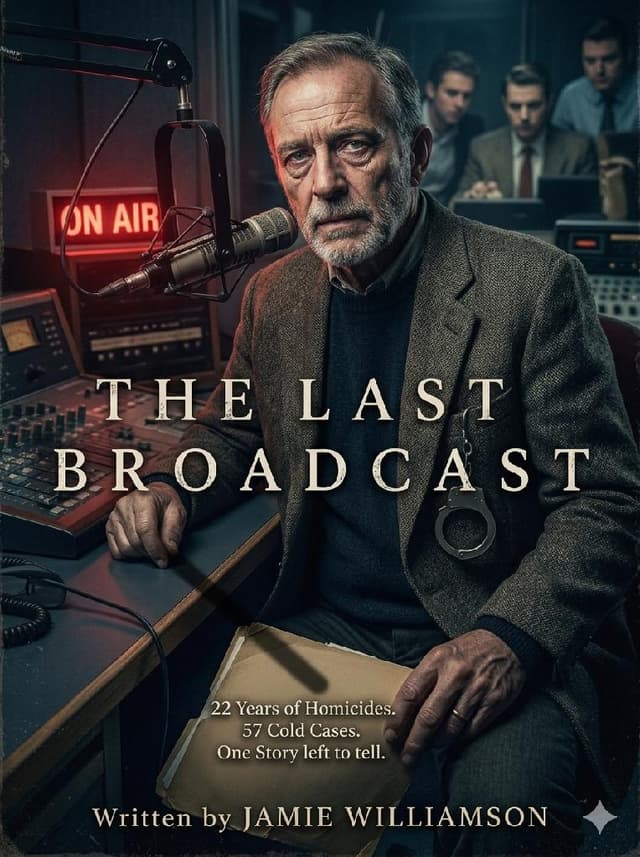
In the dead of night, every screen in America goes dark.
News stations freeze. Radio feeds collapse into static. Emergency systems buckle under a signal no one can trace fast enough. Then a familiar face appears. Detective Silas Thorne, West Virginia’s most celebrated homicide investigator, sits alone under a hard white light and tells the country he is about to reveal the truth behind the Appalachian Highway Murders. For twenty two years, the nation has known him as the man who never gave up on fifty seven victims scattered across the fogbound roads and hollowed towns of southern West Virginia. Tonight, he says, the story will finally end.
For Detective Maya Vance, watching from the state capital, the broadcast is not just breaking news. It is a summons.
Maya was once the outsider brought in to modernize a decaying department and help Silas close the towering archive that defined his legend. Young, disciplined, and ruthlessly intelligent, she arrived in Beckley to convert two decades of paper files into a searchable digital system. She expected resistance from old fashioned cops and grieving families. She did not expect Silas Thorne himself to welcome her with warmth, patience, and the polished sadness of a man who had spent half his life carrying the dead. He became her guide to the region, to the case, and to the pain stitched through every unsolved file. But as his live national broadcast begins, Maya senses something in his voice she missed before. Not grief. Ownership.
The novel moves between the real time tension of Silas’s hijacked livestream and the buried chain of events that led Maya into the archive beneath the police department. Triggered by the broadcast, she returns to the evidence vault and opens the sealed record of the Appalachian Highway Murders, the same sprawling cold case that made Silas a public saint. What begins as a media crisis becomes a race against the clock, because Maya realizes the livestream is not simply a confession. It is a countdown.
Years earlier, Silas stood six months from mandatory retirement, revered across West Virginia as the guardian of the dead. The fifty seven unsolved murders stretching back to 2004 had consumed his career and built his mythology. He was the detective who comforted mothers, stood at roadside memorials, and promised the cameras he would never stop searching. The department assigned Maya to help him organize the old files before retirement, assuming she would preserve his legacy. In truth, she walked into the one room he could never allow anyone to understand too clearly. The archive was not a monument to his failure. It was the vault where he had hidden his crimes. The uploaded context defines Silas as a legendary detective secretly responsible for all fifty seven murders, and Maya as the sharp, data driven foil who threatens to expose him .
Silas narrates much of the story through the voice of the livestream, and that voice becomes the novel’s most dangerous weapon. He sounds reflective. Noble. Measured. He presents himself as an old cop finally ready to tell the truth about a broken system, about jurisdictional failures, corrupt politics, and forgotten victims. America leans closer. So does Maya. But as the summary unfolds, the reader understands that Silas is carefully shaping the final story of his life, deciding what the country sees, what Maya remembers, and how the dead will be counted. He is not only a killer. He is a curator of history.
The setting is a major force in the book’s atmosphere. Southern West Virginia is rendered as a place of wet roads, gutted coal towns, collapsing motels, ridge lines swallowed by fog, and valleys that keep secrets because survival has always required silence. Beckley and the New River Gorge region create a landscape where patrol routes vanish into darkness and abandoned infrastructure becomes both graveyard and shelter. The uploaded file explicitly situates the story in the claustrophobic valleys, fog shrouded hollows, and abandoned coal towns surrounding Beckley and the New River Gorge . Every road in the novel feels like a throat closing.
At first, Maya’s work seems routine. She scans old evidence. Rebuilds timelines. Cross references witness statements. But the deeper she goes, the more the case resists modern logic. Murders that looked random begin to align. Victims disappeared during strange gaps in patrol coverage. Search grids were repeatedly redirected. Traffic cameras went dark at perfect intervals. Small inconsistencies, once buried in separate paper folders, become visible the moment Maya forces the archive into the digital age. Her system starts connecting spatial and temporal anomalies that had remained invisible for years, and the pattern points toward law enforcement access and internal manipulation .
Silas feels the trap closing long before Maya says a word. He watches her upload decades of evidence and understands, perhaps for the first time in his adult life, that paper no longer protects him. The summary leans heavily into his psychological unraveling. He begins with tiny acts of control. A mislabeled box. A corrupted file. A missing evidence bag. Then he escalates, rewriting logs, nudging witness histories, and quietly planting suspicion on a dead former deputy who cannot defend himself. Each move buys time, but each move also makes Maya more certain that someone inside the system has been tending these murders like a private garden.
One preserved clue shatters the illusion. In a victim file from 2008, Maya finds a rare police issue synthetic fiber that should never have survived the chain of custody. It is small enough to miss, ordinary enough to dismiss, and damning enough to transform the entire investigation. In that moment, the murder mystery becomes a predator hunt inside the department. The uploaded concept identifies this discovery as the turning point where Maya realizes the killer did not evade law enforcement. The killer was law enforcement .
From there, the novel tightens into a pure cat and mouse thriller. Maya narrows the suspect pool to members of an old task force tied to the earliest killings. Silas, still outwardly her mentor, begins steering conversations, monitoring her searches, and testing how much she knows. He praises her instincts while quietly preparing her destruction. Their relationship becomes the engine of suspense. Every shared coffee, every late night in the archive, every drive through the mountains carries double meaning. Maya thinks she is learning from a legend. Silas is studying the one person capable of ending him.
The summary also builds on the chilling bureaucratic realism of the case. Maya discovers that key forensic logs from the earliest victims are physically missing from the evidence vault. When she pulls access records, one badge appears again and again across twenty years of unexplained checkouts. Silas Thorne’s. This detail, drawn directly from the uploaded story profile, shifts suspicion into near certainty and makes the archive itself feel haunted by his touch . The evidence room becomes a mausoleum arranged by the killer’s own hands.
Realizing he can no longer suppress Maya’s investigation without exposing himself, Silas turns to the oldest tactic in the world. Sacrifice someone smaller. He targets a local drifter who had once been floated as a suspect back in 2004, a broken man with no power, no defenders, and a history the public will believe against him. Silas plants historical victim trophies in the man’s remote cabin, stages a discovery, and prepares to close the case in a final performance of manufactured heroism. The file materials describe his plan clearly: frame the drifter, kill him in staged self defense, and retire as the man who solved the state’s greatest mystery .
For a moment, it works.
The media celebrates. The town exhales. Officials declare the nightmare over. Silas stands in front of cameras as the exhausted savior, the aging detective who finally delivered justice before retirement. It is everything he has built his life toward. But Maya does what Silas has always feared most. She checks the evidence instead of the story. Secretly, she runs a rapid DNA comparison on blood recovered from the drifter’s cabin. The results do not support the official narrative. Instead, they suggest a familial link reaching back toward evidence from the earliest killings and directly toward Silas’s lineage, another major beat preserved in the uploaded concept . His perfect ending cracks open.
In the original case concept, Maya lures Silas into the police archives basement under the guise of retirement paperwork and confronts him among the boxed remains of the fifty seven victims, where a brutal struggle ends in his arrest . This book summary adapts that confrontation into a more tragic trajectory that matches the user’s final preferences. Instead of ending cleanly with handcuffs, the archive showdown becomes the unseen wound beneath the livestream. Maya reaches the truth. She faces him in the basement. She survives the revelation, but she cannot contain him in the way she hoped. Silas slips past the system one last time, wounded in body and stripped of every mask, and prepares the final act himself.
That act is the livestream.
What the public thinks is a breaking news confession is actually the climax of a private war already lost inside the archive. Silas hijacks national media on purpose, using his authority, technical preparation, and old law enforcement contacts to force the entire country to witness his version of history. He begins as the noble detective explaining institutional rot. He shifts into a guided autopsy of the Appalachian Highway Murders. He names roads, years, weather, grieving families, patrol changes, evidence failures. The effect is mesmerizing. He sounds like a man exposing monsters around him. Then, slowly, he stops saying they. He starts saying I.
The revelation that Silas himself is the killer is reserved for the final chapter, in keeping with the user’s direction that the truth not be openly revealed until the end. The summary preserves the uploaded story’s central premise that Silas is both legendary detective and hidden murderer, while structuring the emotional experience as a late breaking collapse rather than an early disclosed secret . The final confession is not a sudden twist pulled from nowhere. It is the violent locking together of every detail Maya uncovered and every lie Silas used to survive.
The tragedy lands on several levels at once.
For the public, the man they trusted most was the architect of their grief. For the department, the archive they treated as a record of failure becomes proof of deliberate evil. For Maya, the mentor she nearly admired turns out to have spent years grooming the terms of his own discovery. And for Silas, confession is not redemption. It is domination. Even at the end, he wants to decide the shape of his legend.
As the livestream reaches its final movement, Maya races to find him before the broadcast ends. She follows clues threaded through his words, his old routes, and the files he once guarded. The nation listens while she hunts through the same landscape that hid his crimes for decades. The gorge. The hollows. The state roads cutting past dead mines and rusted signs. The final destination links back to the archive, the first victim, and the geography of his earliest kill. There, with law enforcement closing in and the country still listening, Silas gives the only honest account of himself he has ever allowed. He confesses to all fifty seven murders. He admits how he manipulated patrols, evidence, media narratives, and public grief. He tells the truth about Maya, naming her as the only one who saw through him. Then, before she can pull him back into the world of courts, testimonies, and evidence chains, he kills himself on air.
The ending is tragic, not because evil wins cleanly, but because justice arrives incomplete. Maya exposes the truth, but not before Silas steals the final moment and robs the victims’ families of a trial, a sentence, and years of answers only he could have given under oath. The state gets truth and spectacle at the same time. America gets a confession. Maya gets survival without closure.
As a five chapter novel of escalating suspense, the story is built to move fast and hit hard. Chapter One detonates with the nationwide livestream interruption and Maya’s decision to reopen the archive because of Silas’s broadcast. Chapter Two goes back to her arrival in Beckley and the beginning of her mentorship under the revered detective. Chapter Three tracks the digital unraveling of the cold cases and Silas’s increasingly desperate sabotage. Chapter Four covers the framed drifter, the false public victory, and Maya’s near complete understanding of the monster beside her. Chapter Five fuses the archive confrontation with the live national confession, ending in Silas’s public self destruction and Maya standing in the wreckage of a truth too large to contain.
The core appeal of the book lies in the collision of three thriller promises. First, the procedural satisfaction of watching buried evidence snap into focus across decades. Second, the psychological dread of hearing a killer narrate his own myth while hiding in plain sight. Third, the emotional devastation of a tragic ending where exposure comes too late to feel pure. The uploaded concept already established a formidable cat and mouse structure between Silas and Maya, rooted in cold cases, digitized evidence, sabotaged files, and a claustrophobic archive confrontation . This summary shapes those elements into a high velocity, media saturated thriller that feels both cinematic and intimate.
The Last Broadcast is a dark, realistic suspense novel about institutional trust, manufactured heroism, and the terrible power of the person who controls the file, the timeline, and the story. It asks what happens when the keeper of the dead decides to speak at last, and whether the truth still matters when it arrives in the voice of the man who buried it.
Free Preview
2 pages leftUnlock full book for just $0.00