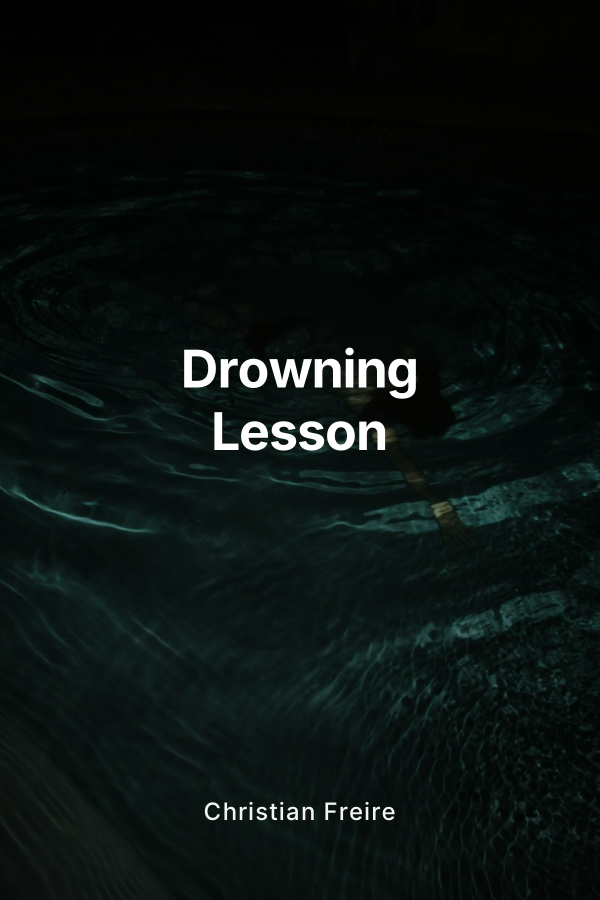
The novel follows Mara Keene, a twenty three year old rookie lifeguard who takes a summer job at a gleaming suburban aquatic complex, certain that the blue rectangle of the main pool will be her way out of debt and directionless drift. Instead, an early shift ends in a near fatal “accident” that stains the water with the first hint of something rotten beneath the chlorinated surface and sets in motion a spiral of dread, legal scrutiny, and moral erosion that will end in a mansion pool and a death she cannot wash off.
From the first chapter the book entwines two timelines. In the present, Mara stands on the brittle edge of a sensational trial, her name trending beside words like killer and cover up, as lawyers and reporters pick apart a viral video that captured the night a wealthy pool mogul’s private party ended in screams and sirens. In the past, we see the small choices, the compromises and fears, that led a conscientious if insecure young woman into the center of a legal and ethical catastrophe.
Everything begins with the early accident at the public pool, a quiet weekday morning that curdles into nightmare. Mara, still shaky in her authority and desperate to prove she belongs, is stationed alone when a roughhousing pack of kids dares each other to touch the drain grate at the deep end. One boy vanishes beneath the surface longer than he should. Mara dives, expecting the simple choreography of a textbook rescue, yet finds the child’s ankle trapped against the suction of a faulty outlet.
Time warps inside the dim, humming water. The grate vibrates, the boy’s eyes roll, her own lungs burn. Her hand slips, skin flayed against jagged metal, her whistle chain snags on the grate, and for a raw second it is not the boy but Mara who is pinned, her chest collapsing as the surface flashes far above. When she finally tears herself free, dragging the semi conscious child up into the screams and whistles of arriving staff, she staggers to the deck shaking and vomiting water, her own terror eclipsed by the manager’s fury and the facility’s panicked urge to control the story.
That scene lodges in Mara as a living splinter. Officially no one died, the boy revives, and the incident is framed as a minor equipment malfunction compounded by her “inexperience.” Unofficially the complex’s owner leans hard on her to tweak her incident report, to omit any mention of a known defect or previous complaints, while a city safety inspector looks pointedly away. Mara signs, because she needs the job, because everyone tells her this is how things work, because the memory of being held by the drain has already begun to feel like a private weakness rather than a warning.
The accident and its quiet cover up plant the book’s thematic core: the way institutions convert human fear and pain into liability, then smother it. Mara’s small act of compliance wraps a thread around her ankle that the plot will keep tightening. Her recurring nightmares of being caught under the surface feed a waking hypervigilance. Every glint of water looks like a trap, every laughing child like a future witness. Yet no one else seems to care. New filters are installed, liability waivers are updated, and the season rolls on.
Into this simmering anxiety steps Damon Cole, the charismatic owner of an expanding chain of boutique pool clubs and luxury aquatic “experiences.” He appears first as a rumor among the staff, then as a sponsor of an in service training, all perfect teeth and effortless charm, talking about “turning water into lifestyle.” Damon’s organization quietly acquires the struggling municipal complex, bringing new uniforms, stricter scripts, and a corporate code of silence. Mara should quit. Instead, she finds herself promoted. She is told the company values her composure under pressure. She is told her early accident is behind her, as long as she never speaks about it again in the wrong way.
The book’s dread deepens as Mara’s personal vulnerabilities line up with Damon’s needs. She has medical debt from an uninsured parent, student loans from a degree she never finished, and a mother who is just steady enough to guilt her for any instability. The new company offers health coverage, a modest raise, and the flattery of “lead lifeguard” on her name tag. To secure this fragile step up, she attends extra training, learns to parrot a script about “incident free aquatic excellence,” and watches as genuine safety concerns vanish into the sludgy depths of internal memos.
A pivotal mid book turning point occurs when a second, more ambiguous incident unfolds: a late afternoon crowd, a distracted parent, a toddler who drifts toward the deep end ladder. Mara sees the child, moves, and hesitates for a blink as an older guard insists the kid is “fine.” The kid slips under. The rescue is messy, the outcome barely positive, and Mara is shaken by how that sliver of doubt, that tiny pause born from her eroded confidence, nearly killed someone. This time the company’s response is smoother, more chilling. HR appears before the ambulance leaves, crafting language, orchestrating witness statements, positioning Mara as a quiet hero while subtly reminding her that any external complaint about staffing or training would “muddy” the narrative and threaten everyone’s jobs.
The story binds this mounting moral compromise to Mara’s inner psychological unraveling. At night she scratches her ankle raw where phantom pressure from the drain seems to pulse. She starts seeing patterns in the ripples of pool water, faces in the distortion of underwater lights. The smell of chlorine follows her home, clinging to her sheets, her hair, the inside of her lungs. The book maintains an ambiguous line between literal haunting and trauma response. No ghost is ever definitively shown, yet the water seems to watch her, waiting.
The second major thread is the legal and media fallout that will come later, seeded early through brief, unnerving flashes. The novel opens with just such a fragment a silent looped clip from a phone screen, replayed in a dark room. In it, a woman at a lavish pool party stands frozen while someone thrashes behind her in the lit, turquoise water. Guests shout. The camera swings. The woman does not move. That woman is Mara, but the reader will not fully understand what led to her paralysis until the story’s final pages.
As Damon’s empire grows, he begins using Mara as a quiet consultant, inviting her to exclusive events at his flagship properties. He flatters her “instincts,” then asks private questions about which policies could be “streamlined” to make guests feel more “free.” He introduces her to lawyers and investors as “our most trusted safety officer,” a title that is nowhere in her contract yet binds her more tightly to the company’s choices. With each party she attends, Mara sees a new layer of risk hidden under the gloss: overloaded decks, alcohol with no lifeguard coverage after set hours, staff reduced to decoration rather than protection.
Mara tries to push back in small ways. She sends cautious emails about ratios and signage. She leaves anonymous tips on regulatory hotlines that go nowhere, crushed beneath backlog and lobbying influence. She considers quitting again, only to find that the company’s non compete clauses, debt entanglements, and her own bruised resume make escape perilous. Her world slowly shrinks to the tiled edges of other people’s pools.
When an investigative journalist begins sniffing around Damon’s empire, asking pointed questions about past incidents, Mara is split between terrified complicity and a flicker of hope. The reporter hints they have heard about the early drain accident, about more serious events that Damon’s legal team may have quietly buried. Mara’s internal conflict peaks here. If she tells the truth, she risks losing her job, being sued for breach of confidentiality, even facing criminal exposure for falsifying reports. If she remains silent, she can feel the next tragedy building like a pressure wave under her feet.
The novel’s climax unfolds at Damon’s seaside mansion during a decadent summer blowout, the night that will later be known online as “the drowning gala.” Mara is invited as both staff and guest. She is told to “circulate,” to reassure nervous VIPs about water safety while looking elegant in a branded swimsuit cover. Security cameras glitter from the eaves. Guests have phones in hand. Liquor flows. The pool is a monumental architectural masterpiece, with an invisible edge vanishing into the dark horizon.
By this point Mara is already unraveling. She sees children darting where no lifeguards have been assigned, drunk adults daring each other to jump from a balcony, inflatable toys obscuring sightlines. The music throbs. The surface flash of the water begins to strobe with her memories. At the edge of the deep section she notices a familiar flaw in the drain housing, something off in the angle of the grate. Her ankle throbs. She warns a junior staffer, is brushed off, and finally approaches Damon directly.
In a sick echo of the first accident, Damon smiles, squeezes her shoulder, and tells her not to “borrow trouble.” He reminds her who pays her student loans. He reminds her who wrote a quiet letter to keep that first “little mishap” off her official record. He says that if she cannot trust herself around water, maybe she is in the wrong line of work. The threat is soft yet absolute. Mara walks away feeling as though the ground itself has tilted.
The fatal sequence that follows is depicted with suffocating, intimate detail, the narrative repeatedly cutting between Mara’s blurred perception that night and the cold, objective, looping viral footage later dissected in court. A guest slips under the surface near the infinity edge. People shout playfully at first, filming, assuming the splashing is still part of the party. Mara hears something in the tone of one voice and turns. Her body locks. For one unbearable instant she is back at the first pool, her whistle chain caught, the grate humming, the water above thick as glass.
In the video she appears to glance toward the deep end, to register the struggle, then to stand frozen for several heartbeats while the victim’s motions slow. It is another guard, not Mara, who finally dives. By then it is too late. That gap between awareness and action becomes the prosecution’s central exhibit, the fulcrum on which her fate will balance.
The book’s final act details the aftermath with unflinching realism. The death at the mansion detonates Damon’s carefully curated brand. Screengrabbed clips from guests’ phones collide online with leaked photos of earlier incidents, including the child nearly crushed by the defective drain at Mara’s first job. The narrative shows how a tragedy becomes content, how strangers construct and contest moral judgments in comment threads while the real people caught in the blast radius can barely breathe.
Mara finds herself simultaneously villain and pawn. Civil lawsuits name her as a negligent professional, while Damon and his corporate entities attempt to shift liability onto her by emphasizing her supposed independent authority as “lead safety officer.” Her own past incident reports, the ones she altered under pressure, are produced in court as evidence that she minimized risks, that she normalized lax practices. She is interrogated on camera about the seconds of hesitation in the viral clip. Experts debate whether her response met, failed, or surpassed industry standards.
The realistic legal fallout is one of the book’s most harrowing elements. Rather than sensational car chases or melodramatic outbursts, the horror resides in depositions held in bland conference rooms, in the slow grind of discovery, in the way language is twisted into weapons. Lawyers parse the difference between accident and foreseeable harm, between mistake and culpable negligence. Insurers maneuver to avoid payout, citing technicalities in training documentation and contractual fine print. Damon’s partner, who structured much of the company’s liability shield, slithers through questioning without direct exposure, leaving Mara to absorb much of the public rage.
Intercut with this procedural dissection are chapters of Mara’s isolation. She returns to her childhood home between hearings, where neighbors avoid her gaze, where her mother hovers between love and resentment at the media harassment. Reporters stalk the sidewalk. Someone spray paints murderer on the old family mailbox. Mara’s world, once made of water and tiled floors, shrinks to the airless rectangle of her bedroom and the flicker of screens replaying her worst moments.
The book never lets the reader fully relax into the idea that Mara is purely a victim. She knew. She signed. She looked away. At key moments she chose job security over truth. Yet it also reveals the systemic pressures that corroded her judgment, the way individual accountability is both necessary and insufficient when massive corporate interests are built on risk externalized onto low paid front line workers. The question of whether Mara “deserves” the weight of blame she receives hangs unresolved like humidity over deep water.
In the courtroom sequences the drainage accident that opened the book returns in forensic detail. Engineers testify about suction forces, obsolete equipment, and ignored safety bulletins. Regulators admit to understaffing and inadequate inspections. The boy she once saved, now older, is wheeled in to describe nightmares of being unable to reach the surface. The line between that day and the mansion drowning is drawn and redrawn for the jury, as each side tries to own the narrative. Mara watches a sanitized, diagrammed version of her memories projected on a screen, feeling as if her inner life has been stolen and turned inside out.
As the verdict approaches, the supernatural undertones of the story crest without ever becoming overt fantasy. Mara’s sense of being followed by water intensifies. She wakes with damp footprints on the floor that may be condensation. She hears faint gurgling beneath the hum of fluorescent lights at the courthouse. In the bathroom she sometimes glimpses, in the mirror behind her, a blurred crowd reflected as if through water, as though all the drowned and almost drowned whose lives intersected with Damon’s empire are standing just outside her field of vision.
The novel’s resolution refuses easy catharsis. Legally, the outcome is mixed. Certain charges are reduced, others stick. Civil settlements are negotiated offstage. Damon suffers serious reputational and financial damage but avoids prison, shielded by layers of incorporation and carefully distributed responsibility. Mara faces a narrower but deeper kind of sentence a lifetime prohibition from aquatic work, a fractured public identity, and the inescapable private knowledge that she once froze when she most needed to move.
In the final chapter she returns alone to the derelict municipal pool where it all began. The complex is slated for demolition, drained, scabbed with algae and graffiti. She climbs the rusted ladder of the lifeguard stand one last time and looks down into the empty basin. Without water, the stains on the concrete look disturbingly like shadows of former swimmers. Wind scrapes loose leaves across the floor with a sound like distant waves. In that silence she finally lets herself remember every detail of the early accident without corporate filters or self protecting edits. She says the boy’s name aloud.
There is no ghost that rises from the deep, no spectral hand that drags her under. The horror is quieter the realization that safety was always a story people told themselves to feel brave enough to step into the water. What failed was not one broken grate, not one frozen lifeguard, but an entire culture that priced risk, outsourced blame, and treated human lives as entries on a balance sheet.
“Drowning Lesson” ends with Mara walking away from the ruined pool into a future that is uncertain and legally constrained yet not entirely void of agency. She cannot undo what happened. She cannot resurrect the dead or scrub away the video. Yet she can refuse, finally, to sign away her version of events to anyone else. The last image is of her thumb pressing against a recorder app on her phone, beginning to speak the story as she experienced it, in her own cracked, halting voice.
As a whole, the novel is a slow tightening of invisible fingers around the reader’s throat, a study in how ordinary procedure and plausible liability can mask moral horror until the moment a camera lens happens to be pointed in the right direction. Its dark atmosphere builds from tangible details the sting of chlorine in the back of the nose, the smear of underwater lights across the ceiling, the aching weight in a rescuer’s arms rather than from overt monsters. The dread arises from recognition, from the uneasy knowledge that any one of us might find ourselves standing at the edge of the water, hearing a cry, and not knowing until later whether we moved fast enough.