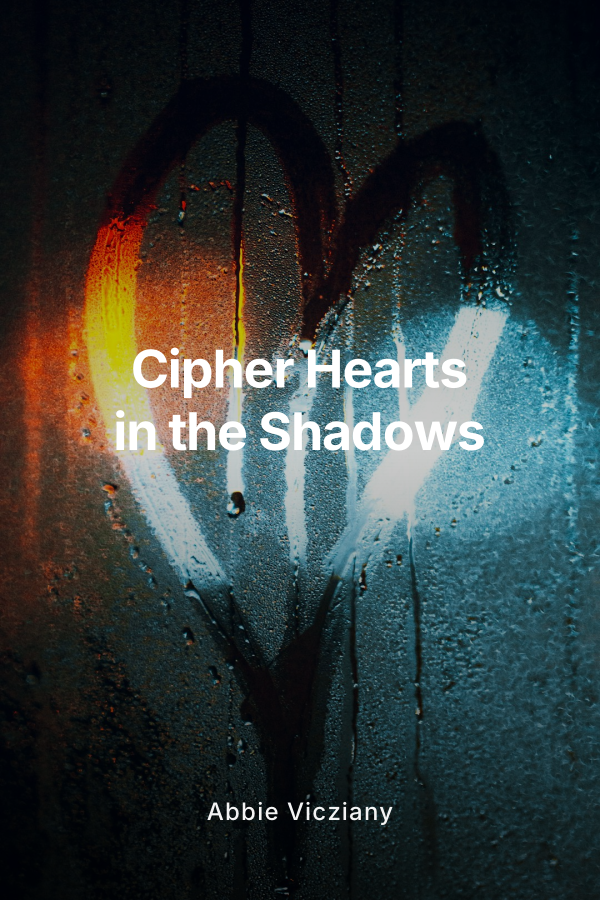
In a world where information is more powerful than bullets, two gifted secret agents are the last line of defense between order and chaos. Rosewood and Walter were never meant to trust each other, let alone fall in love. They are weapons shaped by different hands, sharpened by rivalries, burdened by extraordinary abilities that make them invaluable and dangerously fragile.
Rosewood is a legend whispered about in the corridors of agencies across the globe. With a gaze that cuts through lies, she reads micro-expressions so precisely that even the most disciplined operatives flinch beneath her attention. Every twitch, every tremor, every flicker of an eyelid becomes a confession in her hands. Her gift is her edge, her shield and her prison. It makes her impossible to deceive and unbearably easy to isolate. People fear what she sees. People fear what she knows.
Walter is the rumor no one can prove, the ghost who moves through firefights with uncanny precision. In moments of crisis he can slow his own perception of time, stretching seconds into lifetimes inside his mind. Bullets carve lazy arcs, footsteps echo for ages, choices crystallize with brutal clarity. It is not time travel and it is not invincibility. It is a costly miracle that drains him, leaves him shaking, and tempts him to sacrifice more of himself each time he uses it. His ability makes him lethal on the field and deeply vulnerable when the world speeds back up.
Their agency knows enough to exploit them and not enough to understand them. Their gifts are logged, measured, weaponized. Their exhaustion is dismissed as collateral. Their hearts are treated as irrelevant. They are assigned where the risk is greatest and the margin for error is nonexistent.
When whispers surface of a looming global data hack, Rosewood and Walter are forced onto the same assignment. The threat is chilling in its simplicity. A coordinated cyberattack will fracture the world’s financial systems, cripple infrastructure across continents, and unlock vaults of private data for the highest bidders. It is not just a matter of crashing markets. This hack will expose every undercover operative working in the shadows, tear off the masks that keep them alive, and throw governments into chaos. If they fail, millions will suffer and their own agency will burn from the inside out.
Their mission drags them through crowded European streets, across glassy corporate towers and rain-slicked rooftops, into cramped safehouses in American cities, and through a hidden network of foreign bolt holes where trust goes to die. Every city feels like another chessboard. Every crowd hides a sniper, a pickpocket of secrets, a face that might be friend or enemy. The world becomes a web of screens and codes, of handoffs and half-truths, of eyes always watching.
Rosewood and Walter meet in the worst possible way. She is the analyst pulled reluctantly into fieldwork, bristling with suspicion, armed with a mind that sees through masks. He is the operative who cares more about results than rules, reckless in a way that both infuriates and intrigues her. Their first encounter is an argument disguised as a briefing, an instant clash of wills that paints them as enemies before the mission even begins.
Their rivalry is not theatrical. It is survival. Rosewood believes Walter is dangerous because he trusts his instincts more than the plan, more than the evidence she can read on every face. Walter believes Rosewood is a liability because she hesitates to act without understanding the motives behind the movements she deciphers. They carry old scars and stale grudges, their histories with the agency marked by secrets they are not allowed to share.
Yet from the start, something complicates their hostility. Beneath the sharp words and sharper glances, a reluctant interest blooms. Rosewood cannot stop noticing Walter’s steadiness in a crisis, the careful way he positions himself between her and danger without acknowledging it. Walter cannot ignore the way her voice softens when she reads a witness who is truly afraid, or how her eyes darken when the agency asks for more than it should.
They keep their curiosity buried, locked away alongside classified files and bruised memories. Neither can afford to fall for a partner who might not be there tomorrow. Neither can risk giving the agency leverage in the shape of a heart.
The deeper they dig into the conspiracy surrounding the global data hack, the clearer it becomes that nothing about their mission is simple. The villain is not just a faceless hacker in a dark room. The enemy is a network of mercenary coders, rogue operatives and corrupted insiders who twist the tools meant to protect the world into instruments of control. Every success on the field reveals another layer of betrayal. Every lead they follow ends in a dead end or a body.
On a rooftop in a European city, under a cold slice of afternoon sky, everything shifts. Surrounded by enemies and out of options, Walter pushes his ability beyond what he has ever attempted. Time in his mind slows to a suffocating crawl as he calculates impossible angles, planning how to pull Rosewood from the path of bullets she does not see yet. He saves her, but the cost nearly kills him. In those suspended heartbeats, Rosewood sees something that terrifies her more than any threat. She sees the way he looks at her when he thinks there is no future left to protect.
In the aftermath, as Walter lies shaking and half-conscious and the world surges back to its normal speed, Rosewood realizes that keeping her feelings buried will not keep either of them safe. It will only make the losses more brutal when they come.
Together they begin to move not as enemies forced to cooperate but as partners who know each other’s limits and fears. Their banter evolves from barbs to armor, from cruelty to a shared language of deflection that lets them feel closer without admitting it. In tense interrogations, she reads the flicker of doubt in informants’ eyes while his slowed perception lets him anticipate the exact second things will explode. In the quiet hours between missions, when the only sound is the hum of old refrigerators in rented safehouses, they share fragments of their pasts in the darkness.
The global stakes and the personal stakes spiral together. The closer they come to identifying the architect behind the hack, the more the enemy anticipates their movements. Operations fall apart at the last second, plans are exposed from within, and both Rosewood and Walter must confront the possibility that someone in their own chain of command is feeding information to the other side.
A mission goes wrong, catastrophically wrong, leaving them stranded in a foreign safehouse with their aliases burned and their extraction delayed. Exhaustion, guilt and adrenaline strip away their last defenses. Surrounded by cracked plaster and outdated maps, pressed close by the thin walls and the whir of outdated air vents, they finally speak the truth they have been dodging. Confession does not come in one cinematic burst but in fragmented, trembling sentences. They admit the fear that losing each other is becoming worse than any professional failure. Their first kiss is not clean or perfect. It is messy, desperate and real, born out of the knowledge that at any moment the door could burst open.
From that night on, they are no longer just partners. They are two people in love in a profession that has no place for love, fighting an enemy who would gladly exploit that fact. Their bond becomes both a risk and a weapon. They learn how to shield it, how to build strategies around their concern for each other instead of pretending it does not exist. Rosewood uses her insights to anticipate who might target their connection. Walter times his ability not to be a hero, but to make sure neither of them has to stand alone.
The climax of their mission forces them into an impossible choice. To stop the final phase of the data hack, one of them must stay behind in a compromised facility while the other escapes with the only physical copy of the decryption key. The agency demands the mission take precedence over any single life. Love, according to the protocol, is a variable to be ignored.
Rosewood and Walter refuse to ignore it. In a final act of defiance against both the enemy and the cold arithmetic of their own side, they rewrite the outcome together. Combining her uncanny read of human intentions with his painfully extended perception of time, they orchestrate a last stand that is not noble sacrifice, but a calculated, furious insistence on surviving together.
The hack is stopped. The global markets stabilize, the agents in the field remain in the shadows, the world continues spinning, mostly unaware of how close it came to fracture. Not every betrayal is punished. Not every question is answered. The mastermind behind the chaos pays a price, but the roots of the corruption run deep.
In the aftermath, the agency tries to separate them, to redistribute assets and erase attachments. Rosewood and Walter have faced bullets on rooftops and death in safehouses. They have seen what it costs to give up your heart to the job. This time, they choose each other. Through quiet rebellion and uncompromising loyalty, they carve out a fragile space where their love can coexist with the work that defines them.
Cipher Hearts in the Shadows is a romantic, high-stakes tale of two elite agents who begin as rivals, collide as reluctant allies, and emerge from fire and betrayal as lovers bound by more than obligation. It is a story of rooftop chases and whispered confessions, of secret abilities that hurt more than they help, of loyalty tested in blood and code. Above all, it is a story about what it means to find the one person you would risk everything for, in a world that insists you risk nothing but your life.