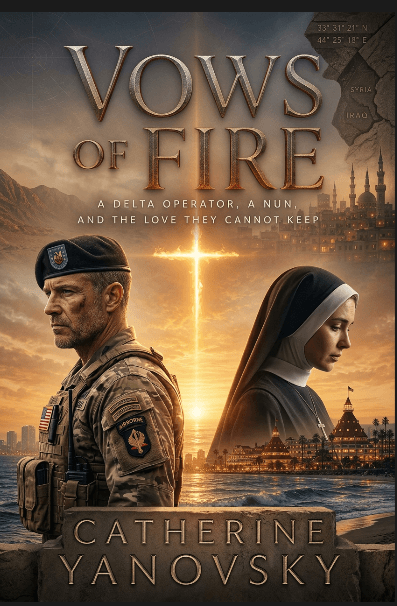
In 2024, off the sunlit coast of Coronado, California, two lives collide on a stretch of sand that belongs to neither church nor base. Dave Walker, a seasoned Delta Force operator temporarily training with the Navy SEALs, is used to reading threats at a glance. When he spots a young woman jogging the shoreline in simple exercise clothes, what captures him is not danger but an inexplicable sense of peace. Sister Mary Catherine, twenty‑six, Roman Catholic nun with a quiet radiance and a lineage that weaves Italian, Irish, and Mexican roots, feels the force of that first shared look just as sharply. It is love at first sight disguised as a chance meeting, and neither of them yet knows the other’s true life.
What follows is a slow, restrained unfolding of a forbidden bond. Their paths cross in town and at the local parish where Mary Catherine serves, and their friendship grows in the spaces between deployments and daily ministries. Dave is drawn to her purity of heart, to the way she looks directly at the violence he carries and still sees the man inside the warrior. She in turn is disarmed by his courage and honesty, and by the shadows of Post Traumatic Stress that he tries to hide. The easy laughter they share over coffee, the quiet talks on church steps after evening Mass, and the few simple prayers she offers for him create an intimacy that is deeper than either intended.
Yet every shared moment sharpens an inner conflict that defines the heart of the story. Dave knows she belongs to God, that her brown hair, hazel eyes, and olive skin are veiled not by cloth but by vows. He has taken lives in the Middle East, makes his living in the shadows of war, and feels unworthy of the serenity she embodies. Mary Catherine, a nun since nineteen and a virgin who has never truly tested the limits of her vocation, discovers that beneath her habit she is still a woman who longs for marriage and children. The memory of her father, a special forces soldier killed when she was four, both pulls her toward Dave and warns her away. She understands the cost of loving a man whose life is pledged to danger.
As Iran raises threats against neighboring countries and Israel, Dave is sent on a series of short, razor‑sharp covert missions. The pace of the novel tightens as the narrative alternates between his operations in the Middle East and her quiet, relentless service at the Coronado parish. While he infiltrates enemy territory, plans extractions, and makes split‑second decisions in dusty alleys and desert nights, she teaches catechism, tends to children, visits the sick, and kneels in the hush of Adoration. The contrast between his external wars and her interior battles anchors the action thriller in a deeply spiritual struggle.
A key turning point comes when a mission goes catastrophically wrong. Dave loses his closest Delta buddy, the man who has watched his back for years. In the chaos that follows, Dave faces a moral and spiritual collapse. The death is not just another casualty in an endless theater of war; it is a crack in his carefully controlled soul. He questions every kill, every order obeyed, and feels a frightening emptiness where his sense of purpose used to live. In the heat and dust, with gunfire still echoing in his memory, he senses a spiritual loss that terrifies him more than any battlefield.
On his return to Coronado, the story narrows around his reunion with Mary Catherine. Grief, guilt, and numbness collide in him, and she becomes the one safe harbor he trusts. Their conversations turn more vulnerable, stripped of pretense. She listens as he describes the mission in halting fragments, and when words fail him, she simply remains beside him in silence. It is in these moments that she prays with him gently, not lecturing or preaching, but speaking of a God who does not abandon the broken. Simple prayers become bridges between his violence and her vocation.
The religious realism intensifies as Mary Catherine wrestles with the gravity of her vows. Scenes of confession with her parish priest guide her discernment, highlighting the Catholic understanding of sin, conscience, and grace. She admits her growing attachment to Dave and the awakening of desires she thought her habit had sealed away. Her priest reminds her that obedience is not the absence of feeling but the choice to place those feelings under a higher love. Yet no counsel can remove the very human ache she feels when Dave sits in the pews, head bowed, or stands at the back of the church in his dress uniform, a living reminder of the life she might have chosen.
The night that changes everything does not come with fireworks but with a quiet inevitability. After a memorial Mass for Dave’s fallen teammate, emotions run raw. Dave can no longer shoulder his grief alone, and Mary Catherine can no longer hold back the storm within her. In a private moment that begins with comfort and shared tears, restraint slips. Their one night of intimacy unfolds with tenderness and urgency, shaped by years of buried longing and the awareness that what they are doing violates the very vows that define her life. The sensuality is real, yet framed in the tragic knowledge that this act is at once an expression of love and a step across a sacred boundary.
Morning brings not simple regret but a deep, complicated reckoning. Both characters experience the night as a paradox: a moment of profound human union and a rupture in Mary Catherine’s consecration. Dave fears he has stolen something holy from her, while Mary Catherine feels both the sweetness of finally knowing the touch of the man she loves and the weight of having failed the promise she made to God. The Catholic framing of sin and forgiveness is woven through their internal monologues and her return to the confessional, where she names what happened not to be crushed by shame, but to seek mercy and clarity.
From here, the narrative moves toward its bittersweet end. Dave continues to deploy, now carrying the memory of that night as both a comfort and a penance. His sense of God grows not from simplistic answers but from facing his own brokenness. In the heat of later missions and the quiet of barracks nights, he recalls Mary Catherine’s prayers and begins to reach toward a faith that can coexist with his painful past. Her influence becomes a quiet light at the edge of his battlefield world, pointing him toward a God present even in blood‑stained sand.
Mary Catherine, after intense spiritual struggle, chooses to renew her vows with deeper conviction. She recognizes that her love for Dave is real and enduring, but that her call is to serve a larger field of souls. Her longing for marriage and children does not vanish, yet she offers it back to God, trusting that her sacrifice will bear fruit in unseen ways. Through her priest’s guidance and her own prayer, she comes to believe that even their fall is not outside the reach of grace. Their shared sin becomes a place where God’s mercy can work, rather than a final condemnation.
The closing chapters parallel their separate paths. Dave, perhaps lighting a candle in some small chapel near a base, thinks of her with gratitude rather than despair. Mary Catherine, praying in Coronado, holds him in intercession, no longer asking for a way to be together, but for his protection and healing. The external threat in the Middle East remains, the cost of war is not minimized, and the wounds of trauma do not magically disappear. Yet within that harsh reality, both characters find a quiet, hard‑won peace.
The final tone of the book is one of gentle acceptance. Readers are left with the sense that love can be true even when it cannot be kept, that vocation sometimes demands sacrifice that does not make emotional sense, and that God’s presence can inhabit even our most painful failures. Vows of Fire becomes not only a military action romance set against real‑world tensions in Iran and the Gulf region, but also a meditation on God’s presence in brokenness, the mystery of forgiveness after sin, and the different shapes that heroic love can take.
Free Preview
2 pages leftUnlock full book for just $4.99