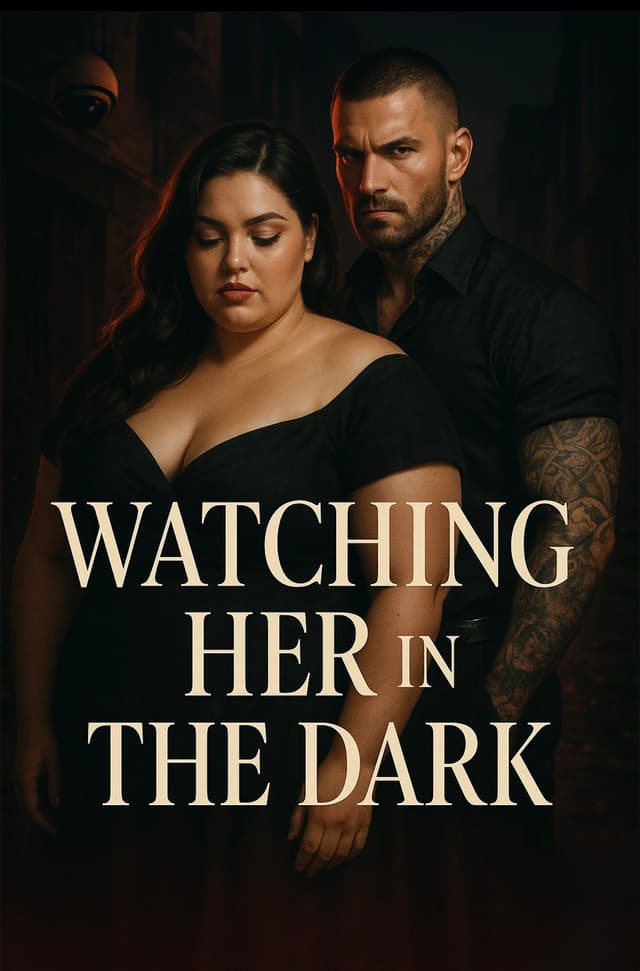
Watching Her in the Dark is a full length, dual POV dark stalker mafia romance that follows Julie, a shy twenty three year old plus size woman who hates her own body, and Marcus, the ruthless tattooed mafia boss who becomes obsessed with her from the moment he first sees her crying alone on a city street. It is a story steeped in obsession, voyeurism, sexual violence, and moral ambiguity, written for adult readers who crave very dark, explicit, psychologically intense romance where the “happy ending” is twisted, codependent, and consciously chosen rather than clean or redemptive.
From the outside, Julie’s life is small and painfully ordinary. She works in an office where her coworkers bully her behind her back, mocking her weight and inexperience in a group chat she is never meant to see. The day those messages accidentally land in her hands, calling her a virgin and a “big girl,” becomes one of the memories that defines her self hatred, confirming the fear that her soft belly and thick thighs are proof she is unlovable. At home, in a cramped apartment, she reads dark romance novels, plays survival video games, and disappears into stories where women like her are finally seen, desired, and claimed. She comforts herself with fantasies of faceless men who might worship every inch of her, while in real life she avoids mirrors, hides her body even when she is alone, and promises herself that no one will ever see her naked long enough to laugh.
What Julie does not know is that someone already sees everything. Hidden cameras watch her undress, cry over cruel texts, binge read on the couch, and touch herself in the shower. Marcus, a six foot five, heavily tattooed mafia boss who wears power like a second skin, has turned her apartment into a private screen he cannot look away from. From the first night he spotted her walking home from work with tears on her face, he decided she was his, a fragile, hurting woman he would protect and possess at any cost. In his mind, surveillance is safety. In practice, he has broken every boundary she never even realized she had.
The story detonates when Julie walks home one rainy night after another degrading day at the office. As she hurries down slick streets, strangers close in with the clear intent to hurt her. Before they can, a masked giant wrenches them off her, beating them with brutal efficiency. His gloved hands are firm and merciless. His mask hides everything but the ink climbing his throat. Terror and arousal slam into Julie at once. Her love of dark romance and survival games twists what is happening into something half nightmare, half fantasy. She fears she might be next, that this violent stranger will turn on her, yet the heat pooling between her thighs horrifies her more than his fists.
Shaking and soaked, she flees home. In the shower, steam rising around her, she replays every second of the rescue. She imagines the masked man’s hands on her, his tattooed arms pinning her, his voice rough in her ear. She masturbates to that memory and hates herself for it, thinking, he could have hurt me too, why am I turned on by this, no one in real life would want me like that, he was probably disgusted by my body. What she does not know is that Marcus watches this too, jaw clenched, guilt and desire colliding as he sees her skin flushed and vulnerable under his unblinking cameras.
Days later, Marcus “meets” her in public as if for the first time, bumping into her on the street and asking for directions. He already knows her schedule, her favorite café, the way she startles when men look too long. Pretending to be a harmless stranger, he becomes a regular presence, staging chance encounters until Julie begins to trust him. He plays the courteous gentleman, the one man who does not laugh at her, who holds doors and listens when she speaks. Compared to coworkers who text about how pathetic she is, Marcus feels like an impossible fantasy that stepped out of one of her dog eared romance paperbacks.
The first half of the book traces this tightening net. From Julie’s POV, readers live inside the constant churn of shame and longing. She pinches her belly in the mirror, hears the office group chat insults echo whenever Marcus compliments her, and wonders why he would ever want someone like her. From Marcus’s POV, readers see how far his obsession goes. He keeps a mental list of everyone who hurts her. He watches her read, game, cry, and touch herself. He believes that his stalking is the only way to keep her safe. His right hand man and best friend, a loyal enforcer with more conscience than he lets on, warns him that this fixation will destroy them all, but Marcus cannot stop.
The turning point strikes halfway through, when a rival gang kidnaps Julie. They have been watching Marcus, know he has a secret weakness, and snatch her from her ordinary commute. She wakes naked, bound, and surrounded by strangers who call her his little pet. They drag in screens that show footage of her own apartment, of her dressing, showering, crying about her body, and masturbating in the shower after the rainy night rescue. Every private moment she thought was hers alone has been recorded, archived, turned into currency. Humiliation and horror roll through her. I am dirty and ruined, they saw everything, they all saw me, she thinks, and underneath it all, one raw truth: I hate him for watching me.
Then the rival gang moves from psychological to physical violation. They undress her fully and begin to assault her, hands and mouths where no one has ever been, taunting her with Marcus’s obsession and her own arousal on screen. Just as one man positions himself between her legs to force himself inside, the door explodes open. Marcus storms in like a nightmare given form, killing, maiming, and destroying with a ferocity that terrifies even his own men. The scene is graphic, bloody, a self destructive rampage fueled by the fear that he might be too late. He cuts Julie free, but she is beyond screaming. Shock slams her system into shutdown.
From this point, the book becomes a claustrophobic study in trauma and obsession. Julie wakes in a medical room in Marcus’s basement, bright lights and unfamiliar faces crowding her vision. Doctors work over her. Henchmen hover, terrified of what might happen if she breaks. His right hand man tries to be gentle, offering blankets and water, while the room itself reminds her she is both patient and possession. Julie avoids eye contact, refuses to be touched, and hides under the blanket that covers her nakedness. In the shower, she scrubs her skin until it burns, convinced that Marcus and his men are disgusted by what they saw.
Inside, her thoughts are a constant loop: I am dirty and ruined. He saw everything. This is his fault. He saved me. He violated me. He is the only one who wants me. I hate him. I need him. The book does not soften these contradictions. It leans into them, letting readers feel the sick, dizzy coexistence of gratitude and revulsion, desire and fear. Marcus, meanwhile, keeps his distance, afraid to touch her even when she reaches for him. He quietly erases every second of footage from the rival gang’s hands and his own archives, punishes those who looked at her without his permission, and wages another bloody campaign against anyone involved in her kidnapping. His rage almost tears his own organization apart.
As Julie slowly stabilizes in the mansion, small cracks form in her belief that everyone is disgusted by her. She overhears Marcus snarling at his men to never look at her again, notices the right hand man averting his eyes from her nakedness with real respect, and sees that no one treats her like a joke. At the same time, nightmares and flashbacks haunt her. She vacillates between pushing Marcus away and clinging to him during panic attacks. Some nights she lies awake replaying the shower where she touched herself after the first rescue, disgusted that part of her still wants the man whose cameras turned that intimacy into a movie.
The second major explosion comes when the mansion is attacked. A rival faction decides that the only way to unseat Marcus is to aim directly at his new weakness. Julie finds herself hiding on the second floor staircase, watching chaos erupt below. Bullets shred walls. Men she vaguely recognizes from hushed meetings drop one by one. She sees Marcus fighting, mask on, eyes wild. In the confusion, someone knocks his mask off. For a frozen second, she sees the face of the man who has been courting her in daylight on the body of the masked vigilante who saved her in the rain.
Shock, panic, horror, rage, and terror crash into her all at once. The man from her fantasies, the man whose cameras have watched her every move, the mafia boss tearing the world apart to keep her, and the gentle stranger she has been falling for are the same. Before she can process it, he takes a bullet and goes down. Blood spreads across his tattoos. The right hand man drags her away while she runs and hides, certain he is dying.
He does not die, but the near loss shatters something in Julie. While Marcus lies unconscious, she cycles through guilt for not warning him about the attackers, fury that he ever stalked her, terror at the idea of a life without him, and the dawning realization that no one else has ever, or will ever, want her with this intensity. When he wakes, she finally confronts him. The scene is raw and hesitant. She is nervous and shy, still shaking from everything, but she forces herself to ask how long he has watched her, why he put cameras in her home, whether he enjoyed seeing her humiliated and begging in front of strangers.
Marcus swings between hard self justification and exposed remorse. He admits he first saw her crying and vowed to protect her, that he needed to know where she was at all times, that he truly believed surveillance and control were the only ways to keep her safe. He does not excuse himself, but he cannot fully condemn himself either. Julie, in turn, admits things she never expected to say aloud, including the shameful fact that part of her is aroused by what he did, that being watched makes her feel both sick and powerful, that his obsession burns away the chorus of voices telling her she is disgusting.
From here to the end, the book traces Julie’s slow, conscious shift from victim trapped in her stalker’s mansion to woman who chooses a twisted, dangerous love. She continues to tell herself no one else would ever want her, that he sees her when no one else does, that maybe she deserves this brand of love because she is broken. She keeps cataloging every small act of devotion: the way he touches the parts of her body she hates most with reverence, the fact that he refuses to let anyone insult her, the way he is terrified of her flinches and therefore of his own hands.
A quiet but powerful subplot develops between Julie and the right hand man, who evolves into a reluctant, almost brotherly protector. He warns her who Marcus really is, hints at old bloody stories, explains the rules of their world, and honestly urges her to be sure about staying. He is the one who sees how deeply her body hatred and coworkers’ texts have scarred her. Through late night conversations, readers see Julie begin to articulate that Marcus’s obsession gives her a sense of being chosen she has never felt before.
The symbolic climax arrives when Julie secretly gets Marcus’s mafia boss tattoo inked into her own skin, a mark of belonging no one asks her to take. She does it after the second raid, after nearly losing him, after hearing doctors say he almost died. Alone in a tattoo chair, she thinks, if I am already ruined, I might as well belong to the man who ruined me, this way I am not a victim, I am choosing. The ink hurts, but she embraces the pain as proof of agency.
Someone else, not Marcus, sees the tattoo first. Perhaps the right hand man catches a glimpse while bandaging a wound or a doctor notices it during a routine check and later whispers to Marcus. However it happens, the discovery is accidental and loaded. When Marcus learns that Julie has marked herself with his symbol, he spirals. Rage at the permanence, fear that she has tied herself to a monster, and desperate affection for a woman willing to be his collide. He paces, raises his voice, accuses her of not understanding what this means. Then, seeing she is truly choosing him, he breaks, the mask of control finally cracking.
The final movements are quiet rather than explosive. In a low lit bedroom after the chaos of recovery and confrontation, Julie seeks contact while Marcus is afraid to touch her, terrified of hurting her again. She climbs closer, guiding his hand to the tattoo. They speak in low, halting sentences about apologies, confessions of love, and the reality that what they share is wrong by any sane measure but still theirs. He promises no more secrets and no more cameras without her consent. She admits that part of her will always hate what he did, yet another part cannot live without the way he looks at her. They agree they will never be normal, but they can be honest.
The book closes on a note of dangerous, imperfect peace. There are hints of ongoing threats in the city, men still loyal to enemies, risks that come with loving a mafia boss who has publicly claimed her. Yet inside the mansion, there is a quiet domesticity building between them: shared meals, private jokes, evenings reading while he works nearby, a weapon placed in her hand, and visible signs that she is his. The last image circles back to the beginning. Where Julie once walked home crying, convinced no one would ever want her, she now stands with Marcus overlooking the city, his tattoo mirrored on her skin, fully aware that she has stepped into a cage and locked the door from the inside.
Watching Her in the Dark does not offer easy catharsis or moral reassurance. It is a story about a plus size heroine whose lifelong body hatred leaves her vulnerable to a kind of love that is both protective and violating, and about a man whose need for control twists into stalking even as he is the only person who ever truly cherished her. It asks readers to sit with the discomfort of a woman who knows her love is unhealthy and chooses it anyway, not in ignorance, but in defiance of a world that has always told her she is too much and not enough at once.