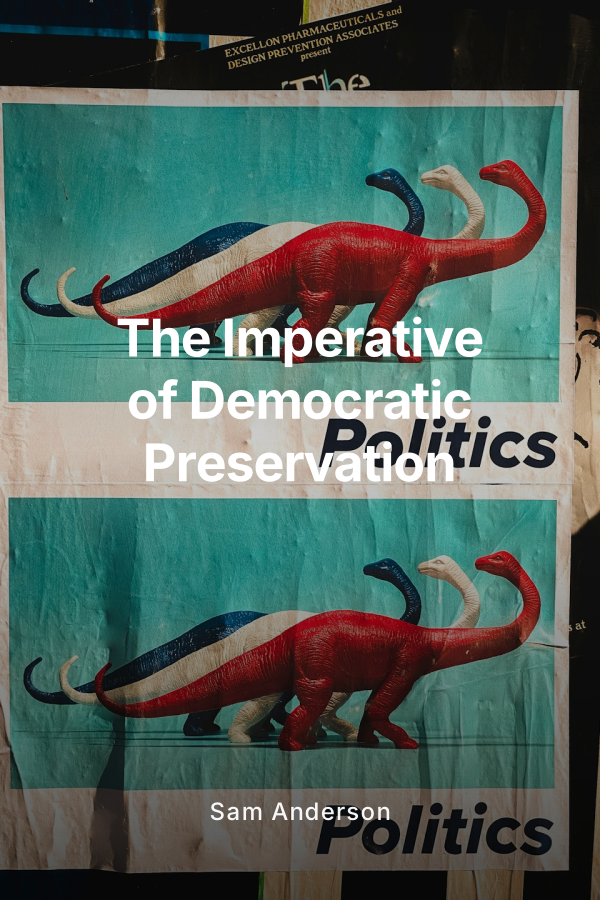
This book offers a sweeping, conceptually rigorous account of why democracies across the world are fraying and what it would take to preserve them as living projects rather than nostalgic slogans. It argues that the familiar script of democratic “waves” followed by stable “consolidation” no longer fits a world where elected governments hollow out institutions from within, citizens lose faith in democratic procedures, and external actors exploit economic and digital interdependence to undermine liberal norms.
Across five chapters and roughly ten thousand words, the book advances a central claim: democracy today must be treated as an ongoing work of preservation, not a finished product. Democratic preservation is defined as the continuous effort to prevent erosion of institutions and norms while keeping open the possibility of deeper self‑government over time. It is not merely about avoiding coups or overt breakdown. It is about understanding and interrupting subtle, cumulative processes that turn once meaningful democracies into competitive authoritarian regimes that still hold elections but no longer allow genuine alternation in power.
The core audience is a mixed community of policymakers, practitioners, and scholars who sense that something more than “business as usual” is required but need a clearer map of the new terrain. The book avoids both fatalism and technocratic complacency. Instead, it offers a language and toolkit for those who want to defend democratic baselines, confront new threat patterns, and rebuild democratic ambition in societies where trust and patience are running thin.
Chapter 1, “From Expansion to Fatigue,” reframes the story that structured much of the late twentieth century. Where earlier decades were narrated as a triumphal surge of democratization, this chapter shows how the apparent victories of that era carried within them deep vulnerabilities. Many citizens who were promised responsive government and fairer economies instead encountered systems that felt noisy but ineffectual, simultaneously saturated with conflict yet unable to address entrenched inequalities, climate risks, or racialized exclusion.
This section introduces the notion of democratic fatigue. Fatigue is not reduced to cynicism or apathy. It is treated as a political condition that arises when expectations built up during transitions collide with institutions that seem captured, polarized, or unresponsive. Citizens become tired of defending a system that yields diminishing returns. Elites grow impatient with checks and balances that limit their room to maneuver and become tempted by shortcuts that erode liberal safeguards. International actors lose confidence in democracy promotion as a reliable investment, especially when geopolitical competition sharpens and coordination problems deepen.
The chapter also explains how global conditions have shifted. Economic and digital interdependence, once hailed as channels for liberal norms, now also serve as vectors for surveillance, economic coercion, and sophisticated propaganda by authoritarian and hybrid regimes. Authoritarian powers project an image of efficiency and order, while perfecting tools that blunt external pressure and inspire imitators. In this environment, standard consolidation theories that assumed a one way movement from uncertainty toward stability no longer capture the risks faced by either young democracies or long established ones.
Chapter 2, “Why Consolidation Is No Longer Enough,” takes aim at the conceptual framework that dominated scholarship and policy thinking in the wake of the so called third wave. Consolidation theories focused on how new democracies might lock in transitions so that coups or relapses into single party or military rule would become unlikely. They assumed a linear temporal sequence: liberalization, transition, early fragility, then a plateau of stability in which “democracy” could be treated as a fixed regime type.
The book argues that this script no longer fits a world where the gravest threats are internal and incremental rather than external and sudden. Four limitations come into view. First, consolidation was tied to a specific historical moment and early post transition years. It offered little guidance for understanding how a century old parliamentary system might still erode, or how a democracy that once seemed consolidated could slide backward without an obvious rupture. Second, consolidation over emphasized overt threats such as coups while underplaying the more subtle practice of elected leaders manipulating electoral rules, packing courts, weakening oversight bodies, and constraining media under the guise of reform.
Third, consolidation treated democracy largely as a domestic story. Parties, constitutions, and civil military relations were central, while cross border flows of money, data, and narratives remained in the background. The book insists that democratic preservation must instead be understood in a multi level frame that includes cyber operations, foreign propaganda, and transnational advocacy networks that defend or challenge liberal norms. Fourth, consolidation tended to fixate on a minimum threshold avoiding outright authoritarian relapse. Democratic preservation, by contrast, acknowledges both a floor and a ceiling. It aims to prevent backsliding below core liberal guarantees and to sustain the ambition of expanding rights, participation, and equality so that democratic systems remain worth defending.
Chapter 3, “Defining Democratic Preservation,” offers the conceptual heart of the book. It defines democratic preservation as a long term stewardship project that treats democracy as vulnerable at every stage, whether in early transition or long after formal consolidation. Preservation is both defensive and generative. Defensively, it protects institutions and norms from erosion. Generatively, it seeks to renew democratic practices so they can adapt to new conflicts and technologies while maintaining core liberal protections.
The chapter develops three core dimensions of preservation. The temporal dimension distinguishes episodic crisis response from continuous monitoring and adaptation. Rather than waiting for overt emergencies, preservation calls for early warning systems that track signs of backsliding such as declining judicial independence, shrinking media freedom, and rising hate speech. It encourages institutional designs that are flexible enough to adjust to new threats yet robust enough to resist being dismantled once in place.
The threat dimension insists on a broad view that includes internal and external, institutional and societal dangers. Internally, polarization, norm erosion, corruption, concentrated economic power, and civic disengagement can all chip away at the quality of democracy. Externally, digital interference, economic coercion, and foreign sponsorship of illiberal actors reshape domestic incentives. These risks operate both within formal institutions and across social life as disinformation fragments publics, inequality fuels resentment, and weakened civic organizations erode the capacity to resist authoritarian drift.
The normative dimension addresses a central question: how to distinguish democracies that remain meaningfully competitive from regimes that have slipped into competitive authoritarianism. The book offers the notion of minimum liberal guarantees, a threshold set of rights and institutional features that must be present for a system to retain democratic legitimacy in more than name. These include effective protections for opposition organizing, independent media, freedoms of speech and association, and elections in which alternation of power remains realistically possible. Where these guarantees vanish, the task shifts from preservation to resistance and re democratization. At the same time, the chapter warns against a purely minimalist view that would treat any electoral regime as “preserved” so long as it avoids outright collapse. Preservation must also address the ceiling the extent to which democracies include marginalized groups, deepen participation, and respond to structural inequalities that otherwise become future sources of erosion.
Chapter 4, “Mechanisms of Erosion and Strategies of Defense,” translates these concepts into observable dynamics and practical responses. It shows how democratic backsliding often unfolds as a patterned sequence rather than a single event. Elected leaders exploit polarization to justify attacks on oversight institutions, frame independent media as enemies of the people, and introduce small legal changes that cumulatively tilt the playing field. Over time, these moves shift a regime along a continuum from robust democracy to eroded semi democracy and, in some cases, full competitive authoritarianism.
To address these patterns, the book outlines a multi level toolkit of preservation strategies that operate inside institutions, across society, and at the international level. On the institutional front, it explores designs that increase resilience such as staggered appointments, supermajority requirements for altering core rules, and insulated watchdog bodies with independent funding and transparent selection processes. On the societal front, it highlights the importance of civic education, cross partisan organizing, media pluralism, and networks that can mobilize in defense of red lines when they are crossed. Internationally, it examines how coordinated responses including conditional assistance, targeted sanctions, and support for independent media and civil society can deter or slow backsliding without fueling nationalist backlash.
Throughout, this chapter returns to an important theme: erosion and preservation are interactive processes. Disinformation fuels polarization, polarization weakens the willingness of political actors to constrain their own side, and weakened constraints open space for further manipulation of information and institutions. Effective preservation strategies must therefore be layered and mutually reinforcing rather than isolated fixes.
Chapter 5, “Reigniting Democratic Momentum,” asks what it would mean not only to hold the line against erosion but to make democracy once again feel like a project capable of solving real problems. Drawing together the threads of fatigue, threat, and stewardship, it argues that preservation will fail if it is understood as a purely defensive exercise that protects procedures while leaving underlying grievances untouched. Citizens will not indefinitely defend a system that seems rigged or irrelevant to their daily struggles.
The closing chapter therefore connects institutional reforms to broader agendas for social inclusion, economic fairness, and climate and racial justice. It suggests pathways by which democracies might rebuild trust through more responsive policymaking, accessible public deliberation, and forms of participation that go beyond episodic voting. It emphasizes that preservation and innovation must move together so that defending democratic baselines does not come at the cost of freezing unjust or exclusionary arrangements.
Rather than offering a set of easy prescriptions, the book equips readers with a sharper conceptual lens and a vocabulary for diagnosing where along the continuum their own democracies sit, which threats are most salient, and which levers of preservation remain available. It invites policymakers to see themselves as stewards in a long arc rather than managers of short term crises, and it encourages scholars to shift their gaze from discrete transitions and breakdowns to the slower, subtler work through which democracies are quietly weakened or quietly renewed.
In an era when democratic erosion has become a familiar phrase yet practical responses remain fragmented, The Imperative of Democratic Preservation offers a coherent framework for thinking and acting. It insists that no democracy is ever permanently safe, that vigilance must be matched by imagination, and that the work of preserving democracy is, at its core, the work of making it once again worth believing in.