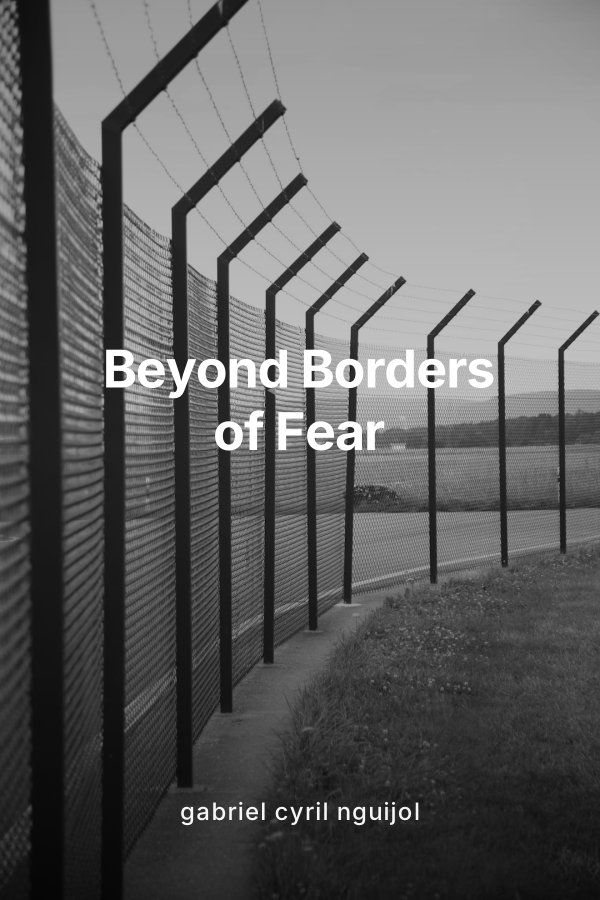
This book argues that the most decisive battles against terrorism in the Lake Chad Basin are fought not only on the ground, but in the realm of ideas, language and regional institutions. It shows how intelligence cooperation emerges from competing narratives about threat and security, how it becomes embedded in norms and identities, and how it is then institutionalised through fragile yet promising regional mechanisms. Grounded in the experience of countries around Lake Chad and their response to insurgent violence, it offers a conceptual and practical roadmap for reimagining intelligence as a collective public good rather than a guarded national secret.
Drawing inspiration from research that traces the evolution of counter terrorism discourse and intelligence sharing in the Lake Chad Basin, the book speaks to policy makers, intelligence professionals, scholars of international relations and African security, as well as practitioners in regional organisations. It blends theoretical reflection with empirical insight to illuminate a central claim: effective intelligence cooperation is shaped less by technology and legal texts than by how actors define the enemy, understand themselves, and negotiate the balance between sovereignty and solidarity.
The analysis engages with concepts of regional security complexes, securitisation, and regime complexity that are widely associated with established international relations scholarship, so proper academic attribution can later be added where required.
Chapter One, “Constructing a Regional Intelligence Community,” traces how terrorism in the Lake Chad Basin has been framed and contested in political, media and security narratives. It shows how the category of “terrorist threat” has expanded, at times blurring into organised crime, irregular warfare and broader political violence, and how this conceptual inflation has justified increasingly intrusive security measures. The chapter examines how global counter terrorism rhetoric, particularly after major international attacks, circulated into African debates and helped define insurgent movements in the region as part of a border spanning menace that no state could confront alone.
Against this backdrop, the chapter explores how elites in Nigeria, Cameroon, Chad, Niger and neighboring states progressively came to see shared intelligence as an appropriate and even necessary response. It highlights the shift from viewing intelligence as a purely national tool focused on regime survival to imagining it as a regional resource for managing common threats and protecting populations. Key regional ideas, including pan African solidarity, non indifference to mass atrocities and the principle that African problems should find African solutions, created a normative environment in which information sharing could be portrayed as both legitimate and urgent.
The chapter then analyses the role of knowledge and identity in this transformation. It emphasizes how expert networks, research centers, international agencies and regional organisations helped define what was “known” about the insurgency, borderlands and local communities. These epistemic communities shaped threat assessments, produced maps and reports, and provided the categories through which decision makers understood both the insurgents and the affected populations. By circulating particular forms of knowledge, they influenced which intelligence practices seemed reasonable and which alliances appeared natural.
Identity politics plays a central role in this story. The chapter shows how states in the basin navigated between self images as weak or vulnerable powers and aspirations to regional leadership. As governments repositioned themselves, they recast intelligence cooperation as a way to reclaim agency, demonstrate responsibility and secure international support. At the same time, discourses portraying the region as a peripheral “arc of crisis” encouraged external actors to sponsor new forms of intelligence coordination and justified their presence in local security arrangements.
Finally, Chapter One situates these developments within the broader idea of a regional security complex. It argues that security interdependence around Lake Chad has deepened to the point where no state can insulate itself from attacks, refugee flows or arms trafficking in neighboring territories. In this setting, intelligence cooperation becomes not a luxury but a structural necessity. Yet the same interdependence also magnifies mistrust, as states fear that sharing sensitive information could expose internal weaknesses or empower rivals. The chapter concludes by framing this tension between necessity and suspicion as the core dilemma that any regional intelligence architecture must confront.
Chapter Two, “From Discourse to Design: Building a Regional Intelligence Regime,” turns from ideas and narratives to institutions and practice. It examines how the basin states and their partners translated the emerging consensus on shared threats into concrete mechanisms for intelligence coordination. Central to this process was the creation of a dedicated platform for collecting, analysing and disseminating information among member services, conceptualised here as part of a broader regional intelligence regime complex.
The chapter reconstructs the incremental path from ad hoc exchanges and bilateral contacts to a more formalised framework that links national agencies with regional bodies and external partners. It shows how continental institutions, such as the African Union and regional economic communities, promoted intelligence sharing as a pillar of their counter terrorism architecture, while simultaneously upholding state sovereignty and non interference. This dual commitment produced a delicate institutional compromise: mechanisms strong enough to foster cooperation, yet weak enough to reassure governments that ultimate control remained in national hands.
A substantial section of Chapter Two is devoted to the geography and politics of the Lake Chad borderlands. It explains how porous, historically contested borders, fluid cross border communities and the difficult terrain of the lake created both opportunities and challenges for intelligence work. On one hand, these conditions facilitated insurgent mobility and illicit flows of arms, making isolated national surveillance efforts largely ineffective. On the other, they meant that local populations possessed vital knowledge about routes, actors and informal economies that formal services often lacked. The chapter argues that any sustainable intelligence regime must therefore engage with community based forms of information, not only with state controlled channels.
The book then analyses the internal dynamics of the emerging regime complex. It shows how multiple layers of authority and overlapping mandates developed as different organisations launched their own counter terrorism initiatives, sometimes reinforcing and sometimes competing with one another. Intelligence officers had to navigate between national commands, regional fusion units, joint military structures and external partners, each with its own priorities and classification rules. This institutional density brought resources and visibility, but it also risked fragmentation, duplication and coordination fatigue.
Particular attention is paid to the politics of sharing. While official documents proclaim commitments to mutual support, in practice many services have remained cautious in disclosing tactical information, operational plans or sensitive sources. The chapter explores the reasons for this reluctance, including fear of leaks, divergent threat perceptions, leadership rivalries and uneven capacities among participating states. It also points to moments when crises, spectacular attacks or international pressure temporarily overcame these inhibitions and led to deeper cooperation.
Rather than presenting a simple success or failure narrative, Chapter Two evaluates both the achievements and the limits of regional intelligence cooperation so far. On the positive side, the book highlights the emergence of shared analytical products, regular liaison meetings, technical training and informal networks of trust among officers who previously had little contact with their counterparts across borders. These developments have contributed to a more coherent picture of the threat landscape and, at times, to coordinated responses that disrupted planned attacks.
Yet significant challenges persist. The chapter discusses how entrenched habits of viewing intelligence as an instrument of regime protection, a legacy of colonial and early post colonial practices, continue to shape operational cultures. It notes that reforms, where they have occurred, are often driven by donor conditions or external training initiatives rather than by internal democratic oversight. The book argues that without a conscious effort to reorient services toward broader human security objectives, intelligence cooperation risks reproducing old patterns of exclusion and abuse under a regional label.
The conclusion of the book draws out lessons that travel beyond the Lake Chad Basin. It proposes principles for designing regional intelligence regimes that are both effective and accountable: anchoring cooperation in shared norms rather than expedient deals, investing in joint knowledge production, recognising the agency of borderland communities and clarifying roles among overlapping institutions. It calls for a shift from viewing intelligence sharing as a concession to external pressures toward embracing it as a strategic investment in collective resilience.
By revealing how ideas, identities and institutions interact in the making of intelligence cooperation, Beyond Borders of Fear offers a fresh lens on counter terrorism in Africa. It invites readers to look past spectacular acts of violence and focus instead on the quieter, complex work of building trust, crafting narratives and weaving together a regional security fabric strong enough to withstand the shocks to come.