Only the first page of this book is left. We lost the rest in October 2026.
We lost access to the service that stored them, and no other copy exists. We're sorry.
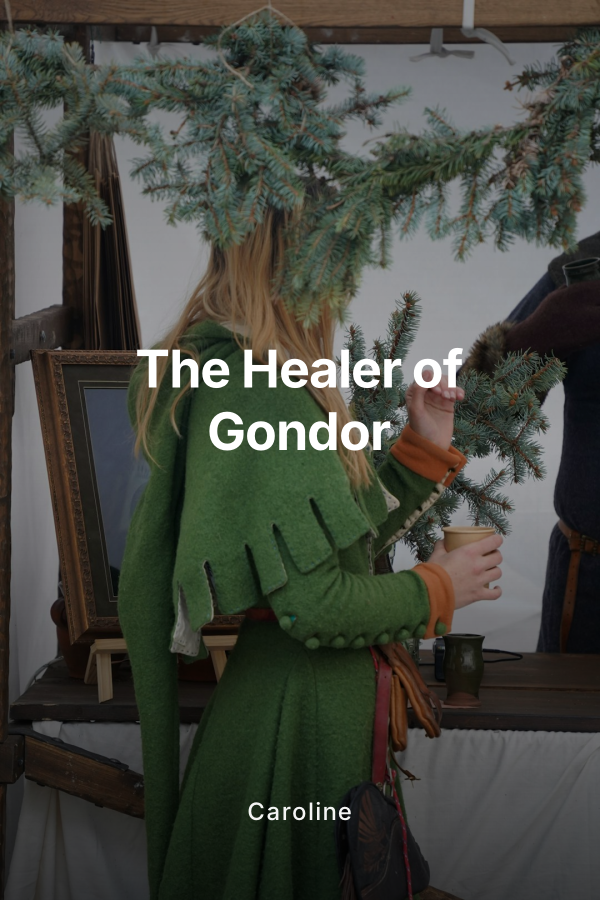
In a weather-beaten outpost of Gondor, hidden between grey hills and encroaching shadow, the Fellowship of the Ring finds a brief and unlikely haven. The garrison is small, its stone walls worn thin by wind and war, yet within it lives Elowyn, the guarded heart of Boromir’s family and the quiet soul of Gondor’s wounded.
Elowyn is a healer whose hands know the weight of blood and whose days are ruled by duty. Dark haired with watchful hazel eyes, she mends broken bodies while hiding a loneliness she has never dared to name. Surrounded by soldiers who come and go, she has built a life made of small certainties: the orderly shelves of her infirmary, the rhythm of patrol reports, the distant hope that her brothers will return.
When Aragorn arrives with the Fellowship, bearing the burden of a quest that may decide the fate of the world, Elowyn’s careful balance begins to shift. He is a man ruled by a harsher duty than even Gondor’s call. His road leads forward into peril, not sideways into the fragile warmth of an outpost. Yet in the cramped corridors and long twilight watches, he finds himself drawn to the healer whose courage is quiet and whose wit cuts through his solemn resolve.
Their love is not swift or easy. It grows in sidelong glances over bandaged wounds, in arguments over risk and responsibility, in shared exhaustion at dawn. Aragorn struggles with the knowledge that his life belongs to the quest, not to any single heart. Elowyn wrestles with the fear that tying herself to him means placing her future at the mercy of a war that could swallow them both. Between them stands Gondor’s need, the Ring’s terrible path, and the silent understanding that sometimes love must wait on the far side of darkness.
Yet the most unexpected allies in their struggle are the smallest. The four hobbits, far from home yet keenly alert to every shift in mood, decide that fate could use a little help. With a mix of innocent meddling and deliberate schemes, they set out to nudge Aragorn and Elowyn together. They arrange shared night watches through “accidental” roster changes, engineer cozy situations within the outpost’s thin stone walls, and spread just enough strategic confusion to leave their two tall friends flustered and off guard.
The result is a tapestry of comedy and tenderness woven against the looming shadow of war. There are nights when Aragorn and Elowyn are forced to share a room because the hobbits have “miscounted” the beds, and the awkwardness of that tight space breaks into late whispered conversations that neither of them expected to share. There are moments on the battlements when half-hearted arguments about blankets, tea, and proper night-watch protocol give way to stories of childhood, grief, and the hidden costs of duty.
Beneath the laughter, however, runs a thread of real danger. News rides in from Minas Tirith with growing urgency. Letters and messengers speak of dark movements along the borders, of pressure mounting on Gondor’s defenders, and of strategy that demands every loyal servant return to their appointed place. The outpost, once a quiet backwater, finds itself drawn closer to the center of the storm.
When a command comes recalling Elowyn to Minas Tirith, duty finally stands between her and Aragorn in a way neither can ignore. Gondor needs its healer. The White City calls Boromir’s sister home. For Aragorn, the order is both a test and a revelation. He must decide whether to retreat behind his sense of obligation, letting her go without a word, or to trust that love can exist alongside the burdens he carries. Elowyn, in turn, must face the truth that her life cannot remain confined to dutiful solitude if her heart has already moved beyond it.
The hobbits are not content to watch quietly from the sidelines. Their gentle mischief turns serious as they push both Aragorn and Elowyn to face what has grown between them. With a surprising mixture of humor and wisdom, they challenge the tall folk to admit that courage is not only found on battlefields or in council chambers. Sometimes it is found in speaking the words that could break your own heart.
The Healer of Gondor is a story of love that ignites slowly in the shelter of stone walls and late-night lamplight. It explores the tension between personal longing and the heavy pulls of loyalty, heritage, and destiny. The narrative balances warmth and wit with the ever-present awareness that the world beyond the outpost is unraveling.
Readers will find:
• A slow-burn romance between Aragorn and Elowyn built on banter, shared burdens, and reluctant vulnerability.
• A vivid portrait of life in a Gondorian outpost, where mundane routines and domestic mishaps coexist with the distant rumble of war.
• Hobbits as intentional matchmakers, whose “harmless” schemes lead to some of the most intimate and revealing moments in the story.
• Humor that arises from character, culture clash, and the absurdity of trying to nurture tenderness while the world prepares for battle.
• Emotional depth grounded in the conflicting demands of duty to a realm, loyalty to a fellowship, and fidelity to one’s own heart.
• A steadily tightening sense of urgency as news from Minas Tirith transforms a temporary refuge into a crossroads of fate.
As Elowyn prepares to obey the summons to Minas Tirith, the final days of the Fellowship’s stay in the outpost become charged with unspoken feelings. Every casual touch, every shared jest, every quiet conversation on the walls feels weighted with the knowledge that parting is near. The hobbits’ last, carefully orchestrated efforts surprise both Aragorn and Elowyn into honesty. Beneath a sky darkened by gathering clouds, with the Fellowship watching from varying degrees of awkwardness and delight, Aragorn and Elowyn finally set aside evasions and speak their hearts.
The promise they make is not one of easy certainty. War lies ahead, and no one can say what the world will look like when it ends. Yet in that uncertain space they claim a possible future together, not as a denial of their duties but as a reason to endure them. Their vow is simple: if they survive the coming darkness, if the realm still stands, they will stand together within it as husband and wife.
The Healer of Gondor offers a happy ending that is honest about the cost of hope. It suggests that love, when rooted in respect and shared courage, can strengthen rather than weaken those who bear the heaviest burdens. It celebrates the power of small people to change great hearts, the stubborn resilience of humor in grim times, and the quiet bravery of choosing joy when nothing is guaranteed.
Above all, it is a tale about the spaces between battles: the kitchens, infirmaries, and watchtowers where people laugh, argue, and fall in love while history grinds forward around them. In those spaces, among bandage rolls and borrowed blankets, a ranger and a healer discover that destiny may demand much from them, but it does not forbid them to dream of a life together.
At the heart of this story stands a simple truth: even in a world tilting toward darkness, two people can find each other in a lonely outpost and promise that, if dawn comes, they will meet it side by side.