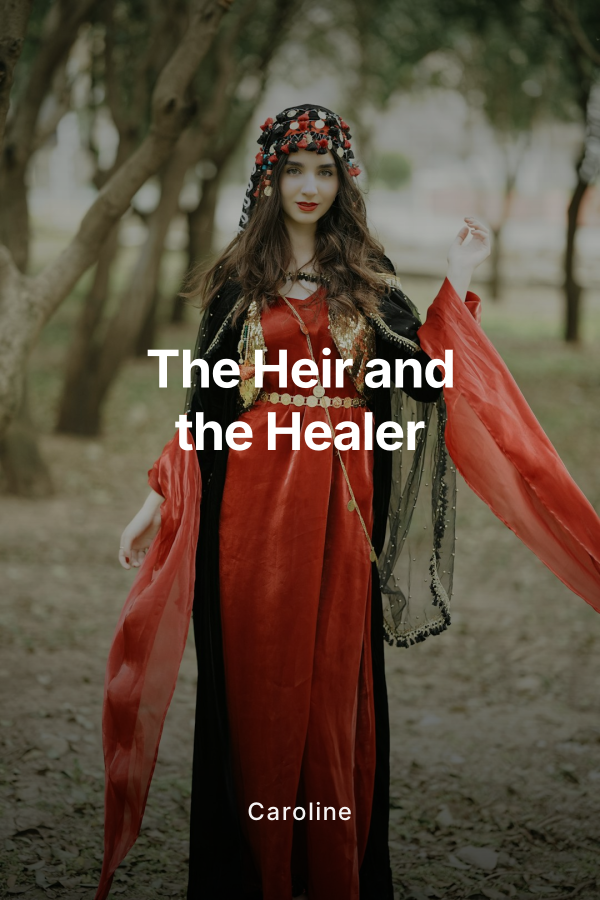
In a guarded estate on the borders of Gondor, far from the courts and councils of power, Elowyn daughter of Denethor lives a life of silken confinement. Youngest of the Steward’s children, sister to Boromir and Faramir, she is praised for her dark beauty and paraded as a future bride for some distant lord. To her father she is not a daughter, but a quiet piece on a grand board, meant to seal alliances and soothe rival houses. To herself she is something far different: a healer with gifted hands, a watcher of the wounded, a woman who longs for a life chosen rather than assigned.
Her small rebellions take place not in council chambers, but in the lamplit hush of the infirmary. While the city gossips about her eventual suitor, Elowyn studies herbs and old treatises, binds the cuts of common soldiers, and listens to the murmurs of captains who speak more honestly in pain than in pride. She hears, as all Gondor does, the scattered legends of a hidden heir of Isildur, a nameless hope for a kingdom long without a king. She does not expect that legend to bleed upon her own floors.
When the Fellowship of the Ring, hunted and newly scarred, finds secret refuge at her father’s outlying estate, Elowyn’s quiet world fractures. The strange company brings danger and destiny under her roof: a wizard whose eyes seem to weigh her soul, an Elf out of old tales, a Dwarf from the halls beneath the mountain, four small hobbits carrying unthinkable burdens, and among them a weathered ranger called Aragorn. He arrives as any soldier might, grim and travelworn, another body for her care. His wounds are deep, his burdens deeper, and his eyes hold centuries of sorrow for a man far younger than his face suggests.
In the first tension filled healing scene between them, the story stakes its promise. Elowyn’s skilled hands tremble as she tends Aragorn’s injuries in the quiet hours of the night, while the Fellowship sleeps and the estate’s guards change watch. He is a captain of men who refuses to flinch, yet winces when her gaze lingers too long. She senses a secret history in him, an invisible crown of duty and regret, without knowing the true weight of his name. He sees in her more than a noble lady in a fine gown. Beneath her courtesy he discovers a firm mind, a rebelling heart, and a courage that is gentle rather than loud.
Their slow burn love story unfolds within tight constraints: a house under watch, a mission that must not fail, and an unspoken code of honor on both sides. Elowyn’s estate seethes with unseen eyes. Servants whisper. Spies carry every rumor to Denethor. Her father has already set her on a path that will end in a political marriage to a safe, colorless suitor, a man as correct as he is uninspiring. Even when absent, that suitor’s presence presses on her days like a hand upon her throat. Every time she lingers with Aragorn in the infirmary, every hushed conversation by the hearth with the hobbits and Gandalf, every subtle brush of fingers as she changes his bandages feels like a step taken on forbidden ground.
The Fellowship sees more than either of them wishes to reveal. Boromir, fierce and protective, senses the fragile thread growing between his sister and the wandering ranger. He is torn between gratitude for Aragorn’s leadership and resentment of the man who, even unknowingly, draws Elowyn’s heart away from the future Gondor demands of her. The hobbits, ever perceptive, exchange knowing glances and soft jests that make her blush and Aragorn fall silent. Legolas watches with elven calm, reading the shape of this new bond as he might read the stars. Gandalf, half mentor and half father to them all, offers Aragorn dry, piercing counsel about love and duty, about promises made in the shadow of war.
Aragorn’s deepest struggle lies not in acknowledging his feelings, but in believing he has a right to them. He carries the fate of the West upon his shoulders, the heritage of a fallen line, and the fragile hope of the free peoples. To allow himself to be drawn to Elowyn feels to him like a betrayal of his purpose. Is he stealing from her the alliance her people need? Is he selfish to dream of a life beyond war with a woman already bartered in unseen negotiations? In one pivotal scene, after a night of sharing memories and fears by the dying embers of the hall fire, he nearly speaks his heart, then withdraws, telling her instead that she deserves a “better” fate than to be bound to a wandering captain with no throne.
Elowyn’s conflict is narrower but no less fierce. She has been raised to obey, to comfort, to adorn. Yet with each wound she tends on Aragorn’s body and each fragment of his burden he reluctantly reveals, she feels her heart aligning not with courtly duty, but with this man whose purpose stretches far beyond her father’s reach. The turning point comes when a message arrives from Minas Tirith, commanding her to set the date of her wedding to the dull, dutiful suitor who represents a crucial alliance. Her father’s will is clear. Her role as pawn must at last be fulfilled.
In that moment Elowyn must decide whether to concede to the life chosen for her, securing safety for Gondor yet silencing her own soul, or to step into open defiance for the first time. Surrounded by the watchful Fellowship, with Boromir torn and Gandalf quietly observant, she chooses her own path. The slow ember of affection between her and Aragorn leaps into open flame not through a single dramatic gesture, but through a calm, irrevocable refusal. She will not bind herself to a man she does not love, not when the world’s fate hangs in the balance and her heart has found its own allegiance.
The Fellowship cannot linger. Duty calls them forward toward darker roads. Elowyn does not join the quest, yet her choice binds her to it all the same. She remains behind within the stone walls of Gondor’s realm, braced against the consequences of defying her father, quietly strengthening the city’s healers, and waiting without certainty that any of the Nine Walkers will return. Letters cannot safely pass. Rumors of war reach her in broken fragments. She hears that battles rage in Rohan, that traitors stir, that a captain in the north has claimed a banner older than memory. Piecing these tales together, she begins to understand who Aragorn truly is and what his coming might mean, not just for the realm, but for the fragile hope in her own chest.
When war finally hammers at the gates of Gondor, Elowyn’s choices are put to a sterner test than court displeasure. The Houses of Healing fill with the injured. She works until her fingers shake, moving from bed to bed, stitching the broken fabric of lives shattered by steel and flame. She treats strangers and friends alike, yet all the while she searches every new arrival for one familiar face: the man who left her with no promise spoken, yet with everything unspoken between them.
The climax of their story arrives in a quiet room rather than upon a battlefield. In the Houses of Healing, among the scent of crushed herbs and blood and candle smoke, Elowyn and Aragorn meet again. He is changed by war and leadership, no longer only a ranger but a man openly bearing the mantle of the heir. She is no longer the sheltered girl of an outlying estate, but a healer whose courage has been tested by siege and sorrow. Their reunion is not a triumphant spectacle but a tender, fragile exchange between two people who have carried each other, silently, through the darkest days.
Here at last, away from watchful courts and whispered politics, Aragorn steps fully into both halves of his calling. He is the leader who will stand for Gondor and all free peoples, and the man who will no longer deny his own heart. Elowyn, standing by his bedside, must reconcile the humble ranger she first knew with the king he has become. Politics and personal desire cannot be separated entirely. Her father’s opinion still looms. The needs of the realm remain real. Yet in this quiet chamber, with Boromir and a few close friends as witnesses or silent guardians at the door, they claim the one freedom they can: the right to choose one another.
Their promise to marry is given not as a fairy tale ending, but as an oath made in full awareness of the difficulties ahead. Aragorn does not ask her to become only a queen, but to stand beside him as healer, as counselor, as equal partner in rebuilding a broken world. Elowyn does not accept only out of love for the man, but out of conviction in the hope he represents and the future they can shape together. The tale closes on a note of hard won joy, with politics still to be navigated, blessings still to be won or refused, but with their bond set firmly against any storm.
“The Heir and the Healer: A Slow Burn Love Story in the Shadow of the Ring” is a romantic fantasy woven through the familiar tapestry of a great war. It explores love that grows in the quiet spaces between battles, in the small acts of tending wounds and sharing burdens. The journey of Aragorn and Elowyn is not rushed or adorned with spectacle. It is a careful unfolding of mutual respect, shared duty, and deepening affection, surrounded by the watchful eyes and differing loyalties of the Fellowship.
For readers who love emotional slow burn romance, noble characters torn between heart and honor, and the idea that healing and hope can be as heroic as sword and shield, this story offers a tender companion to epic struggle. In a world where destiny weighs on every choice, it asks a simple, enduring question: when the fate of kingdoms hangs in the balance, is there still room for a love freely chosen? The answer, hard fought and dearly earned, is yes.