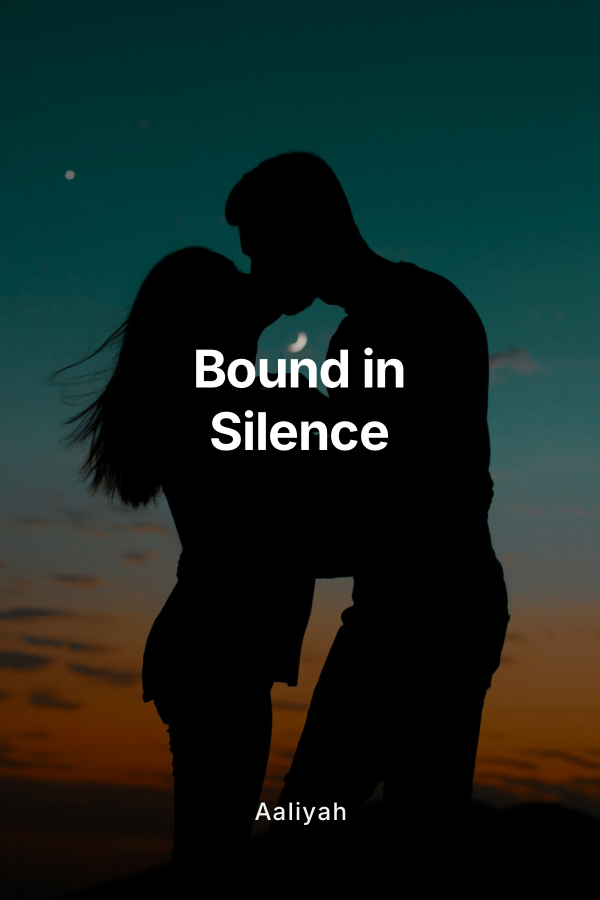
Summary:
At fifteen, Irie Monét and Theodore Arellano became a signature on a contract.
They were not in the room. Their parents were.
Her family is an Atlanta based Afro Dominican political dynasty. His, an Italian American business empire with deep European ties. Their arranged marriage is less romance and more treaty, designed to fuse American influence and European power into one unbreakable alliance.
They see each other once as teenagers, hate everything the other represents, and then are separated.
By sixteen, they are legally married. By seventeen, they are stolen.
Taken along with a dozen other heirs and prodigies from China, France, Spain, Australia, and beyond, Irie and Theo wake up in a hidden facility that exists off the maps and above the law. The world believes these children are missing. Their families know better. Compliance has bought them silence.
Inside the Program, bloodlines are resources and children are assets.
Some trainees possess rare abilities.
Others carry rare leverage.
The facility separates them into categories: weapons, strategists, negotiators, and future leaders of covert operations. Missions, drills, and simulations run their lives. Their failures are public. Their punishments are not.
Irie Monét is built for shadows and language. A strategic mind wrapped in a soothing, scratch edged, sultry voice that people listen to without realizing why. She speaks English, Spanish, French, and reads rooms as fluently as she reads code or contracts. She negotiates under pressure, maps danger five steps ahead, and can turn a conversation without ever raising her tone.
Theo Arellano is built for impact. A combat trained tactician with a deep, grounding voice and a presence that fills any room he walks into. He commands movement, shields others without thinking, and makes decisions in seconds that decide who lives and who disappears. The Program sees his instinctive leadership and starts molding him into a weapon with a conscience they can aim.
They still hate what the other stands for.
They do not get the luxury of distance.
The facility binds them together.
As married heirs by contract, they are paired on the most sensitive assignments: negotiation combat trials, mock political crises, and war game simulations that decide which trainees “advance” and which vanish from the rankings without explanation. Their names climb the mission boards while their trust issues grind against the Program’s demands.
On paper, they are perfect complements.
In reality, they are open wounds.
Irie feels sold. Her life was traded for influence without her consent. Every time Theo uses the language of duty and legacy, she hears ownership.
Theo feels used. He was raised to believe obedience was honor. At fifteen, he accepted the marriage as inevitable. At seventeen, seeing Irie’s resentment, he starts to hate himself for not fighting the contract harder.
Their fights are never about what they say.
They are about parents who chose power over children. About a marriage neither of them chose. About a facility that watches, measures, and weaponizes every flicker of emotion between them.
The Program notices their volatility and turns it into a testbed.
Together, they are thrown into:
• Negotiation pressure drills where Irie must talk down simulated hostiles while Theo remains a statue until she gives a single signal. Every flinch earns punishment. Every hesitation escalates the threat.
• Crisis simulations where Irie balances warring factions and Theo runs security, their misalignment “killing” digital civilians in front of all the other kids.
• War games where they co command mixed teams from rival families. One failed campaign results in a trainee being pulled from the group and never returning.
Under this pressure, something shifts.
Hate becomes competence.
Competence becomes reliance.
Reliance starts to feel like something far more dangerous.
In the surveillance filled corridors and bleak training halls, they build a secret, wordless language.
Theo learns the exact way Irie goes quiet when something is wrong. He notices the moment paranoia curls her shoulders in a dark room, or thunder rattles the compound, or the facility pushes her too far. He reaches for her without thinking, grounding her with a hand on her arm, a quiet “Rie,” a steady presence at her side.
Irie learns the rhythm of Theo’s rage and self sacrifice. She sees the way he pushes himself until his knuckles split and breath stutters, the way he risks his body with a frightening indifference because he has been raised to be a shield first and a person second. She starts to intervene with touch and calm where words would fail, placing a hand on his jaw, threading fingers into his hair, rubbing the tense line at the back of his neck until his breathing evens.
He thrives on contact he will never admit he needs.
She offers it sparingly, and that makes every moment of affection hit like a revelation.
The team notices the surface level tells: the way Irie absentmindedly holds Theo’s jaw while he talks, turning his face toward her when she answers; the way his head finds the soft valley of her chest or stomach when she stands and he sits, her fingers tracing idle patterns along his cheekbones or hairline. They see how his pacing stops the second her hand touches his arm. They pretend not to stare when she stands between his knees after a mission and he exhales like he has been underwater without her.
The Program notices too.
The files Irie is not supposed to access reveal a pattern. Previous cohorts. Marriage contracts signed before abduction. Psychological notes about obedience, pair bonding, leverage. Phrases that split the ground beneath her feet.
“Attachment increases controllability.”
“Physical safety dependency amplifies compliance.”
Their marriage was not just a family alliance. It was an asset arrangement.
The facility did not simply inherit their relationship.
It helped design it.
Once they know this, they should distance themselves.
Instead, they choose each other.
Their rebellion begins with small defiance.
A mission where Theo is ordered to prioritize objective over Irie’s life. A scenario set up to measure his obedience when she is in direct danger. Irie rewrites the plan mid operation. Theo ignores the handler’s voice in his ear and moves to protect her ahead of schedule. Together, they execute a third option, satisfying the mission parameters while refusing the sacrifice.
In the debrief, they lie flawlessly.
They should be broken apart. Their handlers keep them paired.
Why?
Because the facility is not just testing their loyalty to each other.
It is testing how far love can be pushed before it either fractures or fuses into something unshakeable and useful.
Around them, other stolen heirs play crucial roles.
Choy Zhang, son of a Chinese tech magnate, becomes their quiet ally in data and systems. Leah Montgomery from Australia watches their dynamic with sharp humor and brutal honesty. Lara, the French diplomat’s daughter, understands how alliances form in small, human gestures long before documents are signed. DJ, an older trainee, becomes an unasked for mentor who calls Theo out when he weaponizes his voice and breaks the girl who would rather burn than cry for anyone else.
Together, this cluster of teens from rival empires begins to see that they are not students.
They are prototypes.
As missions grow deadlier and the disappearances climb, Irie and Theo face layered choices: obey and survive as instruments of their families and the Program, or resist quietly and risk everyone they care about, in and out of the facility.
All of this unfolds alongside a slow burn emotional arc that refuses easy shortcuts.
Their bond is messy, contradictory, and deeply teenage: brattiness and soft dominance, sharp tongues and shaking hands, heated makeouts in stolen storage rooms and quiet forehead touches after almost dying. Irie will kiss him in the middle of an argument just to shut him up, then refuse to let him dodge rest because he is still bleeding. Theo will snap at her in public out of fear, then tear himself apart with guilt until she pulls him out of his own spiral and forces him to meet her eyes.
Neither of them says “I love you” for a long time.
But it lives in the details:
In the way her sultry Spanglish spills out when he is on a stretcher.
In the way his deep voice softens a full octave when he says her name.
In the way she sobs silently while bandaging him and whispers, “When you do things like that… you hurt me too.”
In the way he trains himself to hear “Theodore” as an alarm that he has crossed a line and must pull back, apologize, and rephrase instead of doubling down.
Bound in Silence follows Irie Monét and Theodore Arellano from resentful strangers forced into a contract, to combative partners forced into survival, to something the Program did not predict and cannot fully control: two weaponized heirs who choose to protect each other more fiercely than the systems that claimed to own them.
Set in a claustrophobic, international training facility where affection is a liability and attachment is a tool, this story weaves together romance, power, psychological tension, and geopolitical intrigue. It asks whether love that begins as leverage can turn into liberation, and whether two teenagers who never asked to be symbols can rewrite the roles carved out for them.
By the end of this first book, Irie and Theo have not escaped.
They have done something far more dangerous.
They have become partners in a secret war against the Program itself.
And they have decided, without saying it out loud, that there is no version of survival they are willing to accept where the other is not standing beside them.