In the glare of Los Angeles gym lights and under the soft hum of locker room vents, nineteen year old Paige is a problem nobody can quite solve.
At six foot five, blonde, blue eyed, terrifying in the ring and on the street, she is a stone faced boxer who does not waste words or feelings. Her teammates do not exist, only sparring partners and a coach. She looks untouchable, emotionless, locked behind a wall of discipline and bruised knuckles.
Until Irie walks into the gym.
Irie, the 5'10 USC basketball star with hazel green eyes and jet black curls, smells like vanilla and victory. She laughs too loud, hugs too long, and lights up entire hallways. On court, she is lethal. Off court, she is softness in lashes and lip gloss. She is femme, magnetic, and so clearly out of Paige’s league that everyone assumes Paige does not stand a chance.
Then they see how Paige follows Irie around campus like a loyal, lovesick puppy.
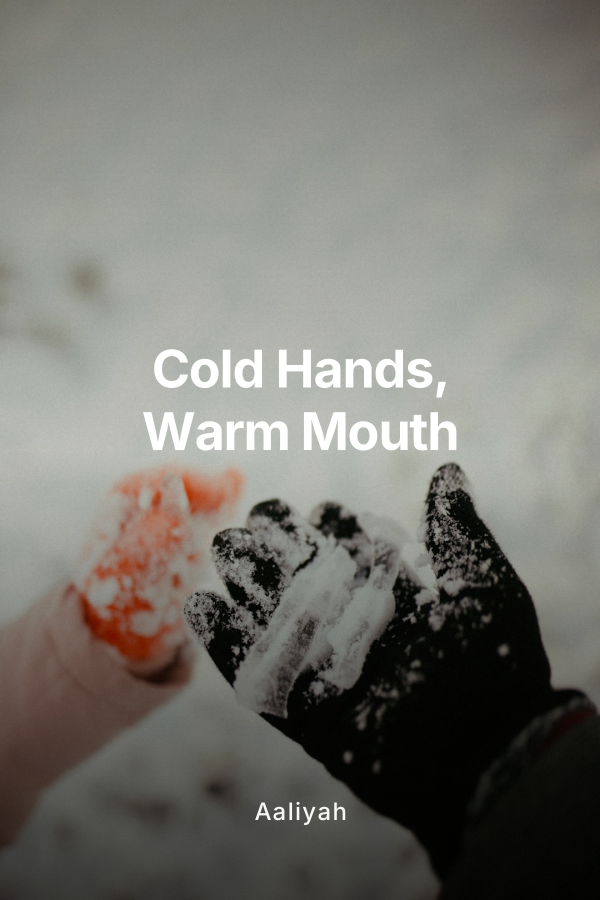
Cold Hands, Warm Mouth follows two secretly obsessed girls who insist they are “just best friends” while behaving like anything but. Around everyone else, Paige is ice. Around Irie, she is open shirt, loose bun, and veiny hands ready to steady Irie’s waist in crowded hallways. Irie plays with the strings of Paige’s sweatpants during practice, tugs her by the waistband without fear, and sits in Paige’s lap like it is reserved for her alone. Their friends watch in disbelief as the scariest girl on campus lets one pretty basketball guard drag her anywhere she wants.
The team notices the flushed cheeks, the messy hair that used to be slicked back, the smudged lip gloss staining Paige’s usually bare mouth, and the swollen lips after every mysterious “car ride.” They whisper, they tease, they clown them for being nasty and unable to wait until they get home. All while one desperate girl from rival UCLA throws herself at Paige and gets the same thing the rest of the world gets from her.
Nothing.
Beneath the filthy teasing and semi public heat, though, lives a slow, painful story of miscommunication and fear. Paige does not know how to speak when it matters. Silence is her first language. She loves Irie’s voice, Irie’s moans, Irie’s face twisted with pleasure, the taste of her, the way making Irie come feels more important than her own needs. She is a munch with a fixation, but she cannot say the simple truths that would keep Irie safe.
Irie, who rarely clings to anyone, finally has a bad week and reaches out for the one person she trusts. For once, she is the one pressing closer, touching Paige first, needing to be held. That same day, Paige has been crushed by a rough game and does not know how to carry two storms at once. Instead of telling Irie the truth, she vents to their friends, calling Irie “too clingy” when she thinks Irie is out of earshot.
She is not.
One careless locker room confession breaks the fragile agreement between them. At the next game, the legendary duo feels off. Irie refuses to look at Paige. Passes that used to be telepathic now bend toward other teammates. The coach drags them aside and tells them to fix whatever is going on or sit down. Irie spits out that Paige did not want her, so she let go. Paige is confused until Nika spells it out in brutal detail. The “lock incident.” The humiliation. The betrayal.
From there, the book tracks the slow, raw unraveling of a girl who only knows how to be strong when she does not care.
Paige starts to break.
She chases Irie down hallways and gets shut down. She uses their sacred code, 3‑5‑5, and locks herself in Irie’s dorm room to force a ten minute, no escape, no lies conversation they once promised would always keep them honest. She does not defend herself. She does not hide. She stands there, huge and shaking, and finally bleeds out the truth about how small Irie can make her feel in the best and worst ways.
Irie, hurt and humiliated, tells her exactly what it felt like to hear her vulnerability turned into jokes. She apologizes for crossing Paige’s boundaries but vows never to touch Paige again. Not without crystal clear permission. Not when one bad day can turn her affection into ammunition.
Paige begs. She coaxes. She tries to negotiate even the smallest scraps of contact, just enough to sit near Irie or hold her hand for a moment. The girl who could fight all night now pulls all nighters on Irie’s floor, refusing to sleep, too afraid that any distance will make the damage permanent.
She pushes herself so far into guilt that she stops eating, convinced she does not deserve comfort if Irie will not even look at her. Her teammates watch in worry as she shrinks into a pale, dizzy shadow of the fighter they know. On the team bus, Irie finally cracks when she learns Paige has been living off nuts and stubbornness. She forces herself to care out loud despite her anger, sharing her sandwich, making Paige drink water, switching seats so she can monitor her through the ride.
Even then, Irie pulls her wrist away when Paige holds on too long.
The story takes them to a brutal turning point. Paige insists on playing through sickness in a crucial game, fueled by electrolytes and sheer pride. Irie sees her sloppiness, the way her legs do not quite obey. In a quiet back room after the match, Paige faints in Irie’s hands. Feverish, hooked to an IV, she wakes to Irie’s furious relief. Irie has not eaten either, consumed by guilt over what Paige did to herself.
Their dynamic flips.
Paige, who would starve herself for punishment, demands that Irie eat. Irie agrees only if Paige eats with her. For the first time in days, they sit side by side in something like peace, shoving bites of food into their mouths while their coach watches from a distance, muttering about the chaos of young love.
As Paige recovers, the book peels back deeper layers of her touch starvation and emotional illiteracy. When she tries to stand too early and nearly topples over, she uses the remnants of sickness to blackmail Irie into holding her again, clinging like a child to the only person who sees through her armor. Once the nurses expose that she is no longer really ill, Irie furiously pulls back, feeling played and overwhelmed all over again.
Paige does not give up. She follows Irie everywhere, trying every possible angle to fix what she broke, until one day she pushes too hard. Irie, overstimulated and exhausted, snaps and tells Paige to leave her alone. The words slice Paige in a way no punch ever has. For the first time, she crumples in front of Irie, crying openly, voice breaking as she begs Irie to stop saying things like that. She lays out her effort, her confusion, her raw fear of losing the one person she loves more than her own body.
Irie freezes, horrified by the pain in front of her. She never wanted to see Paige shatter. Everything in her soft side surges. Whatever she was holding drops to the floor as she rushes to cradle Paige, instinctively calling her baby. The word stills Paige instantly. Those hopeful, glassy eyes look up at Irie like she is salvation. Irie realizes then that the coldest girl on campus is simply starved for safe, consistent touch.
From there, healing is deliberate.
Irie makes it clear that Paige is fully forgiven. She corrects anyone who dares to clown Paige for starving herself over a fight. Paige, in turn, becomes hyper aware of Irie’s feelings. She cuts off any negative comments directed at Irie. She guards Irie’s excitement in group settings, shutting down interruptions when Irie finally wants to share something. In public, the six foot five boxer is composed, lethal, and curt. In private, she turns into a lovestruck fool who melts at a single “baby” from Irie’s mouth.
Around their friends, the banter is ruthless. KK, Ice, Khaleez, Aubrey, and Nika clown them for their inability to keep their hands to themselves, from the messy hair and glossed lips after mysterious “car study sessions” to the way Irie can convince Paige to pull over a car on a dark LA street because she “needs to taste her again.” Paige, oddly honest when it comes to sex, announces explicit truths in front of the group with no shame, forcing Irie to scramble with weak claims that she is “just joking.” Paige calmly replies that she is not joking at all.
Despite the filthy edges, the consent is constant, spoken and visible. Hair pulling is requested and answered, legs parted with care, hands sliding under waistbands only after a look has been returned. The focus is on mouths, tongues, sound, and the particular ways these two girls come undone for each other. Paige could get off from Irie’s voice alone. Irie only says good girl when she is the one between Paige’s thighs, and her calm, commanding tone sends Paige into a haze that even boxing has never managed.
The book does not avoid the spice. It leans into it, especially in car rides after big games, late nights in shared beds, and the private sanctuary of their off campus house. Yet each explicit moment is anchored by plot. Every touch connects back to communication problems, trust rebuilding, and the fear of being too much or not enough. Their bodies speak when their mouths cannot, and eventually, they learn to do both at the same time.
Outside of the intimate chaos, life continues. Irie battles game pressure and fan expectations as a rising star in USC basketball. Paige faces the brutal loneliness of boxing, the pull of a coach who sees her as a weapon more than a person, and the obnoxious attention from a UCLA girl who wants her badly and never stands a chance. Friendships grow deeper. Aubrey quietly becomes the only one Paige can confide in about whether they are toxic, whether obsessive love can still be healthy if both people are trying.
By the time Paige finally takes Irie on a real date and stumbles through a rough edged attempt to ask, “since we are sleeping together, can you be my girlfriend,” Irie has all the proof she needs. She slaps a hand over Paige’s mouth before she can finish the sentence, blushes, and says yes, but forbids public nastiness in the same breath. Paige just smiles, satisfied, already planning how many missed days’ worth of pleasure she intends to make up for that night.
Cold Hands, Warm Mouth is a WLW college sports romance that blends filthy, explicit intimacy with heavy doses of hurt comfort, miscommunication, touch hunger, and obsessive devotion. It is about a boxer who thinks withholding food is proper punishment, and a basketball player who withholds touch just long enough to teach a lesson without breaking a heart. It is about learning that apologies need actions, that boundaries can coexist with hunger, and that sometimes the scariest person on campus just wants to be held like somebody’s favorite.
At USC, the coldest duo on the court and in the ring returns to form. The campus breathes a sigh of relief. Their friends roll their eyes. And in every gym, hallway, and backseat, Paige and Irie quietly rewrite the rules of what it means to be loved loudly, touched gently, and eaten out like worship.