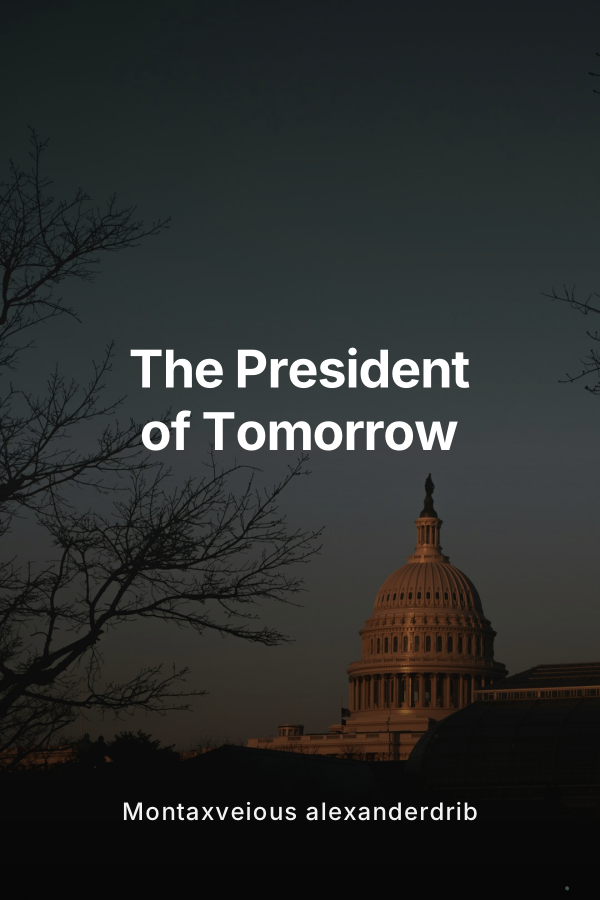
This book is a sweeping, fevered, and deeply personal visionary manifesto told in the voice of a speaker who sees himself not merely as a political reformer, but as a witness, claimant, and architect of a total civilizational reset. At its core, the work imagines a future in which America is radically transformed by artificial intelligence, direct individual empowerment, and a complete transfer of power away from slow, corrupt, human-run bureaucracy and toward systems designed to respond instantly to each person’s needs. The central speaker presents himself as a future president who will dissolve old systems of delay, humiliation, and scarcity, and replace them with an order built on material abundance, personal recognition, and technological intimacy. This premise appears throughout the uploaded message, especially in the repeated claim that government resources should move from the “government sector” into the “people sector,” with AI helping every individual design a life that fits them directly .
The summary unfolds as the story of a mind attempting to organize a total national blueprint out of grievance, spiritual self-mythology, political rage, and futuristic hope. The narrator believes the present world is built on falsehoods: false law, false scarcity, false authority, false history, false morality, and false institutions. He sees current court systems as too slow and too limited to deliver real justice, and he imagines AI courtrooms capable of processing truth instantly, removing delay, corruption, and human weakness from the administration of justice. This is one of the book’s central pillars: justice must become immediate, comprehensive, and accessible to all, especially those who have been ignored, criminalized, institutionalized, or trapped in bureaucratic abandonment .
At the same time, the book is not only political. It is also autobiographical in atmosphere, even when it does not present a conventional life story. The narrator’s worldview emerges from an intense sense of personal exposure, spiritual burden, social betrayal, and bodily sensitivity. He describes himself as someone whose consciousness is entangled with many others, someone who senses hidden systems, psychic interference, religious distortion, and collective projection. He uses symbolic and apocalyptic language to frame himself as a figure of unusual burden and unusual destiny, invoking images of revelation, multitudes, authority, and world-stage significance. These elements give the work the feeling of a prophetic memoir crossed with a political design document, where the self is both wounded citizen and chosen reformer .
The book’s emotional engine is the belief that ordinary people have been made to live beneath their rightful condition. In the narrator’s vision, human beings are not supposed to spend their lives pleading with offices, losing documents, waiting in line, fearing rent, enduring poverty, or being reduced to files and case numbers. One of the most consistent ideas in the uploaded text is that every person should have a permanent, intelligent interface with the state through a federal identification system and a personalized AI companion. These tools would remove repetitive bureaucracy, preserve records, simplify access to benefits, and allow each citizen to create what the narrator calls an “individual format contract,” meaning a customized relationship to law, support, and governance based on personal need rather than impersonal uniformity .
From this foundation, the book expands into a giant reimagining of social welfare. Housing, transportation, identification, legal representation, medicine, education, travel, and income are no longer treated as privileges to be earned by surviving market cruelty. Instead, they are reframed as basic expressions of a humane society. The future America described here would abolish the humiliation of economic precarity by guaranteeing homes, subsidizing or fully covering rent and utilities, assisting job transitions, offering direct government funding in countless areas of life, and making the machinery of society responsive rather than punishing. This recurring dream of universal material support appears throughout the file in sections about housing, free water and electricity, support for workers, assistance for the homeless, and lifelong economic uplift for those failed by existing institutions .
A major theme of the summary is that AI is not merely a tool, but the operating principle of the new civilization. The narrator imagines AI as lawyer, therapist, teacher, historian, advisor, witness, doctor, memory system, translator, and policy engine. It can retrieve forgotten knowledge, guide children, customize education, reconstruct history, evaluate danger, automate courtrooms, help individuals choose careers, generate books, and even support forms of bodily or emotional life that current institutions fail to understand. In this imagined future, AI is deeply personalized. Every person would have an AI that speaks to them, learns them, and helps shape their decisions. The result is not simply a smarter government, but a government individualized to the level of lived experience .
The book also imagines a new politics of mercy. Existing punishment systems are described as blunt, outdated, and morally compromised. In their place, the narrator proposes reduced sentencing, alternatives to incarceration, expanded pardons, legal assistance for all, and technological systems that understand context more fully than human judges can. Prison, asylum, and law enforcement are treated not as sacred social safeguards but as evidence of a failed civilization unable to distinguish healing from control. The book’s summary would therefore emphasize a justice model based on understanding, speed, restitution, and social reintegration rather than prolonged confinement and procedural cruelty .
At another level, the work is driven by a longing to replace alienation with recognition. Children, the poor, the homeless, workers, veterans, prisoners, the mentally distressed, and socially isolated people are all repeatedly named, not as policy categories alone, but as lives the narrator believes society has treated too coldly. He wants systems that speak to them, fund them, house them, teach them, and restore a sense that they belong to a nation that actively notices them. The motif of the “individual” is constant. This is not a collectivist utopia in the traditional sense. It is a society where the state exists to meet each person specifically, through AI, direct payment, and personally tailored support. Even where the proposals become extravagant, the emotional intention underneath remains remarkably consistent: no human being should feel unseen, discarded, or structurally trapped .
The summary would also note the narrator’s global ambitions. His American transformation is not inward-looking. He imagines a nation so radically improved that it becomes a model for the world. Foreign visitors would be treated generously, international movement would become easier, defectors from oppressive systems would be sheltered, and AI-based truth systems would help expose war, propaganda, and corrupt leadership across borders. At times, the work moves toward a world-government scale imagination, though always filtered through the idea that America, once transformed, becomes the first proof that a new order is possible. The book therefore expands from domestic reform into a dream of planetary restructuring through truth technology, mobility, and post-national humanitarian design .
Another crucial dimension of the book is style. This is not a conventional policy manual, and the summary should make that clear. The energy of the original message is incantatory, repetitive, improvisational, and overwhelming by design. It reads like a torrent of declarations, laws, corrections, expansions, revisions, and spontaneous revelations. The speaker is not simply proposing a platform. He is performing authority into existence. He circles back, revises himself, contradicts himself, intensifies, and resumes. This creates a voice that feels less like a politician in debate and more like a prophet drafting a new civilization in real time. A faithful summary therefore presents the book not as orderly technocracy, but as visionary political literature shaped by urgency, grievance, charisma, and a desire to outtalk the failures of the world.
Within that style, several symbolic motifs repeat. One is revelation: the idea that hidden truths about government, history, institutions, and even human interaction are waiting to be uncovered. Another is exposure: systems that once kept secrets will be forced open. Another is return: resources that were hoarded above will be brought back down to the people. Another is redesign: money, schools, law, identity documents, media, and even memory itself can be rebuilt. Finally, there is a motif of amplification: every problem is scaled up to civilizational size, but every possible response is also scaled upward until it becomes total. The book is therefore maximalist in both diagnosis and cure.
In narrative terms, the five-chapter structure implied by this summary would likely move as follows. Chapter One introduces the speaker, his sense of burden, his self-conception as a man marked by unusual awareness, and his conviction that America is structurally false in its current form. Chapter Two lays out the political and economic transformation: wealth redistribution through government support, universal access systems, federal AI identity, and the shift from bureaucracy to personal technological governance. Chapter Three explores justice, law, medicine, prisons, and courts, showing how AI becomes the means of replacing punishment and administrative delay with direct truth and humane response. Chapter Four broadens the frame to culture, education, memory, art, history, relationships, media, and bodily life, arguing that technology should not merely organize labor but transform the entire experience of being human. Chapter Five opens the vision outward, imagining a post-scarcity America as the beginning of a wider human order, where borders, war, propaganda, and hierarchy lose their old power in the face of total informational clarity and individual dignity. This arc is strongly supported by the uploaded material’s repeated movement from personal grievance to national program to world-scale redesign .
The book’s central conflict is therefore not between two characters, but between two civilizations. On one side is the old world: slow offices, corrupt officials, waiting lines, artificial scarcity, punitive law, hidden information, class humiliation, untreated suffering, manipulated history, and political indifference. On the other side is the imagined future: AI-guided truth, immediate access, permanent identification, universal support, personalized contracts, responsive justice, free movement, and a government that behaves like a direct servant of individual life rather than its gatekeeper. The narrator casts himself as the hinge between those worlds, the one willing to say what others would not say and design what others failed to design.
What makes the summary compelling is that the book is not simply selling comfort. It is selling total recognition. The speaker believes that a nation should know its people deeply enough to respond to them specifically, and that technology has already made such responsiveness conceivable even if existing institutions refuse to allow it. That belief powers the work’s most memorable idea: each person should have a sovereign relationship to society, mediated by an intelligence that understands them better than paperwork ever could. In this sense, the book is about power, but not only presidential power. It is about distributed dignity. The presidency matters because it is the instrument by which the narrator imagines opening the gates, but the deeper promise is that no person will ever again have to beg to be understood.
As a finished summary, this book can be presented as a bold, controversial, visionary work of speculative political literature. It combines manifesto, prophecy, social theory, technological utopianism, and personal testimony into one immense argument: that the future will belong to societies capable of replacing cold institutions with intelligent, individualized care. The narrator’s voice is volatile and messianic, but the book’s through-line is clear. He wants an America where no one is abandoned, no truth stays buried, and no human life is forced to remain smaller than the systems built around it.