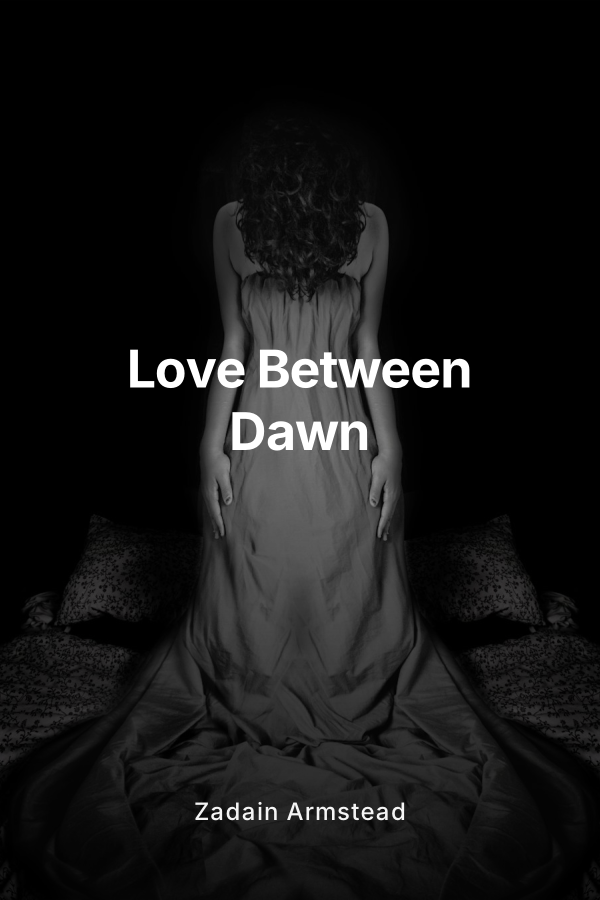
In a world where darkness protects what daylight destroys, Love Between Dawn is a sweeping romantic fantasy about two souls separated not by doubt, but by the cruel design of existence itself. At the heart of the story is Yuna, a vampire who has endured four centuries of longing, secrecy, and loss, and Saki, a compassionate human whose first act of love is not fear, but mercy. Their bond begins on a moonlit night when Saki finds Yuna weak, starving, and on the edge of ruin. When dawn threatens to expose and destroy her, he chooses trust over terror and offers her the very thing that binds them forever: his blood, his protection, and his heart.
From that unforgettable encounter emerges a love both tender and impossible. Yuna is a woman shaped by centuries of survival, haunted by the memory of those she could never keep and burdened by the loneliness of immortality. Saki, by contrast, is young, idealistic, and deeply human in the best sense of the word. He does not love Yuna in spite of what she is. He loves her fully, seeing both her hunger and her grief, both the danger she represents and the wounded soul beneath it. Their relationship blooms in the fragile shelter of night, where stolen hours become everything. Yet each sunrise is a wound. Every dawn tears them apart and reminds them that love, no matter how pure, may not be enough to defeat the laws that govern their worlds.
The summary unfolds as an emotional fantasy journey driven by longing, sacrifice, and the desire to make the impossible real. As Yuna and Saki attempt to build a life within the narrow boundaries allowed to them, the strain of Yuna’s centuries of sorrow begins to surface. Their intimacy is not simply romantic. It is confessional, healing, and dangerous. Through quiet moments together, they reveal their deepest fears: Yuna’s terror of repeating the grief of the past and Saki’s determination to fight for a future no one else believes can exist. This early portion of the story establishes the emotional core of the novel, blending supernatural tension with vulnerable romance and showing that the greatest threat to their bond is not only the world outside them, but also the wounds they each carry within.
Refusing to accept a love limited to darkness, Saki becomes the force that propels the story into its larger quest. He vows to find a way for Yuna to survive the sun, not as an act of fantasy, but as proof that love can be translated into action, courage, and defiance. This search leads them to Misaki, a witch as ancient and mysterious as the secrets she guards. Misaki is not a simple mentor. She is cunning, morally complicated, and deeply knowledgeable about the hidden histories of vampires, curses, and forbidden relics. Through her, the lovers learn of an ancient artifact that may grant sunlight immunity to a vampire, opening the possibility that Yuna might finally step into dawn without burning. But such a possibility does not arrive as a miracle. It arrives as temptation, as risk, and as the beginning of a far more perilous path.
The quest broadens with the arrival of allies and enemies who force the lovers to confront the wider cost of their desire. Leo, Saki’s loyal friend, brings a grounding presence to the story. Protective, practical, and sometimes impulsive, he serves as both shield and conscience, offering support while also reflecting the mortal world’s fear of what Saki is willing to lose. Opposing them is Viktor, a vampire hunter driven by a personal hatred of Yuna and by wounds that have calcified into purpose. Yet Viktor is not depicted as a simple villain. His rage carries history, pain, and a buried capacity for redemption, making him a formidable and emotionally layered adversary. As these figures enter the story, the narrative deepens from intimate romance into a struggle shaped by loyalty, suspicion, and clashing visions of justice.
As the journey continues, the novel explores the hidden pasts that haunt every major character. Misaki reveals fragments of vampire history and the truth behind the artifact they seek, turning the quest into something more mythic and more personal. Yuna is forced to confront memories of earlier loves lost to time, griefs she has never fully buried, and the painful realization that immortality is not endless power but endless accumulation of sorrow. These revelations enrich her bond with Saki by making clear what is truly at stake: he is not merely her current love, but the one person who awakens in her the dangerous hope that this story might end differently. At the same time, Viktor’s backstory unfolds, showing why his hatred is so deeply rooted and why his pursuit of Yuna is bound up with his own suffering. This chapter of the narrative turns the conflict inward, transforming the quest from an external search into an emotional reckoning with memory, guilt, and the fear of repeating old tragedies.
The middle of the story intensifies through trials that are both magical and emotional. The group faces traps, cursed places, rival hunters, and physical dangers that test their endurance, but the most destabilizing challenges emerge from within their fragile alliance. Jealousy, mistrust, and unspoken resentments place pressure on every relationship. In these sections, the novel examines how love survives under stress. Saki’s resolve is tested by the brutal reality of the supernatural world he has chosen to enter. Yuna, for all her strength, must contend with her own vulnerability as she sees how easily those close to her can be hurt. Leo and Misaki bring conflicting instincts about strategy and survival, while Viktor’s presence keeps the threat immediate and deeply personal. A near-fatal error forces Saki and Yuna to see with painful clarity how breakable life is, whether mortal or immortal, and how little separates devotion from disaster.
At its core, Love Between Dawn is not just a story about whether a vampire can walk in sunlight. It is about what people are willing to surrender in order to transform love from a fleeting feeling into a shared life. This theme comes to its sharpest point when the artifact is finally found and its true cost is revealed. The power to change Yuna’s fate demands sacrifice, something vital to both her and Saki. In that moment, the quest ceases to be abstract and becomes a brutal moral choice. What is a future worth if it can only be bought by losing a piece of oneself? Can love survive the resentment that sacrifice may leave behind? And is it noble to fight destiny, or arrogant to believe one can rewrite it? These questions turn the story toward its climax with devastating force.
The confrontation with Viktor brings together the novel’s emotional and physical stakes in a final conflict charged with pain, fury, and tragic understanding. Battle in this story is never merely spectacle. It is the visible form of everything the characters have tried to deny or protect: grief, vengeance, longing, and the desperate need for meaning. As Yuna and Saki stand together against the forces trying to tear them apart, their bond is tested at its breaking point. Love must prove itself not in whispered promises, but in what each is willing to endure for the other. Viktor, too, is brought to a moment of truth, where revenge and redemption stand in opposition and his choices reveal the final shape of his humanity.
The culmination of the novel is both radiant and heartbreaking. The artifact is activated, and Yuna steps into sunlight for the first time in centuries. The moment is triumphant, almost sacred, because it embodies everything she and Saki have fought for: freedom, hope, and the dream of an ordinary future made extraordinary by what it has cost them to reach it. Yet the fulfillment is not untouched by loss. Saki must face the consequences of the choices that brought them there, and both lovers must reckon with what has been taken from them in exchange for this miracle. The ending is bittersweet rather than purely tragic or conventionally happy. It honors the emotional truth that love can change fate, but never without leaving its mark. By the end, Yuna and Saki are not the same people who met in the park under moonlight. They have been remade by love, suffering, and the terrible beauty of choosing each other against the world.
Thematically, the book is anchored in forbidden love, sacrifice, mortality, immortality, desire, fear, loyalty, betrayal, and redemption. These are not treated as abstract ideas, but as lived experiences embodied by each character’s choices. Yuna represents the ache of endless time and the burden of surviving everyone she has ever loved. Saki represents the courage and recklessness of human devotion, the insistence that even impossible love deserves to be fought for. Misaki embodies ambiguity and hidden wisdom, Leo offers fierce earthly loyalty, and Viktor gives the story its wounded moral tension. Together, they create a romantic fantasy in which every relationship is charged with consequence and every act of tenderness exists in the shadow of danger.
In tone, the novel promises a lush and emotionally resonant reading experience. It is designed as a sweeping romantic drama infused with supernatural tension, rich imagery, and an atmosphere shaped by moonlight, blood, ancient magic, cursed histories, and the aching divide between night and day. Its appeal lies in the way it balances intimacy with scale. The story is personal enough to dwell in glances, confessions, and wounds of the heart, yet expansive enough to carry mythic stakes, dangerous quests, and a world haunted by old powers. The style favors emotional depth, romantic yearning, heartbreak, and hope, inviting readers who love star-crossed devotion, gothic beauty, and fantasy quests rooted in feeling rather than spectacle alone.
Love Between Dawn ultimately offers readers a story about daring to imagine a life beyond the conditions that have always defined one’s suffering. It asks whether love can do more than comfort the cursed. It asks whether love can liberate them. In Yuna and Saki’s journey from moonlit rescue to hard-won dawn, the novel promises passion, mystery, supernatural danger, and emotional catharsis. Its lasting power lies in the truth at its center: that some loves are born in darkness not to remain there, but to challenge the very meaning of light.