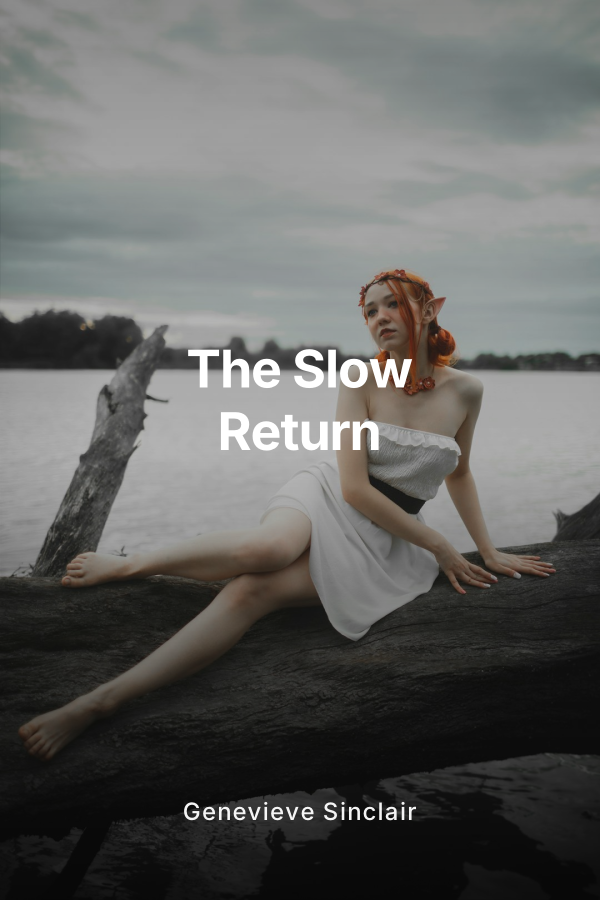
In “The Slow Return,” ambition and memory collide on a jagged stretch of coastline, where the past refuses to stay buried and the heart insists on being heard.
Genevieve “Eve” Sterling built her life on never looking back. At thirty two, she is a hyper successful tech CEO whose wellness app, Aura, has just secured a massive Series C funding round. Investors call her a visionary. Competitors call her ruthless. Her board calls her indispensable. Yet every victory feels hollow, every champagne toast strangely flat. The faster she runs, the emptier she feels.
When the board mandates a “strategic vision retreat” to reset their leadership culture, Eve picks her hometown of Seaglass Cove for one reason only. It looks peaceful in a pitch deck. To her, the town is a symbol of everything she escaped eight years ago, after her father’s funeral. Stagnation. Smallness. A life spent watching other people leave.
Her assistant books out a local inn, Cove’s End B&B, prized for its privacy and views. Eve does not bother to read the owner’s name.
The man who opens the B&B door is the boy she left behind.
Liam Carter was once the quiet center of her unsettled teenage world. Taller now, broader, his sea glass green eyes are weathered but steady. He has turned the shabby family inn she remembers into an elegant, thriving sanctuary. Lush gardens, polished wood, ocean views that breathe for you. He welcomes her with calm professionalism and a polite “Ms. Sterling,” as if eight years and a broken first love were corporate formalities.
There is no visible resentment in his gaze. That unnerves her more than anger would.
Part One, “The Unraveling,” throws Eve’s relentless city life against the tidal pull of home. Her leadership team arrives armed with laptops, pitch decks, and an addiction to Wi-Fi. Seaglass Cove answers with salt air, slow mornings, and a storm that knocks out power, cell service, and every illusion of control she has left.
In the soft, lamp lit darkness of the powerless inn, their worlds collide. Liam’s quiet competence, once a background hum in her life, now dominates every room. He fixes the Wi-Fi without fanfare, lights kerosene lamps, and lays fires as her COO spirals in city bred panic. He teases her about still hating the dark and hands her a flashlight like he remembers every younger version of her she has tried to outgrow.
Old ghosts slip in around the edges. Memories of Liam’s hands repairing her bike, her father’s boat, the way his presence once steadied the fracture lines inside her. Late at night, she finds him in the kitchen, kneading bread under warm yellow light. Flour dusts his forearms, the smell of yeast wraps around her, and a flood of sensory memory makes her chest ache.
He speaks of her father with quiet respect. “He was proud of you. Talked about you all the time.” The words land with the weight of a benediction she never believed she deserved.
Eve throws herself into running the retreat like a war campaign, filling every moment with strategies, projections, and goals. Yet the porches are sun drenched, gulls call overhead, and her team’s attention drifts like tide foam. Liam moves through it all with a grounded rhythm that needles her, his every strength a reminder of what she discarded.
On the water in a canoe, forced into synchronization, they slip into an uneasy intimacy. The slow pull of their paddles mirrors the years stretched taut between them. Liam asks about her life, not her metrics. He sees the exhaustion she hides behind brilliance. A stumble on the dock, his hands at her waist, their faces too close, nearly ignites a kiss neither of them is prepared to survive.
The town itself remembers Eve with a mix of curiosity and judgment. At the local bar, a pointed remark about “forgetting where you came from” cuts sharper than she wants to admit, until Liam’s quiet defense reframes her leaving. “Leaving doesn’t mean you forget. It just means you had somewhere else you needed to be.” He validates a decision that cost him everything, and that unexpected generosity unsettles her more than bitterness ever could.
Night after night, the B&B kitchen becomes their truest confessional. Over warm peach pie and shared silence, they edge closer to the fragile, complex people they are now, not just the teenagers they once were. A crumb brushed from the corner of her mouth by his thumb becomes a live wire between them. One innocent touch, and years of buried want hum to life.
Outside the B&B, Eve’s empire begins to crack. A critical investor call threatened by the storm foreshadows bigger fractures. A competitor leak sparks a crisis that drags her back into frantic firefighting. Liam does not try to solve her problems. He leaves her tea and a note about the tide, then walks her to the cliffs at sunset and offers her the immeasurable humility of silence.
For the first time in years, her mind quiets beside him. The problem remains. She simply feels large enough to meet it.
When the retreat ends, Eve faces the culmination of all she has chased. A London merger beckons with a glittering future, the next logical step for a woman who has shaped her entire identity around success. Saying goodbye to Liam is painfully formal. He hands her a pendant of sea glass from their old hidden spot, wired simply and offered with a single word.
“Luck.”
Driving away, with the B&B shrinking in the rearview mirror and the sea glass cool against her skin, Eve feels a loss that is not professional, not strategic, and not easily explained. Something foundational has shifted. The life that once defined her now tastes like ash.
Part Two, “The Pull Back,” follows Eve as she returns to the city with Seaglass Cove lodged under her skin like a splinter. Her boardrooms are sleek, her apartment curated, her schedule overfull. Nothing feels right. Every man she meets is a pale outline of Liam’s solid warmth. Her sea glass pendant becomes a talisman she is embarrassed to admit she needs.
Their separation is anything but clean. Phone calls about “forgotten items,” texts about logistics, the practical threads she uses as an excuse to hear his voice. Liam is steady, careful. The affection that used to flood from him now arrives in measured drops. He learns from distance what she never let him teach her up close.
She engineers a pretext to go back. A “remote work week,” pitched as a mental health experiment for her leadership, conceals a simpler truth. She is starving for the man who thought “don’t follow me” meant “let me go,” and she can no longer pretend professional curiosity is all that pulls her home.
This time, she is almost alone at the B&B. The quiet between them is no longer neutral. It is charged. A walk through the herb garden becomes a study in restraint, their hands brushing in the soil, their shoulders almost touching. She watches water slide down his forearms at the outdoor sink and realizes with a jolt of helplessness that what she once pitied as a “small” life contains a depth and courage she has never had to test in herself.
As their emotional intimacy rebuilds in fits and starts, their physical tension sharpens from playful teasing into something darker and more consuming. A late night joke in the kitchen, his fingers brushing her wrist, sparks a kiss that feels like coming to and falling apart in the same breath. They break away, both stunned, both afraid of the hunger that surges between them.
The town notices. Rumors swirl. Liam’s old flame, more a symbol of the safe future he might have had than a real threat, stirs Eve’s jealousy to the surface. The town festival becomes a crucible. In each dance step, each lingering touch at the small of her back, they say all the words they are not yet brave enough to voice.
Then crisis hits both of their worlds at once. A viral smear campaign threatens Aura’s reputation just as a burst pipe floods the B&B’s ground floor. For the first time, Eve’s skills meet Liam’s world head on. Side by side, soaked and exhausted, they fight to salvage his home and his livelihood. She coordinates logistics like a war room, he wields hammer and mop with relentless determination. Their partnership in the chaos tastes like a future she never dared to imagine.
In the aftermath, adrenaline still pounding, covered in sweat and mud, they finally shatter the line they have clung to for too long. Their first fully claimed night together begins in tenderness, the gentle, almost shy exploration of bodies that have never forgotten each other. It swells quickly into a need so raw its intensity frightens them both.
Liam, overwhelmed by the terror of wanting this much from the woman who once walked away, panics and shuts down. The emotional walls slam back into place mid embrace, leaving Eve bewildered, aching, and furious with herself for letting him under her armor.
In the quiet that follows, their distance is a living thing. They orbit each other inside the same house, cautious and wounded, as work and time conspire to pull them apart again.
Part Three, “The Convergence,” turns on the choice that has haunted them since their first goodbye.
Back in the city, Eve accepts the London merger in principle and returns to familiar skyscrapers and punishing hours, convinced she has chosen her rightful path. Yet every win tastes wrong. Every photo of the Cove at sunrise that Liam texts her twists something deeper.
In a brutal, telling board meeting, surrounded by men who see her as a high performing asset rather than a human being, she looks down at the sea glass on her chest and finally admits the truth. Her ambition was never the problem. The cage she built around it was.
She rejects the London future and presents a new vision. Aura will become remote first, humane, rooted in wellness not as a brand but as a lived practice. Her company will serve not just global markets, but small towns overlooked by big capital. Seaglass Cove becomes the first pilot site in her mind long before she dares say it out loud.
When she returns to the B&B, she does not come as a runaway CEO hiding from consequences. She arrives as a woman ready to build rather than flee. Her proposal to Liam is not romantic at first glance. It is practical, audacious, and frightened at the edges. She wants to invest in Cove’s End, help him buy adjacent property, expand into a school and residency program he has only ever allowed himself to dream of in private.
“I’m not asking you to choose me over your life, Liam,” she tells him. “I’m asking if I can build mine next to yours.”
Her vulnerability throws his own fears into stark relief. For years, he has mistaken steadiness for smallness, convincing himself that playing safe was the same as being content. The truth is harsher. When she first left, he believed her “don’t follow me” as command, not plea. He chose inaction over risk and has punished himself with that memory ever since.
In a late night confession, his voice rough, he admits it. He tells her what it cost him to watch her drive away, hands trembling, feet rooted to the gravel while his heart begged him to move. He believed he was not enough for the world she wanted. He obeyed her words and betrayed his own desire.
The confession slams open an old wound between them. Eve grieves the version of herself who wanted him to fight for her and did not know how to ask. Anger, guilt, and sorrow knot between them, yet beneath the pain lies an unexpected relief. At last, they are looking directly at the moment that broke them.
Liam’s growth is not instant heroism. It is a series of quiet, terrifying choices. He takes on a risky loan to make their shared vision for the B&B possible, accepting that he is staking not just his livelihood, but his sense of worth, on a future that might still fall apart. He signs the papers alone, fearing that telling Eve might make it feel like leverage rather than partnership.
Eve discovers the documents in his desk by accident, long after the ink has dried. The shock of realizing how much he has wagered without ever asking her for proof of commitment blindsides her. First comes hurt, then guilt, then a raw, humbled determination to match his courage with her own.
Their confrontation is not a screaming match. It is quieter, more cutting. She demands to know why he would risk everything in secret. He answers honestly. Because he loved her once without asking for anything in return, and it broke him. Because this time, he wanted to make a choice that belonged to him, not to her leaving or staying.
In the end, both of them risk what they once clung to as non negotiable. Eve releases the notion that worth is measured in exits and headlines and embraces a definition of success that includes lazy mornings, community, and a man who meets her in the kitchen with coffee and a wry smile. Liam steps out of the comfortable narrative of “content small town innkeeper” and allows his hunger for more to be seen and honored.
Their intimacy deepens with their honesty. The playful heat of their earlier encounters matures into scenes where touch becomes a language of apology, reassurance, and reverence. They learn how to move together without running from intensity, how to stay when panic claws at old scars, how to choose slowing down over shutting down.
A year later, their life is not perfect, but it is deeply, stubbornly alive. Aura hums along on a radically different model as Eve takes investor calls from the sunlit B&B porch. Liam teaches local kids and visiting artists how to read the weather and repair a shutter in the same afternoon. The expanded inn buzzes with guests, stories, and the easy chaos of a dream built slowly, with both hands.
In the swirl of the annual town festival, Eve dances in the same square where she once felt like an interloper. Now neighbors greet her by name. Someone hands her a baby. Someone else complains good naturedly about the new tourists her company has drawn in. Liam finds her in the crowd as if pulled by an invisible tide, his hand settling at the small of her back in a touch that has become her anchor.
Looking up at him, at the strings of lights, at the town that both confined and saved her, she understands the truth of her journey. She did not trade one life for another. She wove them together. Her slow return was never about geography. It was about daring to come home to herself.
She spent a decade outrunning the stillness that scared her, only to discover that the love she was most afraid to risk was the one thing strong enough to hold all of her. In the end, “The Slow Return” is not a story of choosing between ambition and love, city and cove, past and future. It is a testament to the brutal, beautiful work of letting someone truly see you, and the quiet, radical courage of staying.