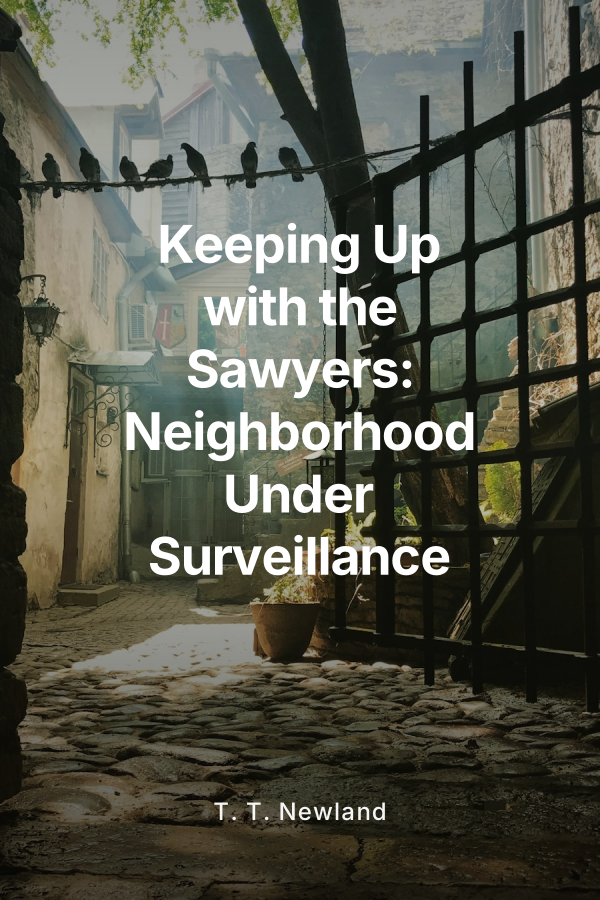
The Sawyers have survived their first school year in Maple Ridge Court without leveling the block, outing their powers, or accidentally toppling a government, which in their world counts as a roaring success. The rules on the fridge mostly worked. The neighbors still think they are pleasantly boring. The kids have almost learned the difference between “minor inconvenience” and “international incident.” Almost.
Volume Two begins with a new school year and a subtle but dangerous shift: Maple Ridge is no longer just a sleepy backdrop for their domestic circus. The neighborhood has started watching back.
A petty wave of suburban paranoia sweeps through the cul de sac after a string of “unexplained” oddities: security cameras glitching whenever a Sawyer walks past, a trampoline that mysteriously reassembles itself after a storm, a toddler who lifts the corner of a couch on a baby monitor. None of it should add up to anything, but it is enough for the HOA gossip mill and the town’s amateur “concerned citizens” to start connecting dots that were never meant to be on the same page.
At the center of this slow-burn scrutiny stands Oliver Sawyer, the family’s quiet psychic patriarch, whose true job has always been containment. Where the first volume showed him as a gentle crisis janitor cleaning up telekinetic spills and psychic outbursts, this volume tests the limits of how long he can keep patching reality with duct tape and Dad jokes. As neighbors upgrade their Wi-Fi cameras, as school rolls out new “safety” tech, and as one particular busybody starts treating the Sawyers like a puzzle begging to be solved, Oliver must thread an impossibly fine needle: erasing just enough evidence to stay safe without leaving a pattern that anyone capable of real analysis could follow.
Annabeth, meanwhile, finds her hard-won domestic peace colliding with a past she refused to let define her children. She is used to shoving back against people who want to weaponize her Diclonius nature. She is less prepared for the soft, suffocating insistence of “normal” suburban motherhood encroaching on her terms. Bake sales, PTA politics, and “voluntary” committees try to swallow her time and autonomy. When a new neighbor with suspiciously sharp observation skills starts volunteering alongside her, Annabeth cannot tell if she is meeting a potential friend, a rival monster hiding in plain sight, or the first scout of forces that once called her a test subject instead of a person.
The children’s worlds expand and complicate in tandem with the neighborhood’s rising curiosity.
Marcy, the telepath with a toddler’s emotional toolkit, is now old enough to understand that her gift is dangerous in the wrong hands, but not yet old enough to stop using it like a social shortcut. Volume Two throws her into the minefield of friendship drama, classroom alliances, and the first fumbling crushes around her. It is one thing to overhear test answers or petty insults; it is another to stumble onto real secrets: a teacher quietly panicking about a surprise inspection, a classmate hiding bruises, a school counselor who thinks the Sawyers are “off.” Marcy must learn that just because she can hear a thought does not mean she is allowed to act on it, and that sometimes the kindest thing she can do is keep what she knows and tell the one adult who will not panic or use it: her father.
Marcus, still a reluctant psychic powerhouse, enters the most dangerous arena yet: middle school group projects and after-school clubs. Desperate to craft a personality profile that screams background extra, he joins the most aggressively average activity he can find: the AV crew. Unfortunately, AV means cables, cameras, and systems that respond a little too well to a boy who can whisper to physics without opening his mouth. When the school decides to install new high-definition security cameras after an unrelated vandalism incident, Marcus finds himself at ground zero of a surveillance upgrade that could, if left unchecked, accidentally capture definitive proof that “weird things happen around the Sawyers.” His personal mission to be beige now has to coexist with a larger one: quietly sabotaging a network without leaving any prints.
Tabatha, straddling the line between girl and weapon, discovers that middle school social ecosystems are more treacherous than any combat simulation. Her horns and vectors were easy enough to hide in the chaos of elementary playgrounds; now she is dealing with locker room mirrors, school dances, and kids who throw the word “freak” like a joke they are not brave enough to own. A student-led anti-bullying campaign, complete with anonymous reporting and sincerity assemblies, brings the worst kind of attention: well-intentioned adults looking very closely at specific kids. When Tabatha’s temper and her secret nearly collide in a bathroom confrontation, she must decide whether her family’s rules about restraint still hold when the cruelty is not hypothetical, and whether being “good” means swallowing every justified punch her vectors ache to throw.
Micah, the clairvoyant strategist, finds his comfortable role as the family’s prediction engine strained by the sheer number of new variables. Neighborhood watch chats, school policy shifts, a possible pattern of “random” safety drills, a local news blogger sniffing around “unusual stories” out in the suburbs: individually, each is noise. Together, they form a shape he does not like. For the first time, his models fail to converge on a reassuring outcome. Volume Two puts him face to face with the limits of control; some trajectories look bad no matter how he nudges them. Micah’s arc tracks his uneasy transition from the kid who quietly reroutes his family around disasters to the one who has to admit that his own anxiety might be creating blind spots. When one of his dire predictions does not come true, he has to ask whether he is actually seeing the future or just mapping his fear onto it.
And then there is Juniper, the giggling apocalypse in toddler form, now old enough for preschool and old enough to start asking uncomfortable questions. “Why do I have to be careful?” “Why can I not show Ms. Kelly how strong I am?” “Why did that boy’s swing break when I pushed him?” Her storyline this volume is a comedic, slightly terrifying parade of near-misses: playground equipment that mysteriously holds together until the teacher turns away, art projects that leave handprints in tables instead of paint, story time sessions where her hugs make beanbags wheeze. As Juniper’s world expands beyond the buffer zone of her family, Oliver and Annabeth must decide whether radical honesty with a tiny god is safer than half-truths that might crack under the pressure of a tantrum.
Layered over all this is the new presence that defines Volume Two’s tension: surveillance, both formal and informal. The HOA starts a “community safety” committee that sounds harmless and feels like a net. A neighbor installs a doorbell camera that captures glitches whenever a Sawyer rushes past on a rushed school morning. The school rolls out a parent portal with too much data and not enough context, inviting endless overinterpretation of every late assignment and nurse visit. A self-styled neighborhood watchdog, bored in early retirement, takes up amateur sleuthing and lands on the Sawyers as his favorite mystery. He sees oddities; he wants patterns. He is not malicious, just dangerously curious.
Comedy thrives in these situations. The Sawyers respond to every new layer of scrutiny with ascending absurdity: synchronized “normal” behavior whenever they spot a camera, elaborate alibis to explain away impossible feats, family rehearsals of “what to say if someone asks why our furniture never quite fits the floor.” There are stakeouts so incompetent they become background noise, HOA meetings that devolve into arguments about hedge heights while Annabeth subtly unscrews a bug under the table with a vector, and a school safety assembly that nearly turns into a mass telepathic panic attack before Marcy remembers her mental volume knob.
Beneath the jokes lies the deeper emotional core: secrecy’s cost. Volume Two leans harder into what constant vigilance does to a family that genuinely loves each other. Oliver’s migraines return as he stretches his powers farther and finer than he ever did in the field, only now he has to explain them as “tension headaches from too many spreadsheets.” Annabeth’s guilt spikes whenever she has to tell the kids “no” not for moral reasons but because the cameras have too good a view of the backyard. The children begin to understand, each in their own way, that Mom and Dad are not just paranoid; there are real people out there who would see their powers as problems to solve or assets to exploit.
The book’s heart lies in how the Sawyers respond to this slow tightening of the net. Instead of turning on each other or fleeing at the first sign of risk, they double down on what has always been their superpower: being a family on purpose. They revise the rules on the fridge again, this time with the kids as equal authors. They turn “We do not blow our cover” from a commandment into a shared project. Marcy practices consent around thoughts with new friends and, in a surprisingly mature moment, chooses not to expose a cruel classmate’s secret because she realizes humiliation is not justice. Marcus learns that sometimes the bravest choice is to be seen just enough to be believed when he plausibly “fixes” a broken system the normal way in front of witnesses, cementing his role as the tech kid instead of the weird phenomenon. Tabatha discovers that protecting her siblings might mean letting an adult really see her fear without seeing her powers. Micah experiments with letting a small, harmless bad thing happen instead of tying himself in knots to dodge every raindrop. Juniper, in a scene that is half comedy, half revelation, nearly outs herself at preschool and is saved not by telepathy or precognition but by the fact that little kids accept “I am just super strong” as a perfectly reasonable explanation.
By the time Volume Two reaches its climax, the “threat” has not revealed itself as a shadowy agency or a cackling villain, but as something far more mundane and insidious: the collective curiosity and infrastructure of a world that insists on documenting everything. The Sawyers face a critical decision when a piece of footage surfaces that, if not handled well, could tip them from quirky to impossible in the town’s eyes. They could run, again, repeating the pattern that defined Oliver and Annabeth’s early lives. Instead, drawing on everything they have learned, they choose a third option: staying put and telling just enough truth to be safe. Not about telekinesis or Diclonius vectors, but about boundaries, privacy, and the right not to perform their lives for other people’s entertainment.
Keeping Up with the Sawyers: Neighborhood Under Surveillance keeps the breezy, joke-laced tone of the first volume while tightening the screws on its central tension. It explores what happens when an overpowered family outgrows the illusion that they can be invisible forever, and must learn to be ordinary in a world that is getting very good at catching the extraordinary on camera. Readers come back for the slapstick set pieces and wildly overqualified problem solving; they stay for the way this strange, potent little clan keeps choosing one another over fear.
In a culture where everyone watches and records everyone else, the Sawyers fight, laugh, and muddle through to a simple, defiant truth: they are not a mystery to solve, a threat to contain, or a show to binge. They are a family, and they intend to keep it that way, even if it means hiding in plain sight under the brightest lights their aggressively average suburb can throw at them.