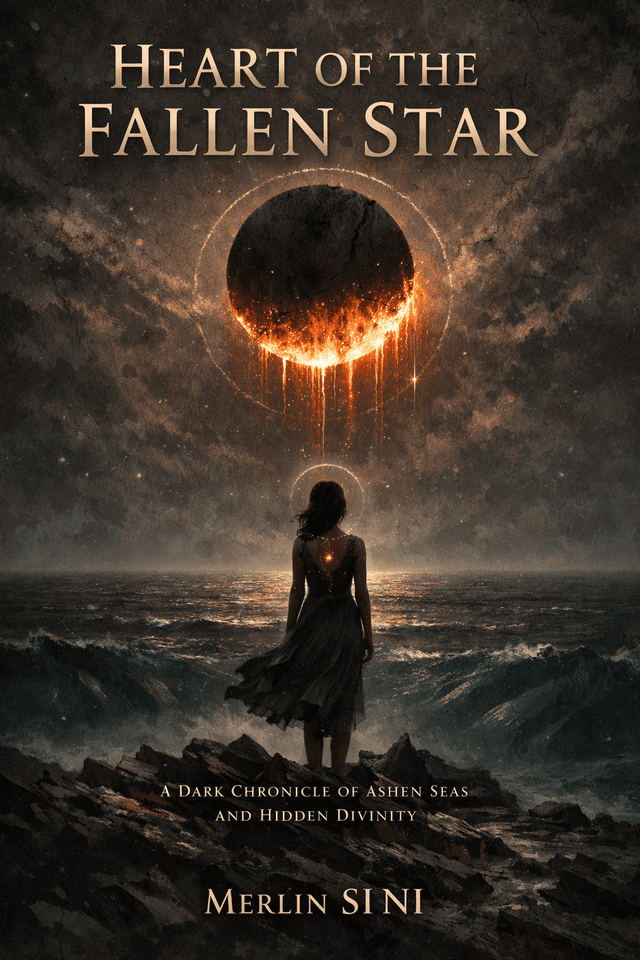
In the lightless age after the sky is broken, humanity survives in hollow stone while the world above rusts beneath a motionless, bleeding sun. Once, a celestial war tore the firmament apart and hurled a living star from the heavens. Now its dying embers sleep inside a human body that does not know what it is meant to become.
This book follows Ilyra, a young hunter of the sunless colony of Caldera Reach, a vast underground refuge built inside a drowned volcano. The people of Caldera Reach cling to life in caverns misted with mineral steam and lit by fungal lamps the color of bruises. Above them stretch the Ashen Seas, a world-ocean gone stagnant and black, haunted by abyssal leviathans and pale storms that never break. Below them the rock groans with old wounds left by the gods and the monstrous things that once served them.
From the first chapter, Ilyra’s existence is defined by scarcity and silence. She is a child of no known lineage, found in the rubble after a cave-in, her arrival marked by inexplicable survival and a ring of glassy, vitrified stone around where she lay. The Elders of Caldera Reach keep their distance. The cavern folk whisper that she is charred on the inside. Ilyra grows up with a deep, nameless guilt and an instinctive terror of fire. Whenever anger flares in her, the air wavers and the lamps stutter.
Her only true tether is Aric, a scarred surface scout who becomes a reluctant guardian. Aric teaches her how to track by sound in the echoing tunnels, how to read the slight changes in wind that reveal a shaft to the surface, and how to make a single arrow count when there are no more trees left to harvest for shafts. Their small, hard-won intimacy anchors Ilyra in a community that never fully accepts her. The bond between them is not sentimental indulgence but a necessity forged in the constant, grinding negotiations of survival.
Above and beyond Ilyra’s hidden power, Caldera Reach has one fragile advantage. Built into the heart of its deepest hall is the Veilward, a disc of fossilized starstone ringed with sigils in a dead language. The Veilward hums to the pulse of the crippled sun and projects a faint warding field that repels the worst of the abyssal beings that prowl the flooded lower caverns. Its light is faint, its protection imperfect, but without it the colony would have been swallowed long ago. Stories say the Veilward fell from the sky in the final days of the celestial war, a fragment of the same shattered star that bled out its life to burn an onrushing tide of oceanic horrors into steam.
That tide did not die. It adapted.
In the lightless trenches beneath the Ashen Seas moves Thalor, the Unmoored Balance, an ancient abyssal intelligence that remembers the war as a scar of molten glass along the ocean floor. Thalor is no simple monster. It is a necessary counterweight bound into the world’s design, a guardian of pressure and depth that feeds on failing starlight and the slow surrender of things that drown. When the gods weaponized the falling star, they wounded Thalor and tore cracks through the laws it was meant to enforce. Since then, the abyss has been listing out of true. The seas have stagnated. Dead tides rot on unmoving shores. Where the star once fell, the fabric of reality thins.
Thalor seeks not revenge but restoration, yet what it needs to mend the balance will end the last of human refuge. It has tasted the Veilward’s echo for centuries, a familiar resonance buried in stone, and understands the terrible truth long before any human does. The relic in Caldera Reach is not merely a fragment of a fallen star. It is the anchor that holds the star’s heart down in flesh.
Ilyra’s life unfolds within this pressure of converging destinies, though she does not yet know the terms. The narrative is structured to let the reader feel her isolation and buried dread before the wider cosmic frame becomes clear. In the opening chapters, we see Ilyra as the colony sees her: useful yet suspect, a quiet girl with the marks of too many “accidents” trailing her steps. A dropped lantern that should have shattered instead melts the stone where it hits. A fever that should have killed her leaves her skin unmarked but burns Aric’s hands when he holds her. Each incident is brief and unsettling, never explained, layered into scenes of everyday labor, hunger, and tension.
When the cavern’s freshwater cistern begins to sour and the fungal fields yellow at the edges, the Elders decree a desperate mission: a surface excursion to an old desalination tower half-sunk in the Ashen Seas, rumored to still hold a working condenser that might save the colony. Ilyra is assigned to the team not because of trust but because there are no more uninjured hunters to spare. Aric goes with her, as does Sera, a brilliant yet embittered engineer exiled from the inner halls for questioning the Elders’ hoarded star-lore. This small, fractured trio becomes the emotional spine of the story, a knot of competing loyalties, resentment, and reluctant care.
The rising tension chapters carry the group through the lethal beauty of the surface. They climb toward the open air through ventilation shafts slick with salt and old blood, emerging into a world of skeleton harbors and ship husks locked forever in coral and rust. The Ashen Seas sprawl out under a sky where the sun hangs like a crippled ember. The ocean is motionless yet not still. Beneath its vitreous skin, shadows the size of cities turn and listen. The prose lingers on these vistas of planetary ruin, not as spectacle for its own sake, but to mirror Ilyra’s internal sense of dislocation. She feels a trespasser in both worlds, below and above, never wholly of either.
At the midpoint of the book, they reach the drowned desalination tower, its frame bent like a rib cage against the pull of the frozen tide. Inside the tower, amidst corroded valves and whispering wind, Ilyra stumbles on a hidden chamber of polished basalt and starstone, so incongruous with the rest of the rusted ruin that it feels like a memory grafted into alien flesh. Here she finds the Liminal Core, a fist-sized sphere of dark, translucent crystal. It burns with a light that is not bright but heavy, a slow, deep radiance that pulls at her bones.
When she touches the Core, several buried truths crack open at once. Flashbacks of a sky on fire and an ocean tumbling upward flood her mind. She sees herself, not as a girl in leathers and scars, but as a blazing singularity hurled down through storms of unmade matter. She sees Thalor wrapped around the world like a great ring of shadow, teeth sunk into the rushing star, holding it back from tearing reality apart. She watches herself fall into the planet’s crust, scattering shards of starstone that become relics like the Veilward. The Core is another such shard, one that remembers everything.
The revelation does not come as a neat, expository lecture. It is an assault of sensory fragments and emotional impressions. Ilyra reels from it, vomiting and trembling in the tower’s dark, while Aric and Sera argue bitterly about what they have found. Sera recognizes the marks carved into the Core’s pedestal from forbidden diagrams once studied in exile. She has long suspected that the colony’s starstone wards are pieces of something vaster and more dangerous than the Elders admit. Now she has proof.
From this point, the story escalates rapidly. Thalor, feeling the Core awaken, rises from the trenches. The Ashen Seas, long still, begin to stir, grinding ice and bone as they move. The air taste shifts, heavy with metal. Birds that have not flown in generations burst from cracks in the cliffs only to fall lifeless back into the water. The narrative braids three threads: Ilyra’s panic and emerging self-knowledge, Aric’s ferocious determination to protect her even as he fears what she is, and Sera’s ruthless resolve to use whatever power is necessary to save the colony from thirst and collapse, no matter the cosmic cost.
Philosophical reflections deepen in this section, exploring questions of identity, agency, and responsibility. If Ilyra is the incarnated heart of the fallen star, is she to blame for the world’s ruin or its only chance at repair? Is Thalor an enemy to be destroyed or a wounded function of the universe that must be allowed to heal, even if humanity suffers for it? The characters do not debate these questions in abstract. They live them as they make choices about whom to trust, what to sacrifice, and how much of themselves they can give before they break.
The divine reveal in the final act is staged through a cataclysmic confrontation on the surface. Thalor breaches near the helpless desalination tower, not as a single monstrous form but as a crown of jaws and eyes and tidal limbs rising from every direction. Reality flexes around it. Gravity shatters in brief pulses, sending shards of wreckage drifting upward before they crash down again. Ilyra stands on a skeleton shoreline that tilts and groans like a ship in high water while Aric and Sera struggle to anchor themselves with cables and pitons driven into stone.
In this crucible, Ilyra’s options narrow to an impossible choice. The Liminal Core has shown her what she truly is. The fallen star that burned the heavens, whose heart now beats in her chest, was not a mere weapon hurled by capricious gods. It was a sentient entity that chose to fall in order to stop an older catastrophe, knowing that it would wound Thalor and shatter the sky. That memory, once buried, returns as her own. She sees that if she yields fully to that divine nature, she can pour herself back into the broken Veilward network, reignite the fossilized starstone veins scattered through the world, and restore a form of motion to the seas.
Yet there is a cost. Doing so will strip Thalor of the excess power it has gathered in the wounded ages, forcing it back into its original role as cosmic counterweight, but also plunging it into such extremity that vast tracts of the ocean will implode. Coastal caverns, including Caldera Reach, may collapse. Tens of thousands might die, even as the world’s long-term balance begins to mend. Alternatively, she can reject the divine call and remain human, keep her small life and her bonds intact for a little longer, at the price of leaving the world to stagnate into an ever-tightening grave.
The climax unfolds not as a simple battle but as a negotiation conducted through terror and memory. Thalor is not simply roaring; it speaks, in crushing images and currents, of the pressure it was born to hold, of the laws that are breaking like coral. Ilyra, half-star and half-girl, answers from both halves of herself. Aric and Sera, clinging to a strip of trembling stone between sky and abyss, can only witness as scales older than nations tremble.
In the end, Ilyra chooses a third path that is no less terrible. She accepts her starborn identity, igniting into a corona of slow, dark fire that does not burn heat but burns certainty. She agrees to return Thalor to its necessary post in the deep, but on a shared tether. She wraps part of herself around the abyssal being, fusing their essences, ensuring that neither can act without the other’s consent. The Ashen Seas lurch as their new equilibrium forms. Tides shudder into motion for the first time in generations, but they run strange and uneven, tearing some coasts apart while gentling others. Tsunamis coil just short of Caldera Reach, diverted by a hair’s margin, then crash down on distant, unseen shores.
From the colony’s perspective, what happens is simple and incomprehensible. A storm of black light rises in the distance. The Ashen Seas move. The Veilward flares once, burning the engraved hall walls into glass, and then goes dark. Caverns shake. Some outer tunnels collapse, crushing those within. The fungal fields crack and then sprout pale, new growth fed by strange mineral-rich seepage. Survival is a lottery of luck and location.
From Aric and Sera’s vantage on the ruined shoreline, the transformation is more intimate and more devastating. They see Ilyra rise, no longer bound entirely to a human frame, her figure flickering between girl and falling star, eyes full of ocean trenches and supernova echoes. She speaks to them one last time, voice both hers and not, promising nothing, offering no easy assurances. There is love in it, mute and rough. There is also distance, as if she already stands half a universe away. Then she sinks with Thalor into the deep, and the ocean closes over them like a lid.
The book concludes on an ambiguous and haunting note. Caldera Reach survives, but altered. Some of its halls are gone forever. The Elders’ authority lies in shards, and Sera returns as an unwilling prophet carrying knowledge that might save or doom what remains. Aric, broken and stubbornly alive, watches the new tides hammer the skeleton harbor and knows that the world has changed in ways no one yet understands. Somewhere beneath the Ashen Seas, a bound star-heart and a restored abyssal guardian learn how to coexist inside a single field of gravity. The balance of the world is closer to right than it has been in an age, but humanity lies precariously near the edge of that equation.
Throughout, the prose remains intimate though the stakes are vast. Ilyra’s inner conflict over her nature, her longing for an ordinary human life, and her fierce, reluctant love for those who claimed her when no one else would, carry the reader through scenes of world-scale ruin. The narrative resists tidy moral binaries. Thalor is terrifying yet necessary. The fallen star is heroic yet culpable. The Elders are shortsighted yet desperate. Humanity is both victim and participant in its own peril.
By the end of Heart of the Fallen Star, readers stand on a threshold. The immediate story is complete: the mission is concluded, the divine reveal accepted, the abyssal antagonist transformed instead of slain. Yet the larger cosmic conflict is only beginning. New tides scrape at the roots of drowned cities. Sky fractures twitch as if remembering how to heal. The heart of a fallen star sleeps, wide awake, in the coldest trenches of the sea, dreaming not of peace but of the next necessary sacrifice.