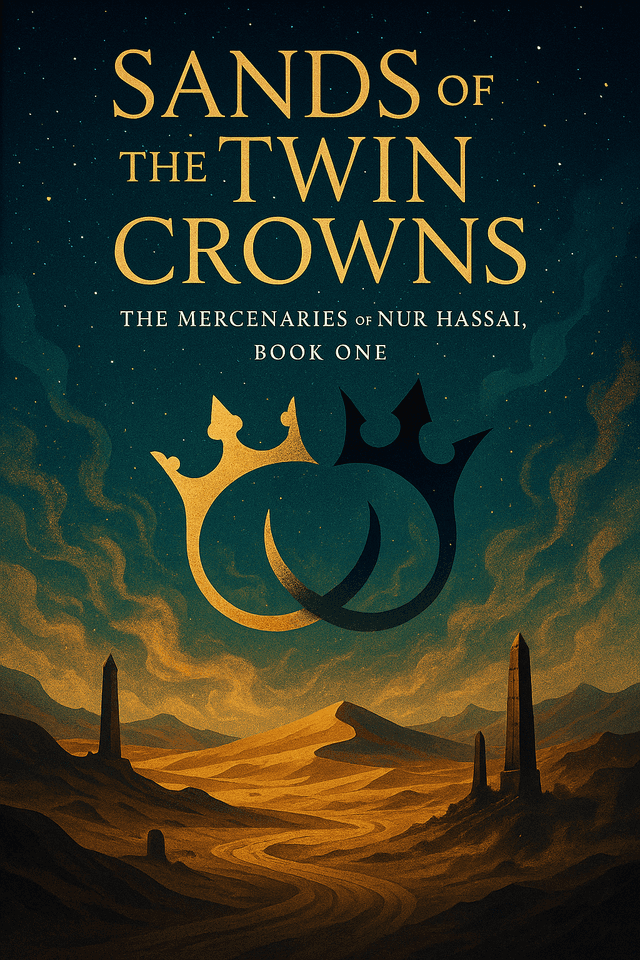
In the desert kingdom of Nur Hassai, where sun-scoured ruins rise from seas of sand and old dynasties refuse to sleep, four wanderers of broken pasts are drawn into a war that will decide the fate of both the living and the dead.
The Living Pharaoh amasses armies and priests to enact a ritual of ascension, a working of ancient power that will bind the land and its people to his immortal will. Against him rises the Undead Sovereign, Parin Ad Nur, a monarch who speaks for a fallen realm and a betrayed people. Between these two tides stands the Brazen Hosts, a famed mercenary company whose loyalty belongs to the highest bidder and whose banners march wherever gold and glory beckon.
Luna Star-glen, a moon-elf druid with eyes of green and blue, bears within her the ache of a shattered home. Her mother Leila Star-glen fell to the Devourers, her father Atem was taken in chains, and her memories of that night lie buried beneath fear and druidic discipline. Trained in the groves of Ozma, a guardian spirit bound beneath the great tree of Elorme, Luna sought balance and healing. Yet in the Brazen Hosts she is sent to do the work of fire and war. When she helps consign a caravan full of innocents to the flames in obedience to her contract, her quiet obedience fractures. Guilt coils in her heart, yet she remains outwardly dutiful, finding what fragile comfort she can in the half-remembered counsel of Ozma and the cool, distant light of the moon.
Ozymandias Xarira, a tiefling warlock, fled the crime-ridden streets of Neverwinter and a legacy he did not understand. His father, Lazax Xarira, bore the hidden title of Keeper, a name whispered only in the underworld. Cast away in a time of bloody revolt, Ozy found sanctuary in the Redstone Mountains with Modi, a dwarf scholar of demonic powers. Under Modi’s austere tutelage, Ozy learned to bend shadows and secrets to his will, until a rite in the haunted forests gave him to the Archfey Ailpein, the Dream Keeper. Chosen and remade, Ozy became a pawn in a game he cannot yet see in full. In unsettling dreams, Ailpein shows him crowns and broken chains, veiled figures and a man he does not recognize who bears the weight of the Keeper’s name. Ozy awakens each time colder and more resolved, using the Brazen Hosts and the Undead contract as stepping stones toward a future whose shape he dares not name.
Keiva, a half-elf warlock from the city of Khara, never belonged. In the eyes of his people he was always less than elven and never fully human, a child of the in-between. Lonely and driven, he turned to forbidden texts and secret grimoires, seeking in the forbidden solace that others denied him. For delving into warlock arts he was cast out, wandering the Elyran Woods with only the stone-marked ruins of Azlanna for silent company. There, a passing shaman opened his eyes to the veiled weave of existence. Thrust into a visionary rite, Keiva met a being that seemed part machine and part elf, a demonic intellect moving along lines of light and metal. It spoke to him without sound and branded his soul with the command: read, and know me. Ever since, Keiva has concealed his fear beneath a mask of swagger and charm, wielding eldritch power with a showman’s flourish while never quite forgetting the cold touch of that impossible presence.
Dusk, a half-elf rogue with plain black hair tied in a simple knot and two worn daggers at his belt, is a man who speaks most clearly through silence. Once, in a city whose name he no longer cares to speak, he belonged to a clandestine guild known only as Lost. When he chose his own conscience over their commands, the guild turned on him. Hunted and harried, he fled south across borders and wastelands until the Brazen Hosts took him on, valuing the steadiness of his hands more than the scars on his past. He walks now in the half-light of campfires and alleys, content to let his blades and his patience speak for him, yet his path will draw the notice of Mishaarin Al Shahin, the Undead spymaster whose art of shadow will hone Dusk into something far sharper and far more dangerous.
Together, these four drift into the orbit of the Brazen Hosts as they ride the borders of Nur Hassai. The story opens on a patrol watching over the remains of a battlefield: scorched sand, shattered engines of war, corpses marked by wounds that do not heal, and banners stiffened by old blood. The air still whispers with the echo of a failed working, a hint of the ascension that the Living Pharaoh covets. In this landscape of ruin and heat haze, the Brazen Hosts are offered a choice by envoys of the Undead Sovereign: stand with the dead against the living tyrant, and be richly rewarded, or refuse and be left outside the shaping of the world to come.
For a company founded on coin, the decision is simple. The Undead offer the best terms, the greatest pay, and the promise of a place in a new order. In a war tent that feels troublingly ordinary, officers of the Brazen Hosts sign their names to a contract whose ink binds more than parchment. Luna, Ozy, Keiva, and Dusk find no hero’s trumpet in this moment, only the mutter of veterans counting their pay and the rustle of banners turning toward a new sovereign.
Within the company, not all is as it seems. Rumors drift like smoke: caravans that vanished in the wastes, caravans whose ashes now dust the dunes; veterans who asked too many questions and simply disappeared; hints of Devourers in the service of older, darker powers; half-remembered mutterings of Mishaarin Al Shahin and a hidden war fought in shadows. The four companions feel the weight of watchful eyes and half-hidden disdain in side-long glances, in jokes that fall silent when they draw near. No one speaks openly of conscience. The Brazen Hosts are mercenaries, and those who wear their sigil are expected to obey.
Their first mission under Undead contract draws them to Nur Hassai, to the burning of a caravan that carries not soldiers but civilians. In the red wash of the setting sun, the Brazen Hosts form a ring of steel around wagons laden with trade goods and trembling families. Orders are simple and absolute. The deed is done with fire, with conjured wind, with spells that twist flame into devouring tongues. Luna feels every scream in the marrow of her bones, the training of Ozma crying out against what her hands are used for. Ozy understands the cold calculus and does not flinch, though Ailpein’s presence stirs faintly at the edge of his thoughts. Keiva masks his horror beneath irreverent jokes and wild flair, yet when the flames subside he cannot bring himself to meet Luna’s eyes. Dusk watches, guarding the perimeter with a face as still as stone, counting the cost in a silence deeper than words.
This moment does not break them apart, yet it leaves a wound that will not heal. Luna’s obedience holds on the surface, but in solitude the façade cracks. She trembles and weeps in the small hours, clutching memories of Elorme’s shade and Ozma’s calm guidance. In those quiet breakdowns, the memory of her teacher is both comfort and challenge, a gentle voice that bids her remember who she was trained to be and a stern one that asks what vows truly mean when measured against such acts.
As the Brazen Hosts sink deeper into Undead service, politics thicken around them. Envoys of Parin Ad Nur arrive draped in dust-gray silks, their eyes lit by unearthly fire. Messengers from the Living Pharaoh are turned away from the camp or made to wait until their pleas wither in the heat. Whispers of tithe, treaties, and treachery drift through command tents as captains weigh profit against future safety. The Brazen Hosts are officially independent, yet the longer they bear Undead coin, the more their fate bends toward Parin Ad Nur.
In secret councils beneath veiled pavilions, Mishaarin Al Shahin, spymaster to the Undead Sovereign, takes note of certain names. Luna Star-glen, whose magic drinks from the moon and the living earth. Dusk, whose skill with blades and shadows marks him as one who might be shaped into a dagger fit for a sovereign’s hand. The spymaster begins Dusk’s training in the arts of unseen war, teaching him to pass like wind through a crowded street and to listen for that single word in a sea of lies. Under Mishaarin’s icy discipline, Dusk becomes more than a sellsword; he becomes a weapon.
It is Mishaarin too who turns his arts inward upon Luna’s mind. Convinced that knowledge of the Devourers will serve the Undead cause, he guides her through guarded memories, coaxing forth the night her home was broken and her parents torn from her. The visions come not as splashes of gore but in flashes of sound and taste and scent: the iron tang of fear in her mouth, the crack of breaking wood, the strange oppressive quiet that fell before the scream. She sees glimpses of shadowed forms, senses the presence of things that devour not flesh alone but the very light in a soul. In this painful unveiling she learns more clearly what befell Leila and Atem Star-glen, and feels a fresh tide of rage and helpless love. Ozma’s remembered teachings steady her, even as Mishaarin presses her to embrace the strength that can grow from pain.
Elsewhere, while the Brazen Hosts maneuver between cities and graveyards, Ozy’s nights are haunted. Ailpein the Dream Keeper visits his sleep seldom yet with terrible clarity. In those rare dreams Ozy walks in corridors of moonlit glass, beneath ceilings that reflect starlight as if submerged in a deep sea. He follows the sound of chains, sees hands reaching from mirrors, and once glimpses a crown lying broken upon a barren floor. A figure appears in the distance, cloaked and nameless, bearing on his shoulders the suggestion of the same title Modi once whispered: Keeper. Ozy wakes with the image of broken links and scattered keys, and though he does not yet know that Lazax Xarira lives, the dreams hollow him out and fill him with a fierce, directionless determination. In waking hours he hides the trembling of his hands in strategy and calculation, offering cold counsel to Brazen officers and Undead envoys alike.
As the campaign rolls on, Luna encounters the Modrons, beings of perfect geometry and alien purpose who wander the edges of Nur Hassai like walking puzzles. In a chance meeting amid ruins half-swallowed by sand, their measured voices and ordered steps brush against her wild druidic soul. In the aftermath, the desert’s light seems to cling to her, gilding a strand of her hair with a sandy highlight that catches moonlight and torch-flame alike. The change is small yet striking, a visible mark of strange alignment between the primal and the precise.
Through skirmish and intrigue, the path of the Brazen Hosts leads inexorably toward the heart of the conflict. The Living Pharaoh hastens his ritual of ascension. Parin Ad Nur marshals both the dead beneath his banner and the living who have thrown in their lot with him. The land itself grows tense. Storms of sand rise without wind. Old bones stir beneath dunes. Silent cities listen.
When at last the armies gather and war rises like a storm-front over Nur Hassai, the four companions find themselves no longer marginal sellswords but lynchpins in a greater design. The final conflict begins with exalted awe, for Parin Ad Nur stands before his mustered forces and cries out words that echo across stone and skull and the trembling hearts of all who hear:
“War is upon us, Monk, and I stand before a choice: do I break my vows to you and tarnish my honor, or do I condemn my people to annihilation?
Fear not, my old friend, I release you from your word, freely and without fear or demand.
Ring the bells, sound the horns! As a Sovereign I invoke my right to call upon my subjects! Though I stand here alone, all the hearts of my people are my strength! The very foundations of this world shake with anger! This place filled with sadness and regret can endure it no longer!
A fallen country betrayed by its rulers is crying with me! You, whose contract was once broken, rise with anger! Not for ruin, or for revenge, but for righteous justice! Ars Regna! Golden Armada! Arise and serve your rightful master!”
At his call, the dead of a broken nation rise, not as mindless thralls but as a host bound by ancient oaths. The sands erupt with spectral banners. The air hums with the clash of unseen bells. Awe shudders through the Undead ranks and the Brazen Hosts alike, yet as the enemy lines surge forward and Salam Ad Nur, champion of the Living Pharaoh, strides to meet them, the ordered beauty of the moment breaks into chaos.
In the maelstrom that follows, each of the four steps into the shape fate has carved for them. Keiva, ever the showman, throws himself into the front of the fray with eldritch power blazing from his hands. His taunts and laughter ring loud above the din, yet inside his chest his heart hammers and his vision blurs. The machine-elf presence that once commanded him to read and know remains silent, leaving him to face battle as he is, a frightened soul wrapped in borrowed fire.
Dusk slips away from the roar of the main charge, moving like a shadow along forgotten paths. Guided by Mishaarin’s training and his own unerring instinct, he threads through combat toward Salam Ad Nur, seeking the smallest gap in armor, the single unguarded breath in which a blade can find its home. His path is one of patient angles and quiet deaths, far from the clash of banners.
Luna stands at the hinge between earth and sky, drawing the cold brilliance of the moon through her and into the battlefield. With a whispered plea that is both prayer and challenge, she calls down a radiance that anchors the final assault. Pale light floods the sands, outlining Salam Ad Nur in stark relief and weakening the protections that guard him. For the first time since the caravan burned, she feels her power used for something that might be called just.
Ozy, seeing the opening and weighing in a heartbeat a dozen futures, chooses a single, calculated act that may cost him everything. Cool and exact as ever, he steps into a position that will draw Salam’s wrath, bending Ailpein’s granted power into a precise stroke that unbalances the champion and leaves him vulnerable to Dusk’s strike and Luna’s moonlit wrath. Whether he survives the price of this choice, and what whispers Ailpein will breathe into his ear afterward, remain questions for another tale.
Together, in one fleeting convergence amid dust and blood, their efforts align. Dusk’s blades find the weak point Mishaarin taught him to seek. Luna’s moon-bound power pins Salam Ad Nur like an insect beneath a scholar’s glass. Ozy’s gambit shifts the tide, and Keiva’s unrelenting barrage keeps the Living Pharaoh’s forces from closing in to shield their champion. In that shared instant, four broken lives and all the paths that led them through sorrow and compromise and buried memory fuse into a single decisive blow.
Sands of the Brazen Hosts is a tale of slow-blooming choices and the long shadows of past sins, of mercenaries caught between tyrants, and of how even those who walk unwillingly under hired banners can, in the moment of greatest peril, shape the fate of kingdoms. It is the first chronicle of a war that will not end with Salam Ad Nur’s fall, for in the unsettled dreams of Ozymandias, in the recovered memories of Luna Star-glen, in the sharpened silence of Dusk, and in the haunted bravado of Keiva, the seeds of greater reckonings are already sown.