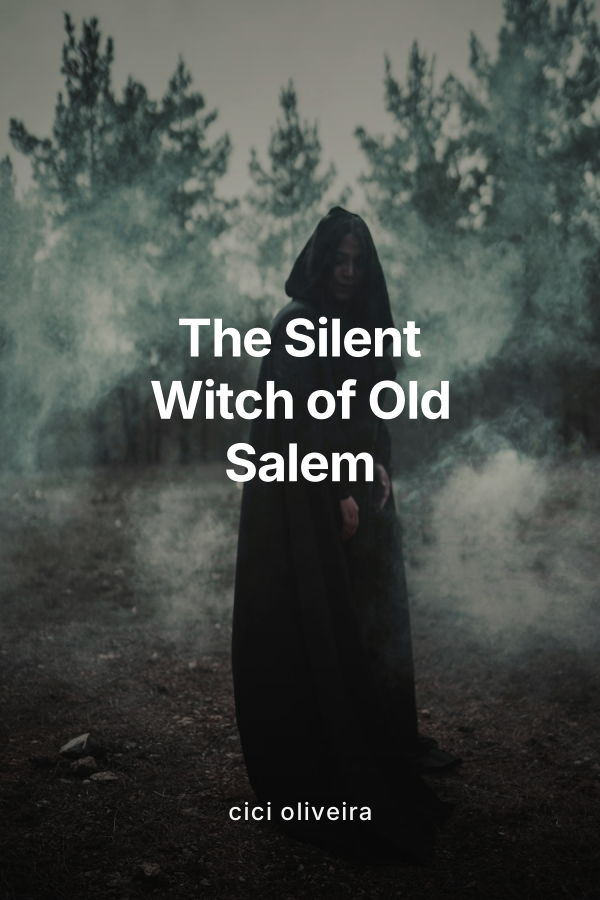
In a town that built its fame on witches and fear, the most dangerous secret belongs to a girl who refuses to speak.
Elara lives on the edge of the old Salem woods in a weathered Colonial house that has anchored her family for generations. To the tourists flooding Essex Street, Salem is a spectacle of witch hats and ghost tours. To Elara, it is background noise. Her real world is the forest behind her home, where silence is never empty.
The woods talk to her.
Not in words, but in currents of feeling, in the shiver of leaves against one another, in the hush of moss underfoot and the restless mutter of the creek. Since childhood, Elara has understood this language as clearly as other people understand spoken sentences. It is not something she asked for. It is simply something she is.
Her refusal to speak aloud is her choice, a deliberate shield built after years of being misread, mocked, and mislabeled. At school she is the quiet girl, the strange one. At home she is her parents’ enigmatic daughter, distant from her mother’s pride in family history and her father’s unease with things he cannot name. Only Shadow, her black German Shepherd, moves through the world on the same wavelength she does. He hears what she feels. He senses what she cannot see.
Everything in Elara’s life is ordered, contained, survivable, until an ordinary October morning in the woods fractures the fragile balance.
The birds fall silent. The forest holds its breath. Shadow, usually calm and obedient, freezes with a low growl that vibrates in his chest. From the thicket comes the crunch of a boot on a branch, heavy and deliberate, followed by stillness so complete it feels staged. Someone is out there. Watching. Waiting. Not an animal. Not part of the natural hum she knows so well.
Elara does not run, but the woods that have always welcomed her now push a warning into her bones. Something has crossed an invisible line. Something that does not belong.
Back inside the house, with the kitchen door locked and the morning light pouring through familiar windows, the sense of intrusion does not fade. The forest outside looks innocent. The whispers do not. They have shifted from companionship to alarm, from gentle secrets to urgent signals of danger. For the first time in her life, the language of the woods frightens her.
That evening, surrounded by her great-grandmother’s battered history books on the Salem witch trials, Elara’s thoughts will not rest. Those volumes, once just artifacts of a dead woman’s obsession, begin to feel more like a map she never learned to read. She has always believed the past to be a story someone chose to write down. Now she begins to suspect it might be a root system buried beneath her feet, twisted through her house, her bloodline, and the woods she loves.
The name the forest whispers to her that night does not come with an explanation. It does not belong to anyone she knows. It lands in her mind like a stone dropped in deep water, sending ripples through everything she thought was settled. The house, the land, her silence, Salem’s legacy, and the strange bond she has with the natural world start to pull together into a pattern she can barely face.
As the days grow shorter and the October air sharpens, the presence in the woods does not vanish. Someone continues to move beyond the tree line, just out of sight. Strange symbols appear scratched into bark. Small offerings or warnings are left along her walking path. Shadow becomes restless at night, pacing the hallways and staring at corners that look empty to everyone else. The line between human stalker and something older begins to blur.
Elara’s gift, once a private refuge, becomes the only compass she has. The forest starts to speak more urgently, in fragmented impressions and flashes of intuition that drag her toward a buried truth she does not want. Her house, with its creaking floors and stubborn doors, holds secrets of its own. Locked drawers open. Old letters surface. Her great-grandmother’s notes hint at a family entanglement with Salem’s darkest days that was never meant to reach the present.
When strange coincidences in town mirror disturbing images Elara receives from the woods, it becomes clear the danger is not confined to her quiet hilltop. A cold pattern repeats through centuries. The town that exploits its history for tourism has never really faced what it did. Some descendents profited. Others hid. A few remembered too much and paid for it. Now that unfinished business has settled on Elara’s shoulders, whether she wants it or not.
The Silent Witch of Old Salem follows Elara as she is dragged from the safety of her silence into a mystery forged long before she was born. Chapter by chapter, the story traces how her solitary walks through the forest become investigations, how her unspoken understanding of nature becomes both a lifeline and a liability, and how her role in Salem’s lingering curse slowly reveals itself.
In Chapter 1, “Whispers in the Woods,” readers meet Elara in her sanctuary and watch it transform into a landscape of unease. The subchapters reveal:
• How the woods’ language shapes Elara’s inner world and isolates her from everyone who cannot hear what she hears.
• The first intrusion that breaks her sense of safety, and the dawning realization that her ability is not only a gift but a warning system she has never needed to trust at this level.
As the tension in the trees mounts, Elara’s quiet life frays. Past and present begin to overlap in unsettling ways, hinting that the name whispered on the wind is tied to more than a stranger’s footsteps. It might belong to someone erased from official records, someone whose story was never allowed to end.
Chapter 2, “Echoes of the Unseen,” pulls Elara deeper into Salem’s forgotten history and her own family’s compromised place within it. The subchapters explore:
• The hidden archive her great-grandmother left behind, filled with discrepancies about the trials, unusual personal accounts, and references to a girl whose testimony never made it into the formal transcripts.
• The growing pressure as modern threats escalate, forcing Elara to confront the possibility that someone in the present is deliberately reigniting the oldest fears in town, using the same patterns of accusation, isolation, and hysteria that destroyed lives centuries ago.
As Elara decodes the messages from both the forest and the past, she discovers that her silence itself is central to what is happening. Her refusal to speak makes her a convenient vessel for other people’s stories, projections, and fears. It also makes her invisible in ways that those orchestrating the danger have not fully calculated. She can listen where others would interrupt. She can move without drawing attention. She can gather truths no one expects her to carry.
The heart of the book lies in the intersection of three strands:
• A psychological portrait of a girl who lives inside a rich inner world no one else can access, and whose refusal to use spoken language is both armor and identity.
• An atmospheric exploration of a New England forest that becomes a character in its own right, protective and perceptive, its mood shifting with the encroaching threat.
• A slowly unfurling mystery that uses Salem’s infamous past not as a backdrop for spectacle, but as a web of unresolved guilt, exploited fear, and generational silence that demands reckoning.
While Elara moves through each chapter, readers will see how trust is earned and broken, how truth can be twisted as easily now as it was when accusations of witchcraft could end a life, and how the quietest person in the room can be the one who finally refuses to carry other people’s lies.
The Silent Witch of Old Salem is not a story of spellbooks and flying broomsticks. It is a story about perception, about what happens when one person is forced to become the interpreter for voices that everyone else prefers to ignore, whether they belong to trees, to victims of the past, or to people still afraid to speak.
By the final pages, Elara will have to decide what to do with the name the woods keep whispering. To bury it is to repeat the sins of Salem’s history. To reveal it is to risk her own safety, her family’s fragile stability, and the little shred of anonymity that has allowed her to survive. In choosing, she must find a new language for herself, one that honors her need for silence while refusing to remain complicit in the town’s oldest, most dangerous secret.
Darkly lyrical and quietly tense, this book invites readers into a world where listening is an act of power, the forest holds a memory longer than any human life, and a girl who will not speak aloud may be the only one who can finally make the truth heard.