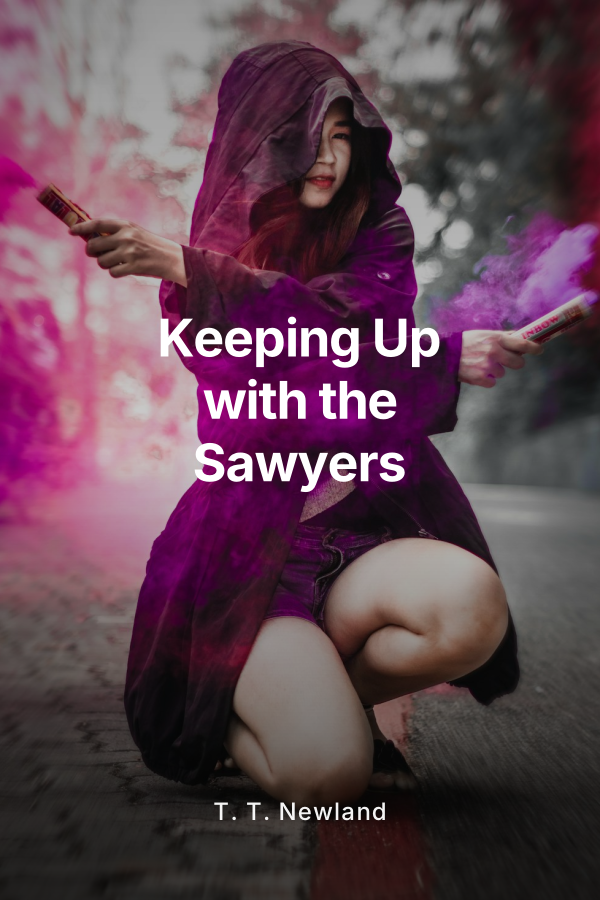
In a quiet suburb that prides itself on being aggressively average, the Sawyer family has perfected the art of blending in. They host block parties, attend parent-teacher conferences, and argue over what to watch on movie night. Neighbors see a wholesome family of seven just trying to get through the week. What the neighbors do not see is that the Sawyers are possibly the most dangerous collection of people on the planet, held together by love, habit, and a stubborn commitment to not blowing their cover.
At the head of the household is Oliver Sawyer, a soft-spoken father who looks like he has never raised his voice in his life. His true strength is invisible: he is a powerful psychic who can move objects, read minds, and bend reality in subtle ways. Oliver quietly cleans up the collateral damage that comes from raising five superpowered children, all while pretending his worst problem is the backyard lawn. Every day for him is a delicate balance between being an attentive dad and an off-the-books crisis response team.
Sharing the burden is Annabeth, his wife, a lab-created mutant known as a Diclonius. She appears human until you notice the horn-like protrusions on her forehead and the unusual color of her hair. Hidden around her are invisible telekinetic arms called vectors that can reach, grab, and strike with terrifying precision. Years of being treated like a weapon have left her fiercely protective of the quiet domestic life she has built. She uses her vectors not for destruction, but for such noble tasks as cooking five things at once and catching toddlers before they faceplant into coffee tables.
Their children are each a chaotic force of nature in their own right. Marcy, the eldest daughter, is an esper with formidable telepathic abilities and the mind of a preschooler. Emotionally and cognitively, she sees the world with the innocence and impulsiveness of a five year old, yet she can hear the thoughts of everyone around her. The mix is catastrophic and hilarious. Secrets do not stand a chance around her, and neither do household rules; when your child can tell which parent is easier to convince before they even open their mouth, discipline becomes an imaginative sport.
Her twin brother, Marcus, is a walking arsenal of psychic talents. If it has the word “psychic” attached to it, there is a good chance Marcus can do it. Instead of embracing the spotlight, he spends most of his time trying to avoid it. He is that kid quietly reading at the back of the classroom, doing everything in his power not to stand out while accidental telekinetic mishaps and unintentional teleports keep dragging him into trouble. Marcus treats “not getting involved” like a full-time job and fails at it daily.
Then there is Tabatha, a younger sister who inherited Annabeth’s Diclonius traits. She has horns, unconventional hair, and vectors of her own. Unlike her mother, though, Tabatha is still figuring out what it means to be both monstrously capable and just a kid who has to deal with middle school drama. Her vectors are as likely to shove a bully’s backpack into a locker as they are to steal snacks from the top shelf. She fights the urge to use her powers for every tiny inconvenience, guided by her parents’ rule that subtlety beats spectacle.
Micah, the younger brother, is a clairvoyant psychic with a mind so sharp it almost counts as seeing the future. He is a bona fide genius whose intellect brushes up against precognition. For the Sawyers, this means homework is finished in seconds and pop quizzes are never a surprise. It also means Micah constantly calculates worst-case scenarios for his family’s secret. He can see disaster coming a mile away, and he spends most of his time trying to nudge everyone around him off collision courses they do not even know they are on.
Finally, there is Juniper, the baby of the family and a walking natural disaster. She is officially the strongest girl on Earth, a God-level threat on any reasonable danger scale. The twist is that she cannot even tie her own shoes yet. Juniper’s raw power slumbers half the time and flares the other half, triggered by the whims of infancy and toddlerhood. A tantrum can register on seismographs, and a giggle-powered hug can dent steel. Keeping her happy is, quite literally, a matter of public safety.
The series explores the daily life of this absurdly overpowered family as they fumble through school events, neighborhood barbeques, parent-teacher meetings, and sibling squabbles while desperately hiding who they really are. Every mundane ritual is overshadowed by the possibility of a catastrophic slipup. A routine soccer game can turn into a telekinetic spectacle. A simple science fair risks exposing Micah’s freakish intellect. A sleepover threatens to reveal Tabatha’s horns or Annabeth’s vectors. Even a family board game night might escalate into a psychic arms race.
Humor drives every chapter. The Sawyers are not grim superheroes or tragic monsters; they are a family that laughs, teases, and bickers while accidentally brushing up against apocalyptic scenarios. A spilled drink might float back into the cup the moment a guest turns away. A bully suddenly finds his shoelaces tied together by no visible force. A teacher is convinced she imagined the desks rearranging themselves when she looked down at her attendance sheet. The world keeps writing off the Sawyers’ oddities as coincidences, camera glitches, or tricks of the light, and the family works hard to keep it that way.
The heart of the story lies in the tension between wanting a normal life and knowing they are anything but normal. Oliver and Annabeth carry the shadows of their pasts in secret, determined that their children will grow up with family dinners and school projects instead of laboratories and test chambers. Each child, in turn, grapples with their own identity: Marcy learning boundaries around people’s thoughts, Marcus trying to accept that hiding forever is impossible, Tabatha balancing her temper with responsibility, Micah living with knowledge that no one else has, and Juniper existing as a tiny, giggly paradox of infinite strength and absolute vulnerability.
Their efforts to stay hidden inevitably lead to bizarre, fantastical situations. The family has to improvise on the fly when school trips accidentally overlap with Micah’s ominous predictions, or when Juniper’s powers surge at the worst possible moment. Sometimes they succeed through clever misdirection and fast thinking. Other times, they escape discovery by sheer absurd luck. The tone stays light and silly even as the stakes occasionally spike, turning potential disasters into comedy set pieces.
Keeping Up with the Sawyers is a slice of life comedy that asks what happens when the world’s most overqualified disaster squad just wants to be left alone to pack lunches, attend recitals, and argue over bedtime. Readers follow the family from school corridors to suburban cul-de-sacs, from living room movie marathons to narrowly averted global incidents, always with the sense that love, in all its messy, funny, exasperating forms, is the only thing strong enough to keep this superpowered circus from flying apart.