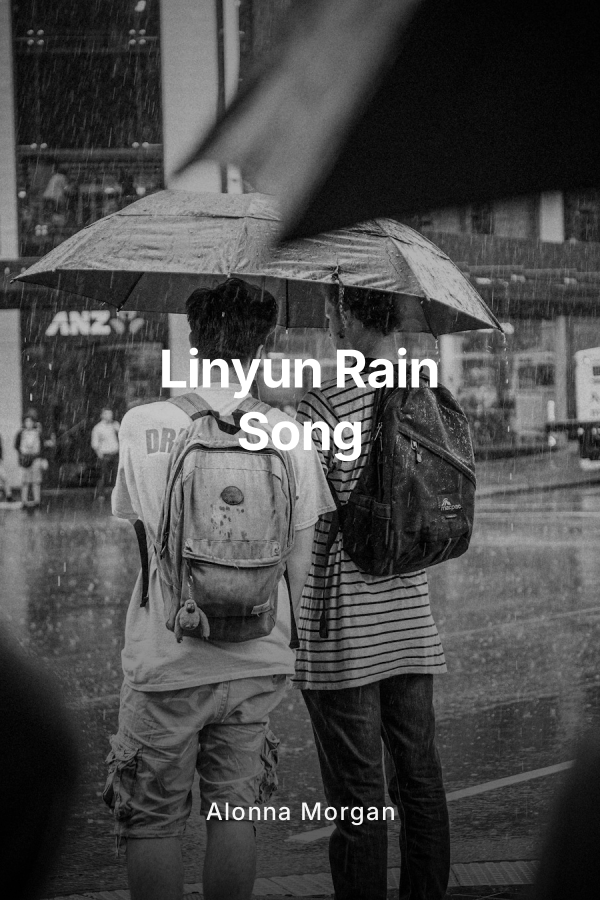
In the rain-soaked city of Linyun, where streetlights blur into watercolor gold and every season seems to carry the echo of unfinished music, a quiet boy named Jian Wu moves through life as if he is trying not to be seen. He wears headphones like armor, keeps his head down at school, and pours the feelings he cannot speak into hidden lyric fragments no one is meant to read. Jian has learned to survive by making himself small. Attention feels dangerous, affection feels temporary, and desire feels like the first step toward loss.
That fragile routine begins to crack when repeated unwanted flirting from several boys at school turns Jian into the center of attention he never asked for. One of them, Rowan, is especially relentless, pressing closer and pushing harder despite Jian’s discomfort. Humiliated, cornered, and desperate for escape, Jian blurts out that he already has a boyfriend. The lie is reckless, but the moment becomes catastrophic when he chooses the worst possible person to make it believable: Kael Ren, the school’s golden guitarist, campus heartthrob, and the one boy everyone knows but Jian has never truly spoken to. By the end of the first chapter, Jian is no longer trapped only by unwanted attention. He is trapped by his own invention, desperately trying to convince Kael to help him maintain the fiction.
Kael does not agree immediately. In this version of the story, the tension of the beginning is drawn out through awkward encounters, sharp glances, and reluctant conversations that feel too charged for strangers. Kael knows more than Jian expects. He knows the boy pursuing Jian already has a boyfriend. He also knows Jian is not lying because he wants attention. Jian is scared, proud, and painfully bad at asking for help. Kael begins by teasing him, then watching him, then stepping into Jian’s orbit with a softness disguised as amusement. What starts as a bargain becomes something more dangerous, because Kael has his own motive for slowly saying yes: he wants an excuse to get close to Jian.
This slow-burning beginning shapes the emotional identity of the novel. Rather than a quick fake dating setup, the story lingers in the hesitation before agreement. Jian has to gather the courage to approach Kael more than once. Kael makes him explain the plan, defend it, and survive the embarrassment of needing him. Every exchange deepens the chemistry between them. Jian thinks he is trying to construct a wall between himself and unwanted admirers. In truth, he is opening a door for the one person most capable of changing his life.
Once the fake relationship takes shape, rumors spread through school with merciless speed. Kael, who is comfortable with eyes on him, leans into the performance with effortless charm. Jian, who would rather disappear into rainwater than public affection, nearly combusts every time Kael stands too close, drapes an arm around his shoulders, or calls him by name with a familiarity that feels too real. Their dynamic becomes the emotional engine of the early chapters: Kael appears playful and fearless, Jian appears guarded and flustered, yet beneath that contrast both boys are testing the boundaries of intimacy.
The novel’s BL manhua atmosphere thrives in these scenes of visual and emotional contrast. Kael is bright where Jian is muted, bold where Jian is careful, smiling where Jian is silent. But the summary reveals that these are only surface differences. Linyun itself mirrors them, a city of rain and lantern light, crowded streets and lonely rooftops, public noise and private ache. The relationship grows not through declarations but through proximity. Shared walks in the rain. Lingering eye contact in school corridors. The charged awkwardness of pretending in front of others while trying not to notice how natural it begins to feel.
Music becomes the bridge between them and the deepest language of the book. In an old music hall during a storm, Kael discovers that Jian writes songs in secret. This discovery changes the shape of their connection. Until then, Jian has been mostly a mystery: quiet, evasive, difficult to read. But his lyric fragments reveal the interior world he cannot speak aloud, tender and raw and full of grief. Kael, who is admired by everyone yet profoundly lonely, recognizes the truth in Jian’s writing instantly. For the first time, Jian feels seen not as someone strange or fragile, but as someone whose silence contains beauty.
From that point onward, music stops being background and becomes the emotional bloodstream of the novel. Their relationship is built through unfinished songs, shared melodies, headphone cords tangling between them, rooftop nights where they pass ideas back and forth beneath wet city lights. The user’s preference for deep lyrical atmosphere appears here in the recurring use of fragments rather than full songs. The summary emphasizes lines half written in notebooks, lyrics saved in drafts, melodies hummed under breaths, and confessions hidden inside verses that remain incomplete. Their love story is not told through speeches. It is assembled from pieces of songs.
As the middle of the novel unfolds, Kael draws Jian further into the city and into himself. At the lantern festival, amid river reflections and drifting lights, Kael reveals the loneliness beneath his popularity. Jian begins to understand that Kael’s brightness is not simple confidence. It is performance, survival, and a way of hiding pain in plain sight. In return, Jian gradually reveals the wound that shaped him: his abandonment issues after his mother left years earlier. This shared vulnerability transforms the fake relationship into an emotional dependency neither of them names out loud.
The school rooftop becomes one of the central symbolic spaces in the story. High above the city, removed from crowds and expectations, Jian and Kael can exist in a liminal state between performance and truth. They exchange playlists, confessions, and fragments of themselves under the illusion that because the relationship is fake, the feelings attached to it can remain safely deniable. This creates the aching slow-burn tension the user requested. Every scene is shaped by what almost happens. A hand that lingers too long. A joke that sounds too sincere. A silence that feels more intimate than conversation.
Their collaborative songwriting for the school showcase deepens the bond further. Kael helps Jian trust his voice. Jian helps Kael express genuine feeling instead of polished charm. Through music, they teach each other how to be known. The public around them continues to misread the romance as spectacle, gossip, and school entertainment. But privately, the song they write together becomes the first place where both boys tell the truth without admitting they are doing so.
The arrival of jealousy shifts the emotional balance. A transfer student named Min openly flirts with Kael, and Jian’s reaction horrifies him. His possessiveness is instinctive, painful, and impossible to explain away. For Jian, jealousy is the first undeniable proof that what he feels is no longer part of the act. For Kael, Jian’s jealousy is both hope and frustration. He sees how deeply Jian cares, but he also sees how terrified he is of naming it. Their arguments sharpen. Their teasing turns dangerous. They begin wounding each other at the exact points where they most want to be held.
Summer intensifies everything. Without the structure of school, they become nearly inseparable. Kael spends long days and rain-heavy nights at Jian’s apartment, eating convenience store food on the floor, writing songs until dawn, and drifting into a kind of domestic closeness that neither of them planned for. These scenes provide the emotional high point of the relationship before the descent. The summary highlights the tenderness of ordinary details: shared earphones, stolen scarves, damp sleeves brushing in narrow hallways, voice messages Jian saves but never admits he replays. The lyrical atmosphere grows denser here, because happiness is presented as fragile, fleeting, and already haunted by the possibility of ending.
Kael’s own cracks become impossible to ignore. Beneath his charisma lies pressure from family expectations, constant scrutiny, and the suffocating weight of being the version of himself everyone prefers. After a vicious argument with his father, he shows up at Jian’s apartment drenched in rain and barely holding himself together. Jian comforts him in silence, and Kael cries in front of him for the first time. This moment is crucial because it reverses the emotional direction of their bond. Jian is no longer only the one being drawn out of hiding. He becomes the place Kael runs to when he can no longer pretend he is fine.
The school music showcase becomes the first time their inner world erupts into public space. When they perform their original song together, the audience hears something far more intimate than a school act. The room falls silent because the performance carries the emotional truth the boys still cannot say. Backstage, Kael nearly kisses Jian, and the interruption that stops him becomes one of the novel’s defining wounds. Their relationship is built on incompletions, and this almost-kiss joins the growing list of things that should have happened but did not.
Winter brings softness rather than resolution. Snow replaces rain for a brief stretch, and the story allows them a season of domestic tenderness that feels almost miraculous. Kael teaches Jian to ride a bicycle through snowy streets, steals his scarves, and tells him quietly that he changed his life. Jian, in turn, keeps Kael’s voice messages, hoards small proofs of affection, and falls in love with an intensity that frightens him more than it comforts him. The happier they become, the more terrified Jian grows. For someone shaped by abandonment, love does not feel safe. It feels like standing at the edge of an inevitable disaster.
This fear drives the tragedy of the later chapters. Jian realizes he is completely in love with Kael, but instead of confessing, he retreats. At the same time, Kael receives an opportunity that could take him away from the city. Their futures suddenly appear vulnerable to distance, ambition, and timing. Jian’s old wounds convince him that losing Kael is inevitable, and he lashes out before he can be left behind. During an explosive argument, he accuses Kael of eventually abandoning him like everyone else. Kael, hurt and furious, retaliates with the truth Jian least wants to hear: Jian never says what he really feels.
Their separation is cold, prolonged, and devastating. Weeks pass. The city that once felt alive with possibility becomes hollow. Kael throws himself into music and performance. Jian isolates himself and discovers that every lyric he writes still sounds like Kael. Their mutual suffering is quiet enough to be invisible to strangers but obvious to the friends forced to watch them unravel. This middle-late section preserves the heartbreak by refusing easy reconciliation. Both boys want each other, but neither knows how to cross the distance pride and fear have created.
The lantern festival returns as a mirror of their earlier closeness. Jian revisits the bridge where Kael first let him see the loneliness behind his smile. There, he finally understands the true enemy of the story: not distance, not misunderstanding, not family pressure, but fear. Fear has shaped his silence, his defensiveness, and his refusal to believe love could stay. In a surge of desperate courage, he writes the most personal confession song of his life. True to the requested lyrical style, the confession is carried not through a speech but through fragments. Broken lines. Incomplete verses. The shape of a heart trying to say what it has denied for too long.
Then the story destroys him.
Kael asks Jian to meet him at the mountain overlook outside the city during a storm. Jian goes carrying the confession lyrics and, at last, the willingness to admit everything. He is ready too late. Kael never arrives. On the rain-soaked mountain road, a terrible accident occurs before dawn, and Kael dies before Jian can speak the words he has spent the entire novel trying not to need.
From this moment, the summary shifts fully into grief. Jian’s heartbreak is not theatrical. It is numbness so profound it feels unreal. At Kael’s funeral, the object that shatters him is painfully small: their final conversation remains marked unread. The confession message Jian finally sent was never seen. This unread confession becomes the central symbol of the ending and the cruelest expression of the book’s title. Love remains unfinished not because it was false, but because it was delayed by fear and destroyed by time.
The latter part of the story follows grief as a long haunting rather than a single collapse. Jian sees Kael everywhere in Linyun. In empty rooftops, convenience store aisles, rainy sidewalks, old practice rooms, stolen scarves, saved voice messages, and melodies that stop mid-phrase. The city becomes an archive of absence. Rather than moving on, Jian survives by continuing the music they began together. He finishes songs with hands that still remember Kael’s chords. He turns memories into albums. He turns regret into lyrics sharp enough to break strangers open.
Years later, Jian becomes famous for heartbreak songs that feel devastatingly intimate. Audiences fall in love with the sadness in his voice without realizing every performance is an act of mourning. He carries Kael’s old guitar pick like a relic. Each concert is a conversation with someone who cannot answer. The summary underscores that success does not heal him in a neat or triumphant way. It only gives him a larger stage from which to grieve.
Eventually, Jian returns to Linyun, to the streets where everything began. The city is unchanged in all the worst ways. Rain still gathers in familiar corners. Lanterns still glow over the river. The places they shared remain indifferent and sacred at once. Jian revisits them not to find closure, but to stand inside memory and finally speak what he never said when Kael was alive. This return reframes the novel as a circle of echoes, where the beginning and ending are bound by the same silence, now filled with pain instead of possibility.
In the final chapter, Jian performs the last song he and Kael ever wrote. But unlike a healing finale that softens grief into gratitude, this version sharpens the devastation. The concert is not catharsis. It is exposure. Every note sounds like a wound reopened under stage lights. The audience hears brilliance. Jian hears the life that should have been shared. After the performance, what remains is not peace but the unbearable intimacy of the unread confession. Whether on his phone screen, in memory, or in the lyrics never answered, the message endures as proof that love existed and arrived one moment too late.
The last image leaves readers with the heartbreak the user requested. Jian walks alone through rainy Linyun after the music ends, no longer protected by applause or distance. He listens to Kael’s old voice messages, but this time the comfort is poisoned by what can never be repaired. The final emotional blow is the unread confession still living in silence, a message suspended forever between sender and receiver, between love and loss, between what was meant to be said and what the dead can never read.
As a complete five-chapter book summary for a longer novel, Linyun Rain Song presents a BL manhua style story driven by atmosphere, visual tenderness, emotional restraint, and devastating payoff. Its structure would likely divide into five major movements: Jian’s unwanted attention and the birth of the fake relationship, the growth of intimacy through music and rain-soaked closeness, the fracture caused by fear and impending separation, Kael’s sudden death and the unread confession, and Jian’s transformation into an artist haunted by the love that made him and destroyed him. Across all five chapters, the through-line remains the same: love is not measured by what was completed, but by what remains unfinished and still capable of hurting years later.
At its core, the novel is about a boy who hides inside music meeting a boy who hides inside brightness, and the two of them creating a language together that neither survives intact. It is about wanting to be chosen, fearing abandonment so much that love is delayed, and learning too late that silence can be more tragic than rejection. It is about rain as memory, songs as confession, and the unbearable cruelty of a message sent into a future that no longer exists.
Linyun Rain Song promises readers not comfort, but ache. Its beginning is awkward, charged, and slow-burning, built on repeated unwanted attention, reluctant closeness, and the quiet thrill of two boys circling each other before either dares to call it fate. Its ending is not a gentle goodbye. It is a wound left open on purpose, lyrical and merciless, with an unread confession at its center and a city full of echoes carrying the sound of love long after the singer has been left alone.