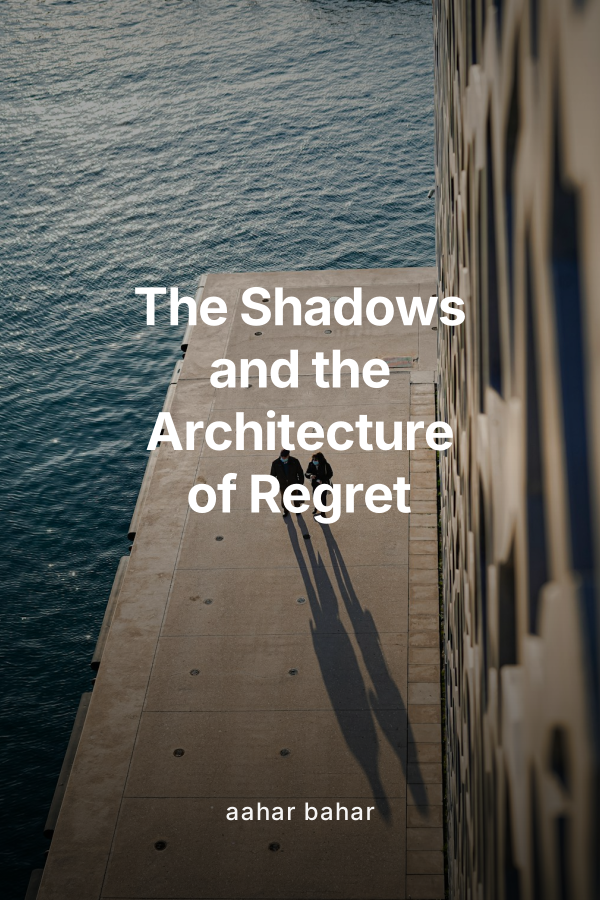
In this second volume of the cycle begun with The Shadows and the Architecture of Regret, the tale returns to Chandra when the ink of her first great choice is scarcely dry. The café’s mirror like counsel has left her standing at the fork between silence and speech, between drifting with the dead man’s wishes and taking up her own pen. Now she chooses, and that choice pulls her from Kolkata’s crowded streets back to the high, mist bound ribs of Mussoorie, to stand not as a grieving lover before a ruined house, but as a claimant in a court of law and a pilgrim in the haunted corridors of The Shadows itself.
The book opens in the cramped office of the conflicted lawyer, amid files yellowed with the dust of other people’s sins. Here Chandra, now in her thirties and long practiced in the quiet service of books, sets her hand to a different kind of record. She instructs him to fight the rival claim upon The Shadows, to defend Raj’s bewildering bequest and the strange, unwieldy gift of restitution it represents. In that simple instruction lies a storm. By choosing to fight, she accepts that her own life will become a case number, that her name will be bound to his in the public ledgers of land and law. She steps into the very labyrinth she once feared, determined that this time she shall walk it with open eyes.
From that decision the narrative unfolds along three interwoven paths that answer and deepen the architecture of the first book. One path follows the measured cruelty of the courtroom. Raj’s cousins rise to contest the will, their polished voices sharpening grief into accusation. They hint that Chandra bewitched a dying man, that she preyed upon his weakness in order to seize a house to which her blood could never make a rightful claim. The judge’s bench becomes a cold stage upon which their old love must be dissected as evidence. Moments once tender, a shared book in a quiet library, a touch in the rain, are dragged out and made to serve as proof of manipulation or of honor, according to whose tongue commands them. Here love is asked to sit beneath oath and answer questions that no heart is made to bear.
The second path winds through the house on the hill itself. Chandra takes leave from her work in Kolkata and comes to live within The Shadows during the course of the trial. The villagers regard her at first with wary eyes; to some she is the wronged granddaughter of those who lost land long ago, to others the interloper who walks the master’s balconies without the proper surname. Day by day, as she shares tea in dim courtyards and listens more than she declares, suspicion loosens, then bends. Old staff who remember Raj as sickly boy and haunted heir offer fragments of memory, partial testimonies of their own. The manor grows less a single looming villain and more a mosaic of vantage points, each stone marked by a different pair of human hands.
Within its walls, the true gothic of this volume quietly stirs. The Shadows, that brooding witness of generations, yields its secrets not through ghostly apparitions, but through paper. Behind a panel, within a locked drawer, between the pages of neglected ledgers, Chandra finds what Raj never brought himself to send. A first unsent letter falls into her hands early in her vigil: Raj’s confession that the cruelty of the rain soaked quarrel was a mask worn to drive her from the path of his failing life, that his words of “convenience” were daggers turned against his own heart as much as against hers. In later chapters other discoveries follow, staggered like the careful tolling of a bell. An ancestor’s confession explains the old protection deal that twisted both families’ fates; another document shows how Raj wrestled with the same choice that now torments her, whether to expose the past or to bury it beneath a noble silence.
These papers do not wash him clean. Instead they reveal him more fully human, a man whose love was braided with cowardice, whose attempts at sacrifice were shot through with the desire to direct the story long after his own exit. Each new page shifts Chandra’s inner verdict by a small degree, away from the burnt anger that followed the rain toward a bittersweet understanding in which tenderness and indictment mingle without cancelling one another. The very house that once embodied an architecture of regret becomes, in this new volume, a living archive, a place where unspoken trials of the dead wait to be read and weighed.
The third path belongs to Chandra’s living heart, and walks beside Mira, the friend from Kolkata whose fierce questions once cracked the old script. Mira arrives on the hill first as visitor and then as quiet ally, shuttling between the village and the district court, between the chill of the hearings and the candle lit nights in which they read Raj’s letters together. Their companionship deepens into something that leans toward the contour of love, yet the arc refuses the easy solace of replacement. After a brutal day in court, when the cousins’ lawyers have raked through Chandra’s past with Raj as if through a field of thorns, the two women sit together beneath a weak lamp in one of The Shadows’ smaller rooms. Raj’s ink trembles between their fingers, his words confessing that he built a barrier of lies so that she might live free of his ruin.
In that quiet hour Mira nearly speaks the word that would turn their bond into a new declaration. The air is thick with all that has gone unsaid: her long watchfulness in Kolkata, her decision to follow Chandra up the mountain, her constant willingness to stand in the line of cross fire that others have aimed at her friend. Yet at the brink she turns the confession aside, choosing instead to name what she offers as steadfast friendship, not petition. Chandra, who has come to read silences as fluently as letters, understands and responds in kind. They make between them a conscious, tender choice: that their story will not be another romance fed into the house’s mill, not another pair of lovers bound into its architecture of regret, but a covenant of witness and care that can stand without the title of lovers.
The alternating rhythm of these three threads court, house, and heart raises the story toward its climax. Evidence from the archive of The Shadows itself filters into the proceedings, not as miraculous last minute scroll, but as a slow reinforcement of Chandra’s claim. Testimonies from villagers, from the conflicted lawyer, from those who saw Raj’s final struggle to set things right, are laid beside the unsent letters that reveal what he dared not say aloud. In the verdict scene the judge does not pronounce Chandra saint, nor Raj tyrant redeemed. Instead the law, in its limited tongue, recognizes the validity of his will and the legitimacy of her inheritance. She wins the house, yet the book makes clear that what she truly gains is not stone, but the right to decide what story shall be rooted there next.
In the closing movement Chandra announces her intention to transform The Shadows. No longer shall it crouch as monument to land wrested and loves ruined; it will become a school and archive, a refuge where village children learn beneath roofs once reserved for masters, where the records of past injustices are preserved rather than concealed. Raj’s letters and the ancestors’ confessions are catalogued, not as relics of private sentiment alone, but as testimony to the cost of silence. The manor’s halls, once echo chambers for unspoken trials of the heart, begin to fill with voices that argue, question, and learn out loud.
Mira prepares to return to Kolkata, her work beside Chandra in the courtroom and the house complete, though her care endures. Their parting is gentle and unclimactic, rich in unvoiced recognition. They walk one last time along the terrace, looking out over the village that has begun to see The Shadows not only as a threat upon the ridge, but as a strange new possibility. There is no promise of future union, only the sure knowledge that their lives have marked one another in ways that neither title nor ceremony is required to bless.
Thus The Archive of Unspoken Trials closes upon a quiet yet decisive transformation. The first volume asked whether love could ever be disentangled from legacy, whether secrecy born of sacrifice might be honored by keeping silence or by breaking it. This second answers not with a thesis, but with a life. Through court records and hidden letters, through village gossip and late night conversations, Chandra turns herself from subject of an old script into author of a new one. The house that once arranged every affection into regret does not lose its shadows. Instead, under her hand, those shadows are taught to shelter learning and honest testimony. The unspoken trials of the dead are entered at last into a living archive, and the living step forward to give their own witness, flawed, courageous, and free.