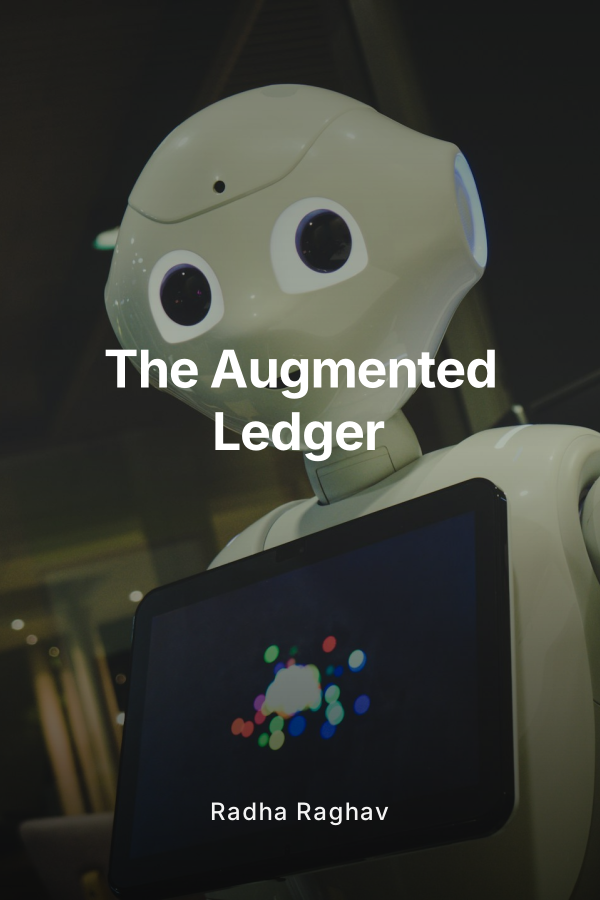
This book is a practical, technically grounded roadmap for traditional accountants who grew up with ledgers, Excel, Tally, QuickBooks, email, and manual workflows, and who now face a profession transformed by artificial intelligence. It assumes readers are smart, numerate, and deeply familiar with accounting concepts, but not comfortable with advanced technology, programming, or complex software configuration. The core promise is simple: AI will not replace accountants; accountants who learn to collaborate with AI will replace those who do not.
The summary below outlines how the full 5 chapter, roughly ten thousand word book will guide a non tech accountant from basic awareness to daily AI use, and finally to strategic reinvention of their role and services.
Chapter 1: From Manual Mindset to Augmented Intelligence
The opening chapter reframes accounting as an information processing system that historically depended on human cognition and manual tools. It walks through how traditional workflows such as data entry, invoice processing, bank reconciliation, and report compilation emerged in a world where every transaction had to be touched by a person.
On this foundation, the chapter introduces artificial intelligence in very simple language tailored to non technical accountants. AI is explained as statistical pattern recognition at scale, capable of reading, classifying, predicting, and generating text and numbers. Everyday examples such as email auto reply suggestions, video recommendations, and conversational AI illustrate how the same mechanics can be used in accounting to read invoices, categorize expenses, detect anomalies, predict cash flow, and draft narratives for reports.
The narrative then bridges into why accounting is a perfect environment for AI. The profession is built on large volumes of structured and semi structured data, repetitive rule based tasks, and strict compliance requirements. These characteristics match exactly what modern AI systems handle well. Huge data, repetition, and rules become inputs to models that can process entire ledgers in seconds, surface exceptions, and support continuous assurance rather than periodic checks.
This chapter also directly addresses the fear that AI will eliminate accounting jobs. Instead of vague reassurance, it gives a concrete decomposition of the accountant’s work into two layers. The first layer includes mechanical tasks such as data transcription, basic classification, standardized calculations, and template based reporting. The second layer includes judgment, interpretation, client communication, ethics, and business understanding. AI is positioned as a force that aggressively compresses the first layer while amplifying the second. Those who embrace this shift can work faster, make fewer errors, and move closer to advisory and strategic roles. Those who resist risk having their value trapped in tasks that are rapidly commoditized.
The chapter closes with a clear value proposition: accountants who incorporate AI into their daily workflow will work faster, reduce mistakes, earn more, and become future proof in a profession that is being rewritten in real time.
Chapter 2: Core AI Capabilities Across the Finance Stack
The second chapter systematically maps AI capabilities to core domains of accounting and finance work. It does not assume any programming ability, instead focusing on tasks and outcomes. For each domain, the chapter contrasts “traditional” workflows with “augmented” workflows that integrate AI tools.
For bookkeeping, the book shows how AI can extract structured data from invoices and receipts, classify transactions into chart of account codes, and link bank feeds for continuous reconciliation. Instead of manual entry followed by periodic reconciliation, the target state is a streaming ledger where AI continuously ingests documents, cross checks balances, and highlights anomalies for review. Commercial tools for automated expense capture and AI enhanced bookkeeping software are discussed as examples of this evolution, but the focus remains conceptual and task centered so that the principles stay valid even as specific tools change.
For auditing, the chapter explains how traditional sampling can be supplemented or replaced by AI driven full population analysis. Models trained on historical transactional patterns can scan every entry, across multiple ledgers, for anomalies that might indicate duplicate payments, fictitious vendors, or unusual expense timing. The accountant’s role becomes one of designing tests, interpreting flagged items, and connecting patterns to business reality, rather than manually ticking and tying a small sample of documents.
Taxation workflows are mapped similarly. AI can assist in reading and classifying transactions for indirect tax regimes, proposing appropriate codes, and running calculations across complex rule sets. For direct tax compliance, AI can help assemble data, fill structured forms, cross reference declarations, and evaluate the impact of alternative scenarios. Over time, personal tax advisory experiences emerge, where models simulate multiple filing options and explain tradeoffs in natural language, while the accountant retains responsibility for legal interpretation, ethics, and final sign off.
The chapter then shifts into financial analysis and management information systems. Here AI is framed as a forecasting and simulation engine that can work on top of existing spreadsheets, databases, or BI systems. Models can predict revenue, forecast expenses, evaluate risk of default, and simulate “what if” scenarios for pricing, cost changes, or market shocks. This moves the accountant from historical reporting into predictive insight and proactive decision support.
Throughout the chapter, a small set of widely accessible AI tools is presented as a core toolkit. Conversational AI systems that can understand prompts, spreadsheet integrated AI features, and AI enhanced accounting platforms are described in terms of what they allow a non technical accountant to do: draft reports, visualize data, automate expense processing, and generate forecasts. The discussion is firmly tool agnostic in principle, using current products only as illustrations for a pattern of capabilities that will persist even as specific vendors and interfaces change.
Chapter 3: First Contact: A Seven Day Onboarding Plan for Non Tech Accountants
The third chapter is an intensely practical onboarding guide. It assumes a reader who is comfortable with accounting but anxious about AI, cloud tools, logins, and prompts. The structure is a day by day, step by step program to go from zero to daily use of AI in a typical accounting workflow.
Day one focuses on language and concepts. It explains key terms in non technical analogies: models as “very fast pattern learners,” training as “showing the system many historical examples,” and prompting as “giving precise written instructions to a very diligent virtual assistant.” The reader sets up a basic account on a conversational AI platform, learns how to log in, and practices asking plain language questions.
Day two is about structured prompting. The book introduces a simple standard template for prompts: role, task, data, constraints, and output format. Examples are tailored to accounting, like asking the AI to rewrite a client email, summarize a complex standard, or outline a checklist for closing the month. Readers see how changing instructions changes outputs, building intuition about how to communicate with the system.
Day three takes the reader into file based workflows. In a guided exercise, the accountant uploads a small trial balance or sample ledger extract and prompts the AI to identify trends, summarize key movements, or prepare narrative commentary. The chapter emphasizes privacy hygiene from the start: stripping client names, removing sensitive identifiers, and understanding terms of use before sharing data.
Day four introduces micro automation for repetitive text and number tasks. Accountants practice using AI to generate standardized email templates for payment reminders, draft engagement letters, or produce checklists for tasks like GST working or bank reconciliation. The focus is on making AI a daily companion for small but frequent tasks, not a monolithic project.
Days five and six shift into domain specific workflows. A handful of “hero use cases” are chosen such as automating parts of GST working, preparing bank reconciliation narratives, supporting audit sampling, or drafting MIS commentaries. For each use case, the chapter outlines a clear “before AI” sequence and an “after AI” version where the conversational model handles data transformation, narrative drafting, or exception surfacing, while the accountant validates and finalizes.
Day seven consolidates learning into a personal AI adoption plan. The reader is guided to list their three to five most time consuming tasks and design a simple experiment for each using AI over the next month. Checklists help them define success criteria, guardrails, and review routines. By the end of the week, the accountant has not only touched AI but has concrete, repeatable workflows in their own context.
Chapter 4: Designing Robust Workflows, Prompts, and Controls
The fourth chapter dives deeper into workflow engineering for accountants who are starting to feel comfortable with basic AI use and want to formalize and scale it across their office or practice. It moves beyond casual prompting into structured, documented processes that can be reused, audited, and improved.
The chapter begins by introducing the idea of an “AI augmented workflow” as a sequence with defined inputs, transformations, AI invocations, and human checkpoints. Examples are built for common tasks like bookkeeping, audit support, tax working, analysis, and reporting. For each process, the book defines clear boundaries for what is handled by AI and what requires human review, especially for compliance and judgment heavy steps.
A detailed section is devoted to constructing strong prompts. Instead of providing a handful of generic templates, the book shows how to think about prompts systematically. It explains context specification, instruction clarity, output constraints, and iteration. For instance, a prompt for GST reconciliation is decomposed into goals, required data fields, tolerance thresholds, and formatting requirements. A prompt for audit planning is built to incorporate risk assessment, materiality, and sampling logic in explicit language. This approach helps readers adapt prompts to new situations rather than memorizing static text.
The notion of prompt libraries is introduced, but with a focus on maintaining them as living assets. Readers are encouraged to group prompts by domain, version them as they evolve, and annotate them with examples of good and bad outputs. The book recommends a standard layout for each prompt entry: purpose, input format, core instruction, example, and known limitations.
Since many accounting tools are evolving to embed AI directly, the chapter also discusses how to remain tool agnostic in design while taking advantage of platform specific features. For example, workflows can be designed conceptually in a way that is portable across AI chatbots, while incorporating add ons for spreadsheet integrations, BI tools, or specific accounting platforms where beneficial. The guiding principle is to avoid lock in to any single vendor by making the logic and prompts human readable and transferable.
Critical sections are dedicated to controls, risk management, and ethics. The book systematically classifies AI risks that are particularly relevant to finance professionals: data privacy breaches, over dependence on outputs, subtle calculation errors, misclassification, and misunderstood regulations. For each risk, specific safeguards are proposed. These include anonymization of client data, maintaining human validation steps, cross checking results with independent calculations, and keeping a clear approval trail.
The chapter emphasizes that AI cannot replace human judgment, handle complex ethical tradeoffs, or fully understand business context and emotions. It explains how accountants should maintain final responsibility for outputs, using AI as a fast and flexible assistant rather than a decision maker. Practical checklists for AI use are provided so that even non technical staff can use these systems confidently without putting clients or firms at risk.
Chapter 5: The Future Accountant: New Roles, Services, and Business Models
The final chapter looks ahead. Having moved the reader from fear to hands on use and then into structured workflows, it now explores how AI reshapes the profession at the level of roles, services, and business models.
First, the chapter analyzes the likely decline of traditional data entry roles and routine compliance work that can be fully standardized and automated. It counters this by outlining a set of emerging roles for accountants who are willing to lean into the shift. These include AI accounting consultants who design and manage automation for clients, financial data specialists who use AI enhanced analytics to uncover insights, virtual CFOs who guide strategy using predictive models, and automation coordinators who bridge between finance teams and technology vendors.
Next, it reimagines client facing services. AI augmented bookkeeping and compliance free up capacity that can be repositioned into advisory offerings such as dynamic cash flow forecasting, scenario based planning, continuous performance monitoring, and risk analytics. The book shows how accountants can package these high value services, set fees based on value rather than hours, and communicate the benefits to clients. It also suggests specialized offerings for different segments such as AI optimized GST and taxation support, or real time dashboards and alerts for small business owners.
The chapter also addresses how small firms and solo practitioners can compete against larger players by using AI to amplify their capabilities. Case style examples illustrate how a small CA firm can cut workload hours, reduce staff burnout, and expand margins by adopting AI driven automation, while maintaining or increasing quality.
Finally, the book closes with a concrete roadmap tailored to different reader profiles. Students are encouraged to treat AI literacy as core to their career, practicing with tools and integrating them into study and internships. Practicing accountants are guided to pilot AI workflows in a controlled way, then systematically integrate them into services and pricing. Business owners who manage their own accounts are advised to automate routine finance processes but remain engaged in interpreting insights and decisions. Across these paths, the unifying message is that AI will not directly “take” jobs, but professionals who learn to collaborate with AI will become significantly more competitive than those who do not.
Throughout all five chapters, the tone remains precise, practical, and respectful of the accountant’s expertise. Technical and futuristic aspects of AI are translated into implications for daily work, not abstract theory. By the end of the full book, a non tech accountant will understand what AI really is, where it fits in their workflows, how to use it safely, and how to reposition themselves as an AI native finance professional ready for the next decade of change.