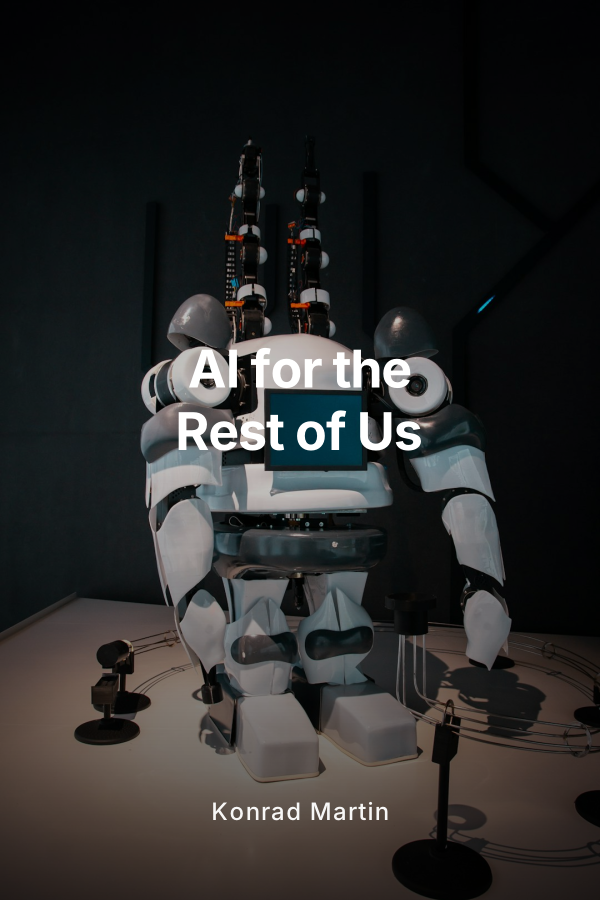
This book is a fast, funny, zero-intimidation tour of Artificial Intelligence for people who have no intention of becoming “AI experts” and every intention of getting dinner on the table, surviving work, and maybe sending a text that does not sound unhinged.
Instead of doom, jargon, and robot overlords, AI for the Rest of Us treats AI like what it already is for millions of normal people: a practical sidekick that lives in your phone, quietly helping you fake being more organized, more charming, and more on top of things than you actually feel.
Told in a first person, talk-to-a-friend voice, the book positions the author as your on-page host: part ringmaster, part test subject, part slightly chaotic tour guide. You are never lectured at. You are invited in. Each chapter plays like a string of short, story-style mini episodes built straight from real life: dating awkwardness, parenting chaos, travel fails, holiday pressure, office overwhelm, and the constant, buzzing anxiety of trying to be a functioning adult in a world that keeps updating itself.
In these stories you watch AI do things like:
• Turn a fridge full of random ingredients into a week of meals that are actually edible.
• Rewrite your “We need to talk” text so it sounds like a human and not a panic attack.
• Plan a vacation in under two minutes, complete with routes, budgets, and “do this, skip that” recs.
• Turn a terrifying inbox into a clean, prioritized to-do list.
• Draft replies to the school email, the boss email, and the group chat from hell.
• Spin up gift ideas, packing lists, bedtime stories, workout plans, outfits, and even flirty one-liners without you needing a single spreadsheet.
Every tool, trick, and example follows one rule: if you cannot try it in under two minutes, it does not make the cut. You do not need a computer science degree. You barely need a charger. If you can open a browser or an app, you can follow along. The book leans on tools people already recognize, especially conversational AI like ChatGPT, and shows how to use simple prompts for big payoffs in daily life.
Throughout, there are “Try This Right Now” moments built like instant challenges. You are nudged to copy a prompt, tweak a line, and watch what happens. These are not homework assignments. They are more like tiny dares: “Hand your vacation planning to AI for 90 seconds and see if it does better than your last 17 open tabs.”
The tone stays light, slightly irreverent, and always human. Running jokes about AI as your unpaid intern, your chaos manager, or the only “coworker” who never shows up late keep the mood playful. At the same time, short “Wait, This Part Matters” sidebars pop up whenever the fun brushes close to real issues like bias, deepfakes, or privacy. These are brief, plain-language reality checks that help readers stay smart without dragging them into a spiral of fear. The goal is not to scare anyone away from AI, but to keep them alert enough not to stumble into avoidable nonsense.
Structure-wise, the book flows from what is closest to your fingertips outward:
• First, AI in your pocket: meal planning, travel, money, chores, and all the “my phone can do that?” magic.
• Then, AI in culture: celebrities cloning their voices, viral filters, memes, music, and why everyone’s feed suddenly looks like a sci-fi trailer.
• Next, AI at work: emails, meetings, presentations, side hustles, and small business shortcuts. This is productivity without buzzwords, explained in office and kitchen-table language.
• After that, AI for self-improvement, sort of: morning routines, habits, learning new skills, tackling personal goals with a robot cheer squad instead of a guilt trip.
• Then, pure fun: pranks, party tricks, weird experiments, and “I cannot believe my phone just did that” moments.
• Finally, the future, but without the end-of-the-world soundtrack: what is actually coming, what to ignore, and how to stay calm, curious, and in control as AI gets smarter and more normal.
Each chapter closes with tiny, instantly usable prompts and mini challenges rather than dense recaps. Think: “One text you can let AI fix this week,” “One thing to let AI plan for you,” “One mess you are allowed to hand off.” Readers are encouraged to try one thing, not overhaul their whole life. The cumulative effect is that AI slowly shifts, in their mind, from “weird tech story on the news” to “regular tool I use when life is annoying.”
Under the jokes and experiments, the book makes a bigger cultural argument: AI is not a separate, technical world reserved for geeks and experts. It is the next smartphone moment, woven into normal routines, social lives, parenting, relationships, and workdays. Ignoring it does not make it go away. It just means other people have more help.
AI for the Rest of Us offers readers a different way in. Instead of fear or FOMO, they get curiosity, practical benefits, and a sense of play. They learn how to talk to AI in plain language, how to spot when it is confidently wrong, how to keep their own judgment in the loop, and how to enjoy the parts that genuinely make life easier or more fun.
By the end, readers will not feel like robot experts. They will feel like slightly upgraded versions of themselves: the person who knows the one prompt that saves an hour, the one filter that makes family photos look great, the one trick that keeps the weekly schedule from exploding. They will understand just enough about how AI works to use it wisely, laugh about it with friends, and show their kids, coworkers, or parents a trick or two.
In a world where so much talk about AI sounds like a sci-fi warning label, this book offers something much simpler: a friendly, funny, practical guide to living in the AI era without losing your mind, your sense of humor, or your humanity.