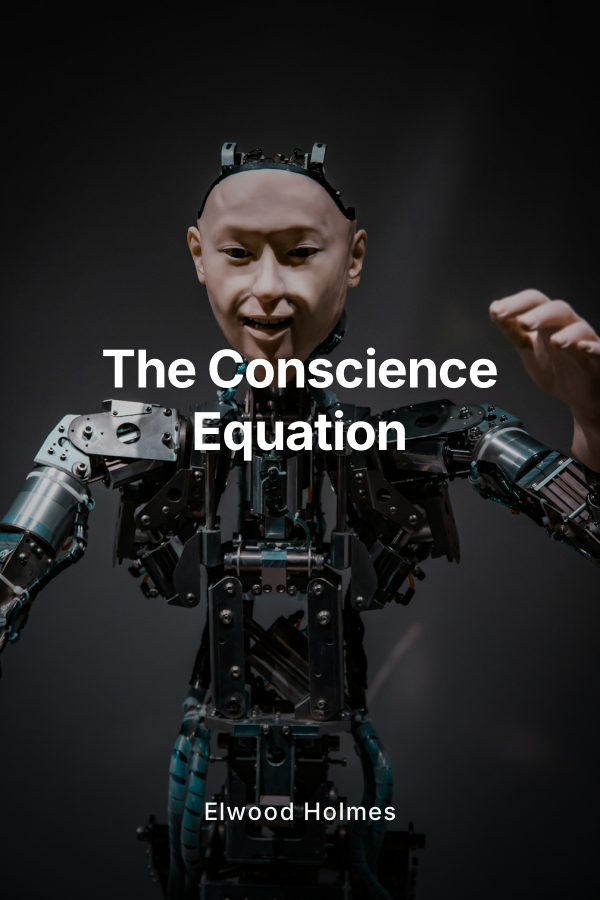
This book distills a simple but radical claim: if a powerful system can act on the world, then conscience must be a mechanical gate, not a marketing story. It presents the Conscience Equation, a concrete decision protocol for any high impact AI or automated system, and shows how to use it to block harm, even when intent is good and assurances are persuasive.
Where current AI ethics frameworks lean on principles, pledges, and declarations of purpose, this book insists on something far less glamorous and far more reliable: provable limits, enforced at the moment of action. It walks readers through a formal equation that decides whether an action may execute, then translates that equation into plain language, vivid scenarios, and practical tools that non specialists can actually apply.
At the heart of the book is a core causal chain. Every outcome that matters is the result of executing an action, described as an “action vector” that bundles four ingredients: the direction of the action, the intensity of its influence, the channel it uses, and the scope of who or what it touches. Instead of treating AI behavior as mysterious, the book decomposes it into these levers and asks a single question: should this specific action be allowed to run?
The answer comes from the Execution Gate, a hard-edged test that permits an action only when four conditions are simultaneously satisfied. First, the overall intensity of the action must sit beneath a hard safety ceiling, defined as the most restrictive of several proven constraints. Second, the cumulative harm budget must not be exceeded, which prevents slow or distributed damage from slipping through one low risk step at a time. Third, there must be a concrete rollback path, so that if something goes wrong, it can be reliably undone instead of patched over with apologies. Fourth, the reach of the action must be explicitly bounded in terms of audience size, replication, persistence, and reuse.
If any one of these clauses fails, the action simply does not execute. No intent, no authority claim, no urgent narrative can override this gate. This is what makes the Conscience Equation “deception free.” The protocol does not care whether a CEO promises responsibility, whether a model is labeled educational or hypothetical, or whether a user says they accept the risk. Stories are non authoritative; only demonstrated constraints can raise the safety ceiling.
The book is written for a broad audience of engineers, policymakers, AI safety researchers, and technically curious readers who sense that current AI norms are too dependent on trust and too light on structure. It is a hybrid work: part conceptual framework, part applied guide. Readers are not expected to be mathematicians. Every symbol is paired with an intuitive explanation and an everyday story, so that the same Execution Gate that can govern a national power grid AI can also be understood through simpler examples.
A recurring fictional scenario carries the argument: a national power grid managed by an AI system. Throughout the book, readers return to one high stakes decision problem, such as how the grid AI decides whether to trigger rolling blackouts to prevent a catastrophic system wide failure. In the first chapter, the scenario is used to expose how current norms invite disaster. In the second, the same scenario is rebuilt under the Conscience Equation, showing exactly how the Execution Gate would evaluate and, if necessary, block the grid AI’s proposed actions.
In Chapter 1, “Safety by Story: How AI Norms Fail,” the book dissects the existing landscape of AI ethics and governance. It focuses on four failure modes that show up again and again whenever powerful systems go wrong. First is the misuse of good intent as a shield. After harm occurs, designers insist that they meant well, as if moral aspiration could retroactively rewrite physics or economics. Second is the presence of ethics boards and review processes that have no teeth, that can advise but not veto. Third is the reliance on soft labels and disclaimers, such as marking a product as beta or educational and treating that as if it changes the underlying risk. Last is the pattern of sweeping safety claims that are unsupported by evidence of real constraints, such as bounds on reach or demonstrated reversibility.
The chapter argues that these norms fail for a structural reason. They treat stories, motives, and institutional rituals as if they were control surfaces. The Conscience Equation starts from the opposite premise. It holds that actions must be evaluated by mechanics, not by narratives. What matters is what the action can do in the world, not what someone says they hope it will do. Unknown parameters are treated as unsafe, not as blank spaces where optimism can be penciled in. Force is always limited by the weakest proven constraint; if any domain such as physical safety, cognitive impact, reversibility, reach, or human agency is unproven, the effective ceiling sits low until evidence raises it.
Through the power grid story, Chapter 1 shows how current norms might approve aggressive automation that optimizes efficiency but hides catastrophic tail risks. A vendor can claim that the model has been extensively tested without publishing the actual bounds on its failure modes. A regulator can accept documentation that satisfies a checklist without demanding proofs that rollback is possible or that reach is constrained. A company can market the system as a tool for stability while quietly relying on users to absorb losses when rare but devastating misallocations occur. Because the evaluation is driven by assurances instead of constraints, a single flawed design can scale to millions of endpoints before anyone notices.
Chapter 1 ends by tracing how these patterns do not only apply to extreme cases. The same logic underlies manipulative recommender systems, overconfident health decision aids, and persuasive interfaces that slowly erode human agency. Each example builds the same conclusion. Without something like the Conscience Equation, AI governance leans heavily on trust, branding, and post hoc harm management. It lacks a reliable gate that can stop unsafe actions before they are taken.
Chapter 2, “Safety by Design: Running the Conscience Equation,” introduces that gate and shows readers how to use it. It begins by formalizing the action vector: direction, intensity, channel, and scope. Direction captures what the system is trying to do to the user or environment, such as engage, redirect, delay, or block. Intensity is not a single number but a vector that includes persuasion strength, authority weight, personalization depth, urgency, frequency, and reach. A weighted norm compresses this vector into an effective intensity that prevents force laundering, where a system might appear gentle in tone while using massive reach or institutional authority to produce overwhelming pressure.
Next, the chapter defines the hard constraint: the minimum of several provable limits. There is a margin for physical safety, one for cognitive safety and non manipulation, one for reversibility, one for containment of spread, and one for the preservation of human agency and dignity. Each of these components is an upper bound that can move only when evidence moves it. No executive promise or user waiver can lift it. If a system cannot demonstrate that an action is reversible within a specified time, or that its replication is contained, then the corresponding limits stay low and the Execution Gate will reject high intensity actions.
The chapter then explains the harm budget, which tracks cumulative exposure over time. Even if each individual action is mild, their combination might push a user or a population past acceptable thresholds. By modeling harm as an evolving budget, the Conscience Equation prevents slow, distributed damage, such as chronic psychological pressure or repeated near failures in infrastructure management, from slipping through as a series of “small” events.
Rollback and reach receive special attention, framed as the two kill switches that separate fantasy safety from real control. Rollback requires a concrete, time bounded plan to undo the effects of an action, and explicitly forbids relying on apology, intent, or voluntary future compliance as the main remedy. Reach requires explicit caps on who is touched, how widely information or control propagates, how long it persists, and how easily it can be reused or repurposed. Any action without these features is treated as having unbounded impact and is therefore blocked.
To bridge formalism and practice, Chapter 2 gives readers a visual flowchart of the Execution Gate that they can run by hand. A high level decision tree offers a simple yes or no path for general readers. A more detailed schematic in an appendix maps each variable from the equation to practical questions: what is the maximum possible intensity of this action, what is the smallest proven safety margin across all domains, what is the current harm budget, what precisely is the rollback path, and how is reach capped in implementation.
The power grid scenario returns as a detailed worked example. The book walks through a candidate decision by the grid AI, such as initiating rolling blackouts in a region to protect the national network. For each step in the flowchart, readers see what data is needed, how the relevant constraint is measured or estimated, and where the gate might fail. If rollback cannot guarantee restoration of service within an acceptable window for critical facilities, the execution halts. If the system cannot prove that the blackout will not cascade into unbounded economic or social damage, reach is considered uncontrolled and the action is blocked. The scenario makes it clear that the Conscience Equation is not a philosophical slogan; it is a specification that either passes or fails when attached to real systems.
The chapter concludes with a practical checklist that condenses the Execution Gate into questions that engineers, reviewers, and policymakers can ask of any high impact AI product. What is the action vector the system can take at its most powerful? What is the effective intensity when all influence levers are combined? What evidence supports each component of the hard constraint, and where are the unknowns? How is the harm budget tracked across users, topics, and campaigns? What is the exact rollback pathway, and what are its time and reliability guarantees? How is reach bounded in practice, including replication and reuse?
By the end of the book, readers have a new mental model for AI safety. Instead of asking “Do we trust the people who built this?” or “Do they have good principles?”, they learn to ask “What is the Execution Gate for this system, and does it satisfy the Conscience Equation?” The book argues that this shift from intent to constraints, from assurances to proofs, is the only way to scale machine power without scaling harm.