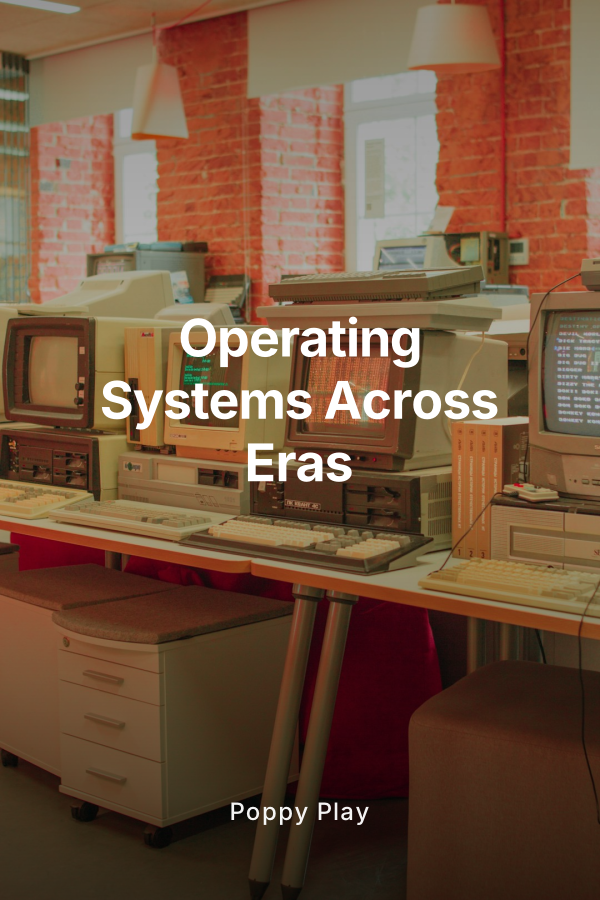
This book offers a structured and critical survey of operating systems as socio technical artifacts that both shaped and were shaped by their historical contexts. It is organized into two chapters that trace the evolution of operating systems from early time sharing platforms to contemporary mobile and cloud centered ecosystems, while maintaining a sustained comparative lens on performance, security, usability, device support, and licensing models as requested in the originating brief .
Chapter 1, “Foundations and Formative Eras of Operating Systems,” establishes a chronological and conceptual groundwork. It focuses on how a curated set of highly influential operating systems defined the expectations and constraints of each era, while also integrating select lesser known systems that embody important alternative design decisions or niche innovations. The chapter begins by theorizing what an “operating system” is in functional, architectural, and socio economic terms, noting that OS design cannot be disentangled from hardware capabilities, organizational needs, and prevailing business models. The narrative then traces the transition from batch processing to time sharing systems, emphasizing how early designs resolved scheduling, memory management, and multi user resource allocation in ways that prefigured modern notions of fairness, isolation, and responsiveness.
Within each historical period, several major systems are treated as anchor exemplars. For each one, the analysis follows a consistent micro structure inspired by the user’s request for a systematic comparison: performance characteristics, security posture, ease of use and interaction paradigms, breadth of device and hardware support, and licensing or distribution model . This uniform lens enables readers to see how different design choices solved similar problems under divergent constraints. For example, the chapter contrasts systems that optimized tightly for specific hardware against those that pursued portability, connecting these decisions to long term ecosystem outcomes such as third party developer engagement and cross platform application availability.
A further distinctive contribution of Chapter 1 is its treatment of “lesser known” operating systems not as curiosities but as sites of conceptual experimentation. Though these systems often failed to achieve mass adoption, they frequently pioneered ideas that later became mainstream in more commercially successful platforms. The chapter shows how novel security mechanisms, unique user interface metaphors, or unorthodox licensing arrangements first appeared in these niche systems before being adapted and normalized elsewhere. This supports one of the central claims of the book: that the history of operating systems is not purely a story of winners, but rather a dense field of prototypes, dead ends, and partial successes that collectively expanded the design space for future systems.
In line with the initial specification that each relevant historical segment include some discussion of web browsers, the chapter concludes each era with a concise overview of browser development in that period . Rather than providing exhaustive browser histories, these sections focus on how browsers leveraged, stressed, or redefined the underlying operating systems. For example, the rise of graphical browsers is linked to advances in graphics subsystems and windowing environments, while later discussions connect browser sandboxing and plugin architectures to OS level security features. This approach underscores a critical theme that recurs throughout the book: web browsers progressively evolved from applications into quasi operating environments themselves, reshaping how users experienced the host system.
Chapter 2, “Comparative Dimensions of Modern Operating Systems,” brings the narrative into the contemporary era, while deepening and formalizing the comparative framework introduced earlier. Where Chapter 1 is largely chronological, Chapter 2 is explicitly analytical and thematic. It revisits the chosen operating systems, now grouped across eras, and stages a structured comparison along five axes specified at the outset: performance, security, ease of use, device support, and licensing. This method enables a cross cutting perspective that reveals both continuities and ruptures in design rhetoric and implementation practice .
The performance section examines how notions of “speed” and “efficiency” have shifted across decades, from throughput on mainframes to latency and responsiveness on personal devices, and now to power efficiency and concurrency in mobile and cloud contexts. The analysis emphasizes that performance is never a purely technical metric; it is always framed by user expectations, hardware evolution, and workload patterns. Case studies show how some systems favored raw computational throughput while others prioritized interactive responsiveness or energy savings, and how these emphases shaped their adoption in specific domains such as scientific computing, business environments, or consumer electronics.
Security is treated as a layered and evolving concept rather than a static checklist. The chapter traces the movement from minimal protections in early systems, through discretionary and mandatory access control mechanisms, to contemporary models that incorporate isolation, sandboxing, encryption, and secure boot architectures. The comparison highlights tensions between security and usability, as well as between open extensibility and controlled ecosystems. Importantly, it situates OS level security features within broader institutional and economic contexts, such as regulatory pressures and commercial incentives to protect app marketplaces. Concepts that may be associated with specific scholars or technical communities are presented generically so that proper attributions can be added later where appropriate.
The discussion of ease of use interrogates user interface paradigms, accessibility considerations, and the broader experience of configuring, maintaining, and troubleshooting an operating system. Rather than treating usability as a secondary aesthetic concern, the chapter argues that interface design is central to how power is distributed between expert administrators and everyday users. Graphical interfaces, command shells, configuration utilities, and system level automation are analyzed as mechanisms that either democratize control or obscure complexity. Cross era comparisons reveal how certain usability advances were contingent on hardware improvements, such as higher resolution displays or more precise input devices, and how mobile interfaces later reimagined long standing desktop conventions.
Device support is approached from both technical and ecosystem perspectives. Technically, the book considers driver models, hardware abstraction layers, and strategies for supporting heterogeneous devices. At the ecosystem level, it examines the reciprocal relationship between operating systems and hardware vendors, in which platform dominance can influence which devices are produced, while hardware innovation can force operating system redesigns. The chapter shows how some operating systems cultivated broad hardware compatibility at the cost of intricate driver ecosystems, whereas others enforced tight integration with a narrower set of devices, often trading openness for predictability and performance.
Licensing and distribution constitute the final major comparative dimension. Here the book explores proprietary, open, and hybrid licensing models, as well as differing approaches to source availability, community governance, and monetization. It analyzes how licensing choices shape innovation patterns, third party contributions, and user autonomy. For instance, open models often enable rapid experimentation and customization, while proprietary models can concentrate resources and enforce cohesive design visions. Rather than valorizing any single model, the chapter demonstrates that licensing regimes are deeply entangled with business strategy, legal frameworks, and cultural values about software freedom and control. Any concepts that resonate with well known movements or legal theories are framed in general terms so that detailed source specific attributions can be appended later.
Throughout Chapter 2, brief but regular overviews of web browsers appear at points where browser evolution inflects the comparative story of operating systems, in line with the initial requirement for a “brief overview of each related page” involving browsers . The analysis shows how increasingly capable browsers altered the practical significance of OS level differences, particularly as more applications migrated to the web. This leads to a concluding reflection on whether the operating system is gradually becoming infrastructural background to browser centered or cloud mediated user experiences, or whether OS level design decisions continue to exert decisive influence over performance, privacy, and control.
By synthesizing historical narrative with systematic comparison, this two chapter book aims to provide readers with both a coherent story and a durable analytical framework. It invites practitioners, students, and scholars to see operating systems not only as technical platforms but also as historically situated negotiations among performance demands, security imperatives, usability ideals, hardware realities, and legal economic structures.