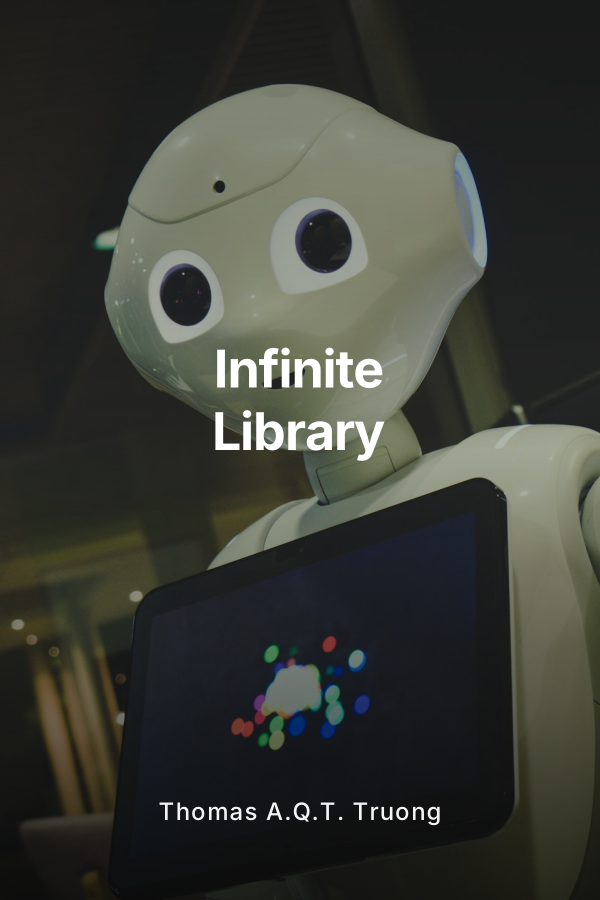
Infinite Library is a manifesto and a playbook in one. It sets out to kill the myth of the tortured, solitary writer and replace it with a new identity: the author as Creative Director, supported by an AI engine that handles the heavy lifting while the human focuses on vision, voice, and meaning. The core promise is simple and radical: turning years of unwritten ideas into a finished, professional book in a single focused weekend, without sacrificing quality or integrity.
The book begins with a stark image: a vast library whose shelves are lined with blank spines. Each empty volume represents a book that should have existed but never made it past a half-finished outline, a hard drive folder, or a daydream on the commute home. From this "graveyard" of unwritten work, the author draws out a central truth: most potential authors do not fail because they lack ideas, but because the friction of traditional writing overwhelms their available time, focus, and skill. Infinite Library is introduced as a new kind of partner, turning raw thoughts, messy notes, and scattered research into a structured, living manuscript. The introduction culminates in a clear promise from the founder: by the time the reader finishes this book, they will have a blueprint to complete their own book in a single weekend and a direct path to act on it immediately.
The strategic heart of the book is a sharp repositioning of what authorship means in the age of AI. The old story says that "real" writers must work alone, suffer for years, and personally type every word. Infinite Library reframes this as a toxic myth that has silenced millions of capable storytellers. Instead of equating authorship with typing speed and stamina, the book insists that true creative value lies in architecture: designing arguments, worlds, and emotional journeys, then directing a capable system to realize them at scale. AI is not presented as a shortcut or cheat, but as a telescope for the mind that lets the reader see, refine, and ship ideas at the speed their life actually allows.
To keep this promise concrete, Infinite Library narrows its focus to four archetypes of "hidden authors" who have the most to gain and the most to lose by doing nothing. First is the Time-Poor Expert, the consultant or executive with decades of experience who keeps losing opportunities to less experienced competitors who happen to have a book. Second is the Blocked Storyteller, the imaginative world builder or game master who always stalls around Chapter 3 and never crosses the finish line. Third is the Global Visionary, whose first language is not English and who fears that imperfect grammar will bury world class ideas. Fourth is the Neurodivergent Creator whose brain overflows with concepts but resists the linear grind of drafting and revision. For each of these readers, the book paints a vivid before-and-after narrative: from stuck, unseen, and overworked to published, leveraged, and heard.
Part I, "The Paradigm Shift," breaks the old beliefs that keep these authors paralyzed. One early chapter dismantles the idea that great art must be produced in isolation through pain. It shows that throughout history, celebrated creators have relied on teams, assistants, and invisible collaborators, and argues that what readers ultimately care about is the architecture of the work, not whether the architect laid every brick personally. Another chapter executes a crucial identity shift: the reader is invited to stop seeing themselves as a typist and start acting as a director. In this framing, the human is responsible for vision, emotional beats, lived experience, and thematic intent, while the Infinite Library AI handles grammar, pacing, structure, and stylistic consistency. This move frees the reader from obsessing over sentence level perfection and returns their attention to the only question that matters: "Does this story or framework actually change anything for the person reading it?"
A subsequent chapter in Part I pulls back the curtain on the technology behind Infinite Library. Rather than resorting to jargon or mystique, it explains large language models in plain language and emphasizes the platform's unique approach: grounding the AI in the reader's own notes, voice samples, and research instead of generic training data. The book details built in safeguards against fabricated facts in non fiction and inconsistent character or world details in fiction, framing these systems as an "engine of empathy" that learns to honor the user's intent and constraints. By the end of Part I, a skeptical reader has been walked, step by step, from fear that "AI will ruin real writing" to a new conviction that refusing to use such a tool is, in fact, a self imposed handicap.
Part II, "The Infinite Method," translates this shift in belief into a repeatable workflow. It is built around three phases. Phase I, "The Download," tackles the real reason most AI writing fails: vague, shallow prompts that lack substance. Instead of asking the reader to write better prompts, the book teaches them to pour whatever they already have into the system: voice notes recorded on the way to work, scattered PDFs, half finished decks, journal entries, blog posts, and mind maps. The reader then watches as Infinite Library ingests this chaos and returns a coherent outline that captures their unique structure and style. Techniques like the "Interview Method," where the AI questions the author to pull out hidden expertise, make the process feel less like filling out a form and more like being guided by a very patient collaborator.
Phase II, "The Symphony," walks the reader through the experience of watching full chapters appear in their own voice while they remain firmly in control of direction and tone. The narrative highlights how the system reads for emotional pacing, knows when to slow down for a story or speed up for explanation, and allows instant regeneration of sections that do not land. For the Time-Poor Expert, this might mean seeing a client facing book take shape over a weekend. For the Blocked Storyteller, it might mean finally crossing the sagging middle of a novel that has stalled for years. For all four archetypes, the "one session" drafting experience is positioned as a revelation: the first time they realize their bottleneck was not a lack of talent, but a lack of leverage.
Phase III, "The Human Polish," insists that the last mile belongs to the author. The book lays out specific passes the reader should make over the AI assisted draft: injecting personal anecdotes the system could never know, sharpening dialogue or argument with their ear for rhythm, and introducing surprises that the AI then threads through the rest of the manuscript for continuity. This section is designed to restore a sense of artistic pride. The finished book is meant to feel fully human because it is human directed; the AI is treated as a brush in the author's hand, not as a replacement painter.
Part III, "The Ecosystem," zooms out from drafting to everything that happens after "The End." One major chapter introduces the Infinite Public Library, a built in distribution layer where new authors can publish their work and reach real readers immediately instead of waiting months or years for traditional gatekeepers. Here the book explores the power of niche: the reality that platforms optimized for blockbuster hits ignore the long tail of highly specific books, while Infinite Library is designed to connect hyper focused projects with the small but passionate audiences who have been waiting for exactly that content. Another chapter unpacks the economics of speed. For consultants and experts, speed to market means capturing attention while a trend is still hot instead of watching slower competitors dominate the conversation. For fiction authors, the ability to produce entire series rather than isolated titles is framed as the key to audience loyalty and real income, especially in a world where readers binge stories rather than reading them once a year.
The final chapters of Part III address ownership and ethics head on. Infinite Library stakes out a clear position: the reader owns the copyright, keeps the royalties, and retains full creative control. The platform commits not to train public models on the reader's private manuscripts, positioning itself as a vault rather than a data mine. This section reframes augmented authorship as a moral as well as practical upgrade: a way to honor one's own ideas by getting them into the world without sacrificing boundaries or autonomy.
A robust appendix turns the manifesto into a tactical field manual. One playbook walks the reader hour by hour through the creation of a short non fiction book in 24 hours, from initial brain dump to launch. Another shows series authors how to build a "world document" that maintains continuity across hundreds of thousands of words, so that characters, settings, and timelines stay consistent across multiple volumes. A final checklist demystifies turning an Infinite Library export into a live listing on major bookstores, including cover design and formatting considerations. Throughout these sections, the book emphasizes "micro wins": very small, very quick actions, like uploading a single messy document or generating a first outline, that give the reader a powerful taste of what is possible in ten minutes or less.
Across its forty concise chapters, Infinite Library weaves persuasion, proof, and practice into a single arc. It begins in the graveyard of unwritten books and ends with the reader holding their own finished manuscript, aware that this is not a one time event but the first step into an ongoing creative career. The book's deeper mission is to democratize authorship by tearing down the three great barriers of time, skill, and focus. It asks the reader to accept a final, irreversible belief: in an age of augmented authorship, the worst thing a would be writer can do is stay alone with a blank page.