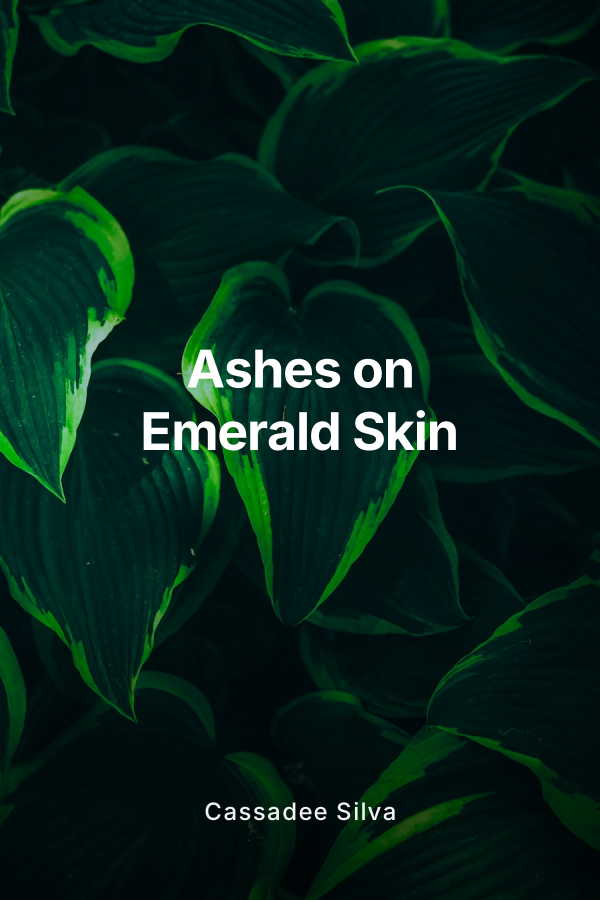
This book is a dark, emotionally charged hurt and comfort romance that follows Izuku Midoriya and Dabi as they navigate abuse, trauma, and the fragile, frightening possibility of healing together. Drawing from a canon-adjacent setting with familiar characters yet an original emotional arc, it is written for mature readers who want an intense exploration of psychological abuse, found family, and slow burn intimacy, without glorifying harm or excusing cruelty.
Izuku begins as a promising but deeply wounded hero student, a boy whose life has been shaped not just by the bruises on his body, but by the far more lasting marks of emotional neglect, bullying, and manipulation. On the surface he is the driven prodigy who pushes himself to the edge to become a symbol of hope. Beneath that mask he is exhausted, terrified of being unwanted, and convinced that any kindness he receives must be repaid with self‑destruction. The story treats his abuse primarily as psychological and emotional, with implications rather than graphic depictions, focusing on the internalized voices that tell him he is worthless unless he bleeds for others.
Dabi enters as a villain who has already embraced the language of pain as his mother tongue. Burned by family betrayal and a lifetime of being treated as a mistake, he wears his scars like armor and uses cruelty as a shield. He is morally gray at best, violent and dangerous, but never one dimensional. His initial interest in Izuku is tactical and predatory. Over time, though, what begins as kidnapping and leverage turns into reluctant guardianship, then into something much softer and more frightening. The book never asks readers to forget Dabi’s crimes. Instead, it asks whether a man who has never known safety can learn how to offer it to someone more fragile than himself.
Across five chapters, the narrative traces their journey from captivity to uneasy coexistence, then to a bond that both of them refuse to name for fear it will shatter. The first chapter establishes Izuku’s breaking point at school and in hero society. Every attempt to speak up is minimized, every injury rationalized away. Authority figures insist he is fine as long as he keeps winning. When a villain attack provides cover for his disappearance, almost no one looks closely enough to notice that something is terribly wrong. This indifference is the story’s first, quiet act of violence, and it lingers over every page that follows.
In the second chapter, Izuku awakens in a crumbling safehouse under Dabi’s watch. There are no restraints, only locked doors and the unspoken threat of what Dabi can do. The abuse here is subtle: gaslighting, emotional pressure, carefully chosen words that remind Izuku how replaceable heroes can be. Yet Dabi also feeds him, dresses his wounds, and snaps at anyone who tries to touch what he has decided is his. The contradiction is terrifying. Izuku cannot tell whether he is being protected, owned, or both. Their arguments are cutting, but through them the story reveals two parallel wounds: Izuku’s compulsion to save everyone, and Dabi’s belief that no one was ever willing to save him.
The third chapter shifts from survival to reluctant partnership. Circumstances force Izuku and Dabi to cooperate against threats that would chew them both up: hostile villains, suspicious heroes, and the unforgiving gaze of a world that only understands simple labels like hero and monster. Dabi becomes a grudging protector, stepping between Izuku and danger out of a possessive rage he does not yet recognize as care. Izuku, in turn, starts to see the cracks in Dabi’s nihilism, the places where he still bleeds hope despite insisting that everything is already ruined. Recovery here is jagged. Izuku backslides into self‑sacrifice, Dabi lashes out whenever he feels cornered, and both of them struggle with the terrifying intimacy of being truly seen.
By the fourth chapter, their bond has deepened into something unavoidably tender. It is not a sudden, sweeping romance, but a slow burn built on shared sleepless nights, bandaged hands, and truths spoken in the dark when they think the other is half awake. The story explores queer attraction and emotional dependence with care, never romanticizing the abuse that preceded it. Instead, it shows how difficult it is for Izuku to believe that affection could exist without conditions, and how impossible it feels for Dabi to touch someone gently when every lesson he ever learned involved fire and punishment. Boundaries, consent, and trust are central. Every small choice to ask, to listen, to pull back from old patterns is treated as a victory more significant than any battlefield triumph.
The fifth chapter serves as both climax and fragile resolution. Outside forces finally converge, forcing Izuku to choose between the rigid expectations of hero society and the messy, compromised safety he has begun to find with Dabi. At the same time, Dabi must decide whether to remain the weapon he was made to be or to step into the terrifying role of someone who shelters rather than destroys. The confrontation is as emotional as it is physical. Accusations from heroes echo past abuse, while the villains’ demands mirror every time Dabi was told his only worth lay in how much damage he could do. Neither man emerges unscarred, but by the end they have something they never expected: a future that is not defined solely by survival.
Throughout the book, the tone remains intense yet compassionate. It does not shy away from the darkness of abuse, but it refuses to let that darkness be the entire story. Instead, it places equal weight on small, grounding moments: a cup of tea left outside a locked door, a blanket draped over shaking shoulders, the first time Izuku flinches and Dabi steps back instead of forward. These quiet choices accumulate, forming a new pattern that slowly teaches them both that safety can be learned.
Ashes on Emerald Skin is ultimately about the cost of learning to feel safe when safety has always been a lie. It is for readers who want to sit with discomfort, to see trauma acknowledged rather than glossed over, and to watch two broken people build something fragile and fiercely defended out of the wreckage of their pasts. It promises no easy redemption and no perfect healing, only the possibility that even the most badly burned hearts can still find warmth in one another’s hands.