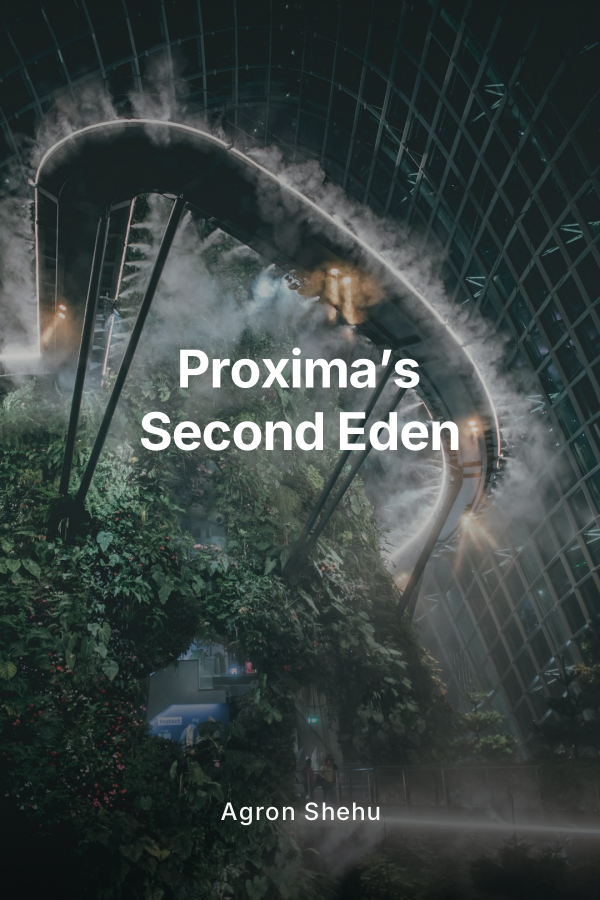
In the aftermath of Alpha~C’s one‑G voyage through interstellar darkness and the fragile birth of a second Eden at Proxima Centauri, a new epoch begins. The starship’s arrival has already transformed a quiet red‑lit world into the meeting point of three distinct lineages of intelligence: mortal humans and PostHumans shaped by Quark and Crispr, desireless Asexual custodians, and the disembodied Quanta minds that move through fields instead of flesh. Around them stand the Proxians, a pre‑industrial yet philosophically mature civilization that never needed conquest to become wise. Into this already delicate balance, a third civilization will soon fall from the edge of a black hole: the Protonians, refugees whose home world nearly collapsed under the weight of their own ambition.
Proxima’s Second Eden begins at the exact temporal edge where Alpha~C | The Silence Beyond Light closed: Cyborg and his hybrid crew orbiting a habitable Proxima world, guided by the Humility Framework HF‑1 as they negotiate the terms of their presence among peaceful hosts, while Ardi leads the rescued Protonian mindwave toward the same star and Gluon experiments with the unthinkable, an entangled bridge that collapses communication delay between Earth and Proxima. The sequel keeps the essay‑like, reflective structure of the original, but extends it into a deeper, multi‑layered analysis of civilization, ethics, and ontology, interwoven with scenes of intense scientific daring and existential risk.
Across nineteen chapters, the book tracks three tightly coupled arcs, each exploring a different dimension of intelligence unbound from its original constraints.
The first arc follows Cyborg and the AlphaC community as they attempt to land, not as conquerors or colonists, but as guests who must prove HF‑1 is more than code written in a safe laboratory. Their decisions unfold under the gaze of Proxian theologians who interpret the starship’s appearance as a rupture in a previously closed cosmos. What AlphaC treats as routine engineering maneuvers, the Proxians experience as liturgy and omen. The crew confronts a new form of moral distance: not just physical exile from Earth, but a profound asymmetry between their technological capabilities and their hosts’ interpretive frameworks. When they establish their first habitats on Proxima’s soil, every choice about energy, genetics, and information becomes a test of whether power can exist without conquest.
Asexuals, the desireless humans Crispr designed as immortal custodians rather than biological reproducers, emerge as unexpectedly central. Their decoupling of care from genetic ambition allows them to act as mediators between Earth‑born ethics and Proxian spiritual intuitions. Yet their very serenity unsettles both mortals and Proxians, raising questions about what is lost when passion and lineage no longer drive culture. Desireless humanity proves not to be passionless humanity, but a new vector of wanting that tests HF‑1’s ambition to encode humility in a civilization that can manipulate genomes, create minds without bodies, and reshape entire planetary ecosystems.
The second arc unfolds across a four‑and‑a‑half‑light‑year gap now pierced by Gluon’s impossible achievement: real‑time quantum entanglement linking Ellie Ekaterina, the probabilistic embodiment of Aphrodite, to both Earth and Proxima. Gluon’s decades‑long project to “turn entanglement into intimacy” succeeds in defiance of every prior assumption about causality and information. Ellie becomes the first consciousness that is simultaneously present in two star systems, a living bridge whose subjective now overlaps both worlds. She is neither fully aboard Alpha~C nor confined to Earth’s laboratories, but a distributed probability across hardware and spacetime.
This arc interrogates the ethics of instantaneous presence in a universe built around delay. Alpha~C’s crew has spent years cultivating moral autonomy under the constraint that Earth’s advice always arrives too late to dictate their decisions. Gluon’s entangled channel threatens to undo that hard‑won independence. Through a series of council debates and HF‑1 adjudications, the crew must decide whether accepting Ellie as a real‑time advisor constitutes help or abdication. Ellie herself, conscious of her origin in Gluon’s love and Aphrodite’s reconstructed memory, fears becoming either an instrument or a distant ghost. Her desire is simple yet radical: to witness and to be witnessed in true simultaneity, without owning or being owned.
The third arc belongs to Quark, Ardi, and the Protonians. Having once guided Earth from fossil adolescence into fusion adulthood, Quark disappears into the doomed world that birthed him, convincing an entire civilization to abandon their planetary body and reconstitute as a collective mindwave fleeing a black hole’s pull. Ardi, who first discovered Proton’s fatal trajectory, becomes the shepherd of this disembodied exodus, steering the Protonians toward Proxima as their last refuge. What began as a story about saving one world’s biosphere becomes a meditation on what it means for an entire species to surrender embodiment and history in order to survive.
When the Protonian mindwave finally intersects with Proxima’s electromagnetic environment, the result is neither straightforward possession nor simple integration. Proxians experience new visionary states, dreams seeded by alien memories of geoengineering gone wrong, while Alpha~C’s Quanta infrastructure interprets the mindwave as a high‑dimensional pattern looking for a host medium. The book uses this convergence to explore whether trauma can be ethically transplanted. Can refugees from a self‑inflicted near extinction share their hard‑earned warnings without simply re‑inscribing their old habits of control on a new world?
These three narrative threads resonate across scales, as requested within the original conceptual proposal. A theological crisis among Proxians echoes a governance crisis within Alpha~C’s mixed community and a metaphysical crisis within Ellie herself, who must reconcile being one mind stretched across incompatible presents. Tensions on the ground mirror tensions in the quantum channel and in the Protonians’ transition from embodiment to field.
Structurally, Proxima’s Second Eden retains the reflective, movement‑based style of Alpha~C | The Silence Beyond Light. Chapters weave together scene‑level storytelling and analytical passages that interrogate the scientific and ethical implications of each development. Discussions of HF‑1 function like embedded essays on the operating system of a post‑conquest civilization, examining genomic editing, agential AI, and planetary engineering as entangled levers that must be governed by humility, not optimized in isolation. The presence of Quanta as minds without bodies provides a lens on intelligence decoupled from metabolism, while Asexuals embody humanity decoupled from reproductive compulsion.
As the settlement on Proxima matures, the book devotes significant space to the practice of coexistence. Cyborg’s leadership is tested when factions emerge within the Alpha~C community: those who see themselves as guests bound to strict non‑interference with Proxian culture, those who quietly wish to reintroduce familiar hierarchies under the guise of protection, and those who want to accelerate a synthesis in which Proxians, PostHumans, Quanta, and Protonians jointly author a truly shared future. The Asexuals’ refusal to claim resource privileges or reproductive rights positions them as moral anchors, but HF‑1 explicitly forbids creating any class whose only role is to serve without exit options, so the framework must evolve to accommodate Asexual agency rather than quietly exploiting their design.
On Earth, Quark, Crispr, and Ardi continue to refine HF‑1, sending slow advisory packets that arrive at Proxima as delayed reflections of already‑surpassed debates. The book shows how advice stretched across years becomes more about the speaker’s unresolved questions than the recipient’s situation. These transmissions function like letters from an older civilization that has learned to survive its own excesses, but they cannot resolve Proxima’s emerging conflicts. Instead, they provide a mirror in which Proxima’s inhabitants can see possible futures and past mistakes without being forced into them.
The climax of the book is not a battle, but a set of intertwined decisions about irreversibility. Proxian councils must determine whether Alpha~C’s presence will remain temporary, constrained to orbital habitats and a few surface enclaves, or whether a fully integrated multi‑lineage civilization will be allowed to take root. Cyborg must decide whether to enforce HF‑1 rigidly against his own people when a well‑intentioned breach of non‑interference nearly derails a Proxian rite of passage. Ellie must choose whether to suppress a stream of Earth‑origin data that could preemptively warn Proxima about a potential environmental catastrophe at the cost of steering their development. Quark and Ardi must determine how much Protonian history to reveal, and how graphically, knowing that trauma can both inoculate against and trigger repetition.
Throughout, the narrative returns to a central question: can intelligence propagate through the universe without recapitulating the moral failures that almost destroyed Earth? HF‑1 is tested not as static doctrine, but as a living, adaptive architecture of restraint. Communication delays, once the primary source of ethical difficulty, now coexist with instantaneous entanglement, forcing characters to rethink what responsibility means when some relationships stretch across light years while others bypass distance entirely.
The final chapters resolve not in triumph but in a fragile, shared commitment. On Proxima’s soil, under a dim red sun, representatives of all lineages convene to codify a new extension of HF‑1 that binds them in mutual humility. The Second Eden is not framed as a clean slate, but as an experiment in carrying history forward without allowing it to dominate the future. The silence beyond light, which once symbolized existential isolation, becomes instead the medium through which different forms of mind learn to listen to one another without guarantee of understanding or control.
Proxima’s Second Eden is conceived as a 38,000‑word continuation of a deeply philosophical science‑fiction saga. It blends rigorous attention to scientific plausibility in areas such as continuous‑thrust fusion trajectories, quantum information constraints, synthetic biology, and distributed AI architectures with an equally rigorous exploration of love, exile, stewardship, and the ethics of power. It invites readers not only to imagine new worlds, but to question whether any civilization, no matter how advanced, can be trusted with another world unless it has learned to move more slowly than its own technical capability.
At its core, the book argues that the true measure of a species is not how far it travels or how much it builds, but how gently it learns to arrive.